
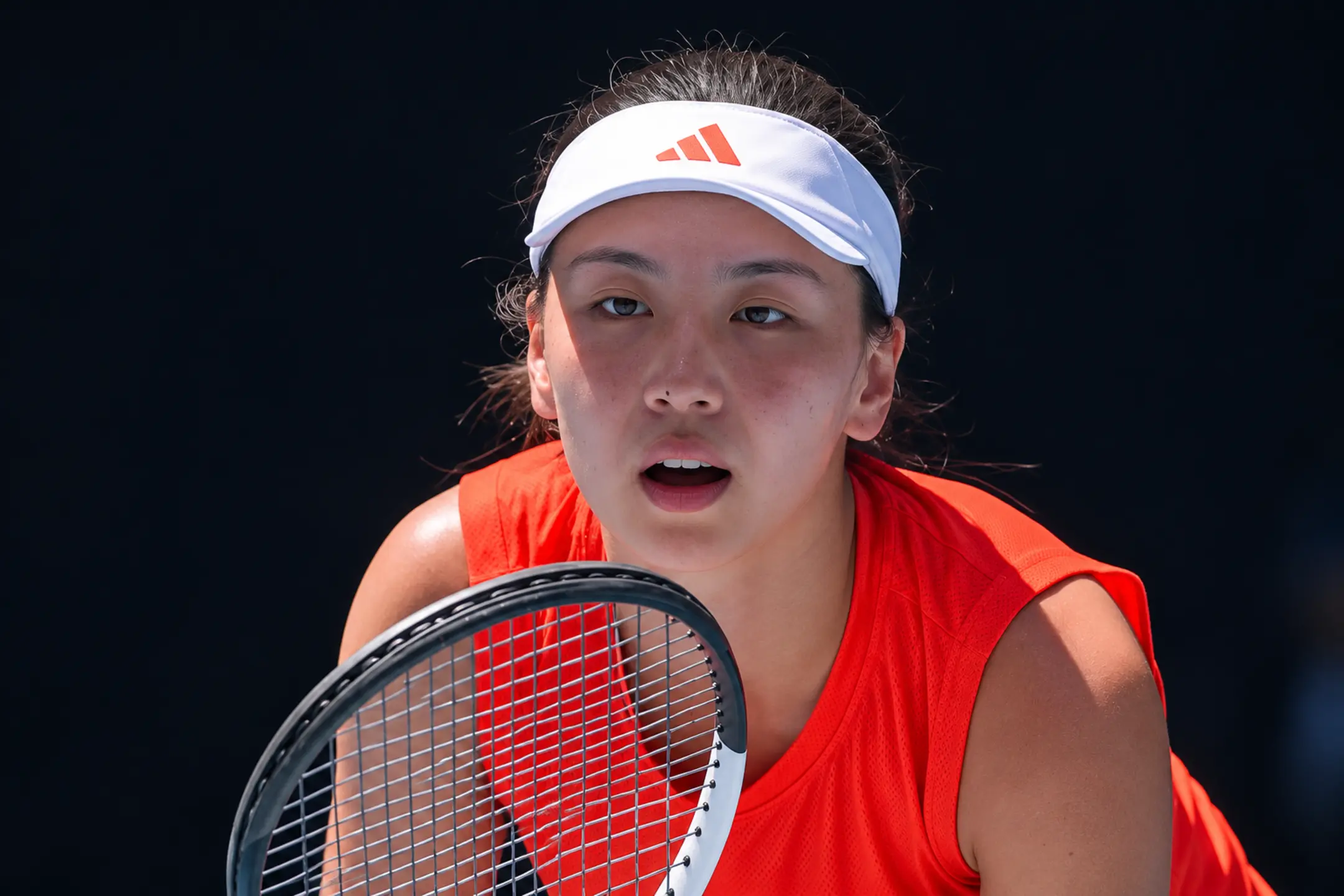
Xinyu Wang finished 2026 ahead of where she had started. The uncomfortable part was how little the second half resembled the first.
An Auckland final, an Australian Open fourth round and a career-high ranking of No. 30 suggested that the Chinese player was finally ready to establish herself among the tour’s leading contenders.
By November, she was No. 38, still an improvement on her No. 57 finish in 2025, but the momentum had largely gone.
At 25, Wang is China’s No. 2 singles player, behind Zheng Qinwen (No. 22) in the November 16 rankings.
Born in Shenzhen on September 26, 2001, she grew up in a sporting family: her father, Peng Wang, was a tennis player and national-team captain, while her mother, Jinghui Zhou, played basketball. Li Na was her childhood role model.
She is also considerably more accomplished than her singles trophy cabinet suggests.
Wang won the 2023 Roland Garros women’s doubles title with Hsieh Su-wei and earned Olympic mixed-doubles silver alongside Zhang Zhizhen in Paris in 2024.
A first tour-level singles title, however, remained elusive throughout 2026.
January Made a Top-30 Future Look Possible
Xinyu Wang opened at Auckland ranked No. 57 and immediately reached the final.
She fought back against Caty McNally, beat Renata Zarazua, progressed when Francesca Jones retired and recovered from a set down to defeat Alexandra Eala 5-7, 7-5, 6-4 in the semifinals.
Elina Svitolina stopped her 6-3, 7-6(6).
Still, after reaching her first tour-level singles final in Berlin in 2025, Wang had returned to a championship match at the first opportunity of the new year.
A second-round defeat to Magda Linette in Hobart did not interrupt the larger story.
At the Australian Open, Wang beat qualifier Anhelina Kalinina before eliminating Jelena Ostapenko, ranked No. 24, in three sets. She then defeated No. 13 Linda Noskova 7-5, 6-4 to reach the fourth round.
Amanda Anisimova, the world No. 4, ended the run 7-6(4), 6-4.
Wang saved eight of ten break points but managed a match-level dominance ratio of only 0.61, a sign that the scoreline concealed how much of the overall pressure came from Anisimova.
The contrast with 2025 was meaningful: Wang had lost in the Australian Open first round that year.
This time she collected three main-draw wins and reached the second week. For a player who had ended 2025 outside the Top 50, it was genuine progress.
February and March Removed the Early Momentum
Wang reached another quarterfinal in Cluj-Napoca, beating Kaitlin Quevedo and Rebeka Masarova before losing 6-4, 6-4 to world No. 91 Oleksandra Oliynykova.
In Doha, a win over Emiliana Arango was followed by a straight-sets defeat to No. 3 Elena Rybakina.
She reached her new career high of No. 30 on February 23. The timing was awkward: the performances that had delivered the ranking were already giving way to a difficult stretch.
Qualifier Masarova, ranked No. 120, beat Wang 6-3, 6-2 in Austin.
Ajla Tomljanovic, ranked No. 85, dismissed her 6-3, 6-1 at Indian Wells, where Wang won only 35.3% of second-serve points and saved none of four break points.
Miami offered a different version of the same problem.
Wang recovered from losing the first set against Caty McNally to take the second 6-1, then lost the decider 6-0.
A season that had started with two notable Grand Slam upsets was suddenly producing no wins across Austin, Indian Wells and Miami.
Clay Exposed the Gap Between Her Ranking and Results
In Rouen, Wang had to qualify.
She recovered from losing her first set 6-0 against Manon Leonard, beat Harmony Tan, then came from behind against Chloe Paquet in the main draw. Her next match ended in retirement against Sorana Cirstea with the score at 5-3.
Madrid was more damaging.
Wildcard Laura Samson, ranked No. 171, came back from a set down to beat Wang 2-6, 6-3, 6-0.
The numbers were revealing: Wang won just 35.5% of second-serve points, leaving her exposed once the opening-set advantage disappeared.
She beat Kaitlin Quevedo at the Vic WTA 125, but lost to No. 129 Alina Charaeva in a deciding-set tiebreak.
Alexandra Eala beat her in Rome, and Lois Boisson won their Strasbourg meeting in straight sets.
Roland Garros delivered a first-round victory over Lilli Tagger before No. 95 Tamara Korpatsch won 6-2, 2-6, 6-3.
Five wins and six losses across her played clay-court matches, including qualifying and the WTA 125, were not a convincing return for a player hovering around No. 30.
Grass Offered a Glimpse, but Not Another Berlin
The inevitable comparison was with Berlin in 2025.
Wang had come through qualifying to make her first singles final, defeating Coco Gauff and Liudmila Samsonova along the way.
In June 2026, Madison Keys eliminated her in Berlin’s opening round, 7-6(3), 6-1.
Bad Homburg offered a late grass-court recovery. Wang overwhelmed Renata Zarazua 6-1, 6-2 and beat world No. 23 Leylah Fernandez 6-3, 6-4.
An unplayed walkover against Elina Svitolina then took her into the semifinals; it was not a match victory over the world No. 8.
Naomi Osaka, ranked No. 15, ended the run 6-3, 6-3.
Wang landed 73.7% of first serves but won only 26.7% of points behind the second. Even with plenty of first deliveries in play, she could not sustain control against the stronger opponent.
At Wimbledon, she beat Elisabetta Cocciaretto in three sets before Belinda Bencic handed her a 7-5, 6-0 defeat.
The 0.36 dominance ratio was among her weakest recorded performances of the year.
North America Showed How High the Ceiling Still Was
Wang defeated qualifier Julieta Pareja in Washington before Liudmila Samsonova beat her 6-2, 6-2.
Toronto was more frustrating: she won the opening set 6-1 against Daria Kasatkina, then lost 1-6, 7-6(5), 7-5.
Cincinnati supplied a modest improvement. Wang beat Hanne Vandewinkel and recovered from a set down to defeat Donna Vekic 3-6, 6-1, 6-4.
Then world No. 1 Aryna Sabalenka stopped her 6-1, 6-3 in just 54 minutes.
Against Sabalenka, Wang won 20.0% of second-serve points and posted a dominance ratio of 0.34.
The contrast with her top-level performances the previous year, particularly the victory over No. 2 Gauff in Berlin, was hard to miss.
The US Open brought a straight-sets win over Emiliana Arango, followed by a three-set defeat to No. 23 Anna Kalinskaya.
Wang’s second-serve points won fell to 33.3% in the loss, again narrowing her options in an extended contest.
Her four Grand Slam appearances had yielded six match wins in total.
Half of them came in Melbourne, and none of the other three majors took her beyond the second round.
A Difficult Finish on the Asian Swing
Singapore delivered her final quarterfinal of the season, including an emphatic 6-1, 6-2 win over Vekic.
Wang won 78.6% of first-serve points and 70.6% behind the second in that match, generating a 2.09 dominance ratio.
Then No. 180 Tatiana Prozorova recovered from a set down to beat her 3-6, 7-5, 6-4.
A chance to build on one of her cleanest wins had slipped away.
The home swing was worse.
Sonay Kartal, ranked No. 129, beat Wang 6-3, 6-2 in Beijing.
In Wuhan, compatriot Xiyu Wang, then No. 91, won 6-2, 6-0.
Xinyu took just 35.3% of second-serve points in Wuhan and recorded a 0.46 dominance ratio.
Alycia Parks beat her in Tokyo. Wang then defeated wildcard Adithya Karunaratne in Hong Kong before losing in three sets to Antonia Ruzic.
The final listed result left her ranked No. 38, behind Zheng but ahead of the rest of China’s singles contingent.
Xinyu Wang Assessment
The verified 2026 record is 26 wins and 26 losses, with one unplayed walkover excluded. It includes qualifying and one WTA 125 appearance.
The bare total captures the imbalance: Xinyu Wang was much better in January than at several points later in the year.
Her most compelling improvement from 2025 was at the Australian Open.
A first-round exit became a fourth-round run, featuring victories over No. 24 Ostapenko and No. 13 Noskova. She also rose from a 2025 year-end No. 57 to a new career high of No. 30 and ended 2026 at No. 38.
But the grass comparison cuts in the opposite direction.
The 2025 Berlin finalist lost her opening match there in 2026; a Bad Homburg semifinal offered compensation but included a quarterfinal walkover.
That is not the same as reproducing Berlin’s four wins over Top 20 opponents in 2025, one of them awarded via retirement.
The technical weakness was not simply the frequency of deciding sets.
Wang went 9-8 in completed three-set matches.
What mattered more was how sharply her level could fall when the first strike or second delivery stopped working: 20.0% of second-serve points won against Sabalenka, 26.7% against Osaka, and 35.5% against Laura Samson.
Her results against the elite also set the limit of the progress.
She beat No. 13 Noskova but lost six other played matches against Top 20 opponents. The walkover against No. 8 Svitolina should not be counted as a Top 10 victory.
Wang remains a convincing Top 40 singles player, with an attack-minded game, a proven capacity to beat strong opposition and a prominent role in Chinese tennis.
What she did not demonstrate in 2026 was the ability to make those strengths productive at the biggest events throughout the year.
Final Verdict
Auckland, Melbourne and the new No. 30 career high made 2026 more than a holding season.
Wang improved her year-end position by 19 places compared with 2025 and gained an Australian Open second-week result that had eluded her the previous year.
But she won no singles title, went only 3-9 in played WTA 1000 main-draw matches and ended with too many early exits against lower-ranked opposition.
The recovery in ranking was genuine; the advance in week-to-week reliability was not.
Letter Grade: B
GPA: 3.0
At 25, China’s No. 2 has already shown she can reach a new level. The next challenge is making a January breakthrough look less like an exception by November.