
Tennis has spent years asking how it can reach younger audiences, attract casual viewers and turn occasional Grand Slam spectators into year-round followers. Podcasts should be one of the easiest answers.
They are inexpensive to consume, accessible almost anywhere and particularly well suited to a sport that moves from country to country for eleven months of the year. A good tennis podcast can explain why a result matters, introduce an unfamiliar player and give people a reason to care about Tuesday afternoon in Doha or the China Open rather than only the second Sunday at Wimbledon.
Yet an increasingly familiar model complicates that argument. A podcast establishes itself with freely available episodes, builds an audience and then gradually begins reserving more of its output for paying subscribers.
The original show may remain free. The better review, an additional episode, the extended discussion, the live show, the tournament recap or some other part of the coverage does not.
Technically, there is still free content.
But is the podcast still free?
Free, Freemium or Already Behind the Wall?
That distinction becomes clearer when some of the better-known tennis podcasts are compared by what a listener can actually access.
For the purposes of this comparison, “free” means something simple: the podcast’s episodes remain available without requiring payment.
A show that offers free regular episodes but puts other episodes or substantive podcast content behind a membership is therefore classified as freemium, not free.
| Podcast | YouTube / Public Availability | Classification |
|---|---|---|
| Nothing Major | Full regular episodes openly available; no obvious paid podcast tier | Free |
| Monday Match Analysis — Gill Gross | Full analysis shows and mailbags publicly available; membership mainly supports the channel | Free |
| Rennae Stubbs Tennis Podcast | Main podcast freely available, although less YouTube-focused | Free |
| Served with Andy Roddick | Large amount of free YouTube content, with additional membership benefits and exclusive material | Freemium |
| The Tennis Podcast | Public episodes remain available, but subscribers receive exclusive podcasts and members-only YouTube shows | Freemium |
| Tennis Weekly | Regular episodes are public, while bonus podcasts, quizzes and Q&As are reserved for subscribers | Freemium |
The interesting part is not that subscriptions exist. It is how quickly the word free becomes elastic.
If seven episodes are available to everybody and three require payment, the seven episodes are free. The podcast as a whole is not.
That may sound pedantic, but it matters when podcasts are regularly presented as one of the ways tennis can become more accessible.
Free Until You Become Interested Enough
There is nothing inherently objectionable about charging for journalism or entertainment. Podcasts cost money to produce. Hosts need to be paid. Travel, equipment, editing, hosting and research are not free.
The problem is the contradiction between two ambitions.
One is commercial: build a loyal audience willing to pay for more.
The other is evangelical: help tennis reach more people.
Those objectives do not always point in the same direction.
The easiest person to persuade to spend £6, $9 or €10 a month on additional tennis discussion is not somebody discovering tennis for the first time. It is the committed fan who already follows the tour closely enough to want another hour of analysis.
And that is where the freemium model becomes particularly clever.
First, make the audience care.
Then charge the people who care the most.

As a business strategy, it is difficult to fault. As a mechanism for broadening the sport, it deserves considerably more scrutiny.
A listener arrives because the show is free. She listens for several months, becomes more interested and then discovers that the tournament review, special discussion or additional episode she wants requires another subscription.
The product has succeeded in creating interest.
It has then placed a toll booth directly in front of that interest.
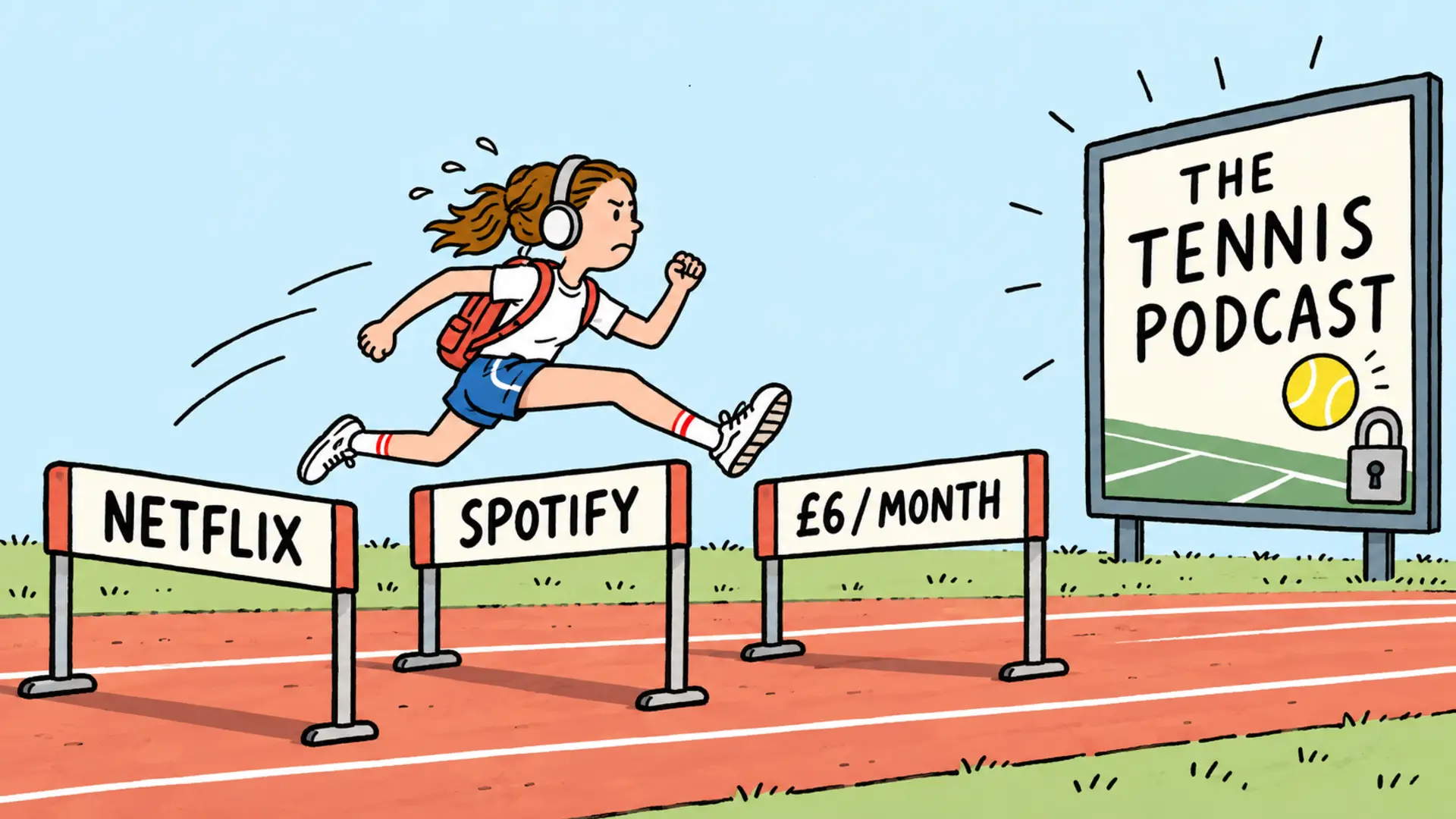
But the person reaching that toll booth may be 14 years old, not a middle-aged professional with disposable income. Her household may already be paying for Netflix, YouTube Premium, Spotify, Disney+, a gaming subscription and the mobile connection through which she discovered tennis in the first place.
Now comes another monthly charge — not to watch the match, but to hear people discuss it.
She may not have a payment card. Her parents may quite reasonably decide that another £6, $9 or €10 a month is one subscription too many.
And that is before geography enters the equation.
Roughly four-fifths of the world’s population lives outside the G7. A price that looks modest in London, New York or Paris can carry very different weight in Manila, Mumbai, Jakarta, Lagos or Bogotá.
Digital content crosses borders instantly.
Purchasing power does not.
That should matter to a sport that calls itself global. If the economic model assumes the disposable income of an adult in one of the world’s richest countries, it is inevitably less accessible to the young audiences elsewhere that tennis also says it wants to reach.
Which leaves a harder question:
Are podcasts helping women’s tennis become more popular around the world, or are they becoming better at monetising people in wealthy countries who already follow it?
Those are not the same achievement.
YouTube Makes the Contradiction Harder to Ignore
The difference is particularly stark on YouTube.
For millions of people, YouTube is already installed, already familiar and already free. There is no need to understand RSS feeds, choose a podcast application or sign up for another platform.
Someone can search for a player, find a match discussion and become a regular viewer almost accidentally.
That is exactly the type of frictionless discovery tennis needs.
A full podcast sitting openly on YouTube can be recommended to somebody who has never heard of the show. A discussion about one player can lead to another video, another tournament and eventually a greater interest in the sport itself.
The algorithm can do something tennis organisations have struggled to do for decades: put tennis in front of somebody who was not deliberately searching for tennis.
But once meaningful parts of the discussion are moved behind memberships, the relationship changes.
The content no longer primarily serves discovery.
It serves conversion.
The viewer is no longer simply an audience member. She is also a potential subscriber.
Again, there is nothing inherently improper about that. But the two objectives should not be confused.
Tennis Already Has an Accessibility Problem
Tennis is hardly suffering from an excess of free access.
- Broadcast rights are fragmented.
- Different tournaments appear on different networks and streaming services.
- Some events require subscriptions that casual fans will never consider buying.
- Matches may begin in inconvenient time zones, and even dedicated followers can struggle to work out where a tournament is being shown.
Podcasts should be the easy part.
The helping hand.
They cannot show the match, but they can provide the conversation around it without another financial barrier.
That role becomes more important precisely because watching professional tennis itself can already be expensive and complicated.
If watching the match requires one subscription, following another tournament requires another, and the conversation afterwards eventually asks for a third, the sport is not becoming easier to follow.
It is constructing a series of increasingly small rooms and charging admission to each one.
Committed tennis supporters may keep opening the doors.
Potential new ones probably will not.
Women’s Tennis Has Even More to Lose
The question becomes more uncomfortable when applied to women’s tennis.
Men’s tennis has historically benefited from a larger volume of mainstream discussion built around globally recognised stars.
Women’s tennis has enormous personalities and compelling rivalries of its own, but large parts of the WTA calendar still receive less sustained coverage outside the Grand Slams.
That makes open discussion disproportionately valuable.
A podcast can spend 20 minutes talking about a player whom a casual viewer has barely encountered. It can make an early-round match consequential. It can explain a ranking rise, establish a rivalry or turn an unfamiliar tournament into something worth following.
Every freely accessible conversation is another possible entry point.
Putting more of those conversations behind subscriptions does the opposite.
And there is a particular irony when this happens around women’s sport.
Tennis authorities, broadcasters and media outlets regularly talk about increasing visibility, reaching younger fans and expanding the audience for women’s tennis.
Visibility and paywalls, however, are natural enemies.
For an established superstar, one piece of podcast analysis disappearing behind a membership wall probably changes very little.
For the player ranked No. 47 whose story receives ten minutes of intelligent discussion, those ten minutes may be one of relatively few opportunities for thousands of people to learn who she is.
That discussion has much greater promotional value when anybody can hear it.
And if the future of women’s tennis is supposed to include young supporters in Asia, Africa, Latin America and other rapidly growing markets, then treating the disposable income of a Western adult subscriber as the default economic model deserves even more scrutiny.
The next great WTA fan may not live in Britain or the United States.
She may be 14, have a second-hand phone and discover a player through a YouTube recommendation.
If the next video tells her that the rest of the conversation is for paying members only, has women’s tennis gained a fan?
Or merely identified somebody it cannot monetise?
The Freemium Defence Has Limits
The standard defence is obvious: most subscription podcasts have not removed their free show.
Subscribers simply receive more.
That distinction is real, but it should not end the discussion.
There is an enormous difference between asking listeners to pay for merchandise, an ad-free feed, early access or participation in a private community and asking them to pay for actual editorial content.
If membership buys a mug and access to a Discord server, the journalism remains open.
If membership buys additional episodes, tournament reviews, analysis, Q&As and live programmes, then some of the journalism has been removed from the public conversation.
The table above shows that this is no longer an unusual experiment. It is becoming a recognisable business model.
Start with an open podcast.
Build familiarity and trust.
Develop an audience.
Add a membership.
Then steadily make membership more attractive by putting desirable content inside it.
At some point “support us if you like what we do” becomes “pay us if you want all of what we do.”
Those are not the same proposition.
A Good Business Model Is Not Necessarily a Growth Model
Subscription podcasting may be excellent business.
A relatively small group of loyal supporters can create predictable revenue. Advertisers become less important. Producers gain financial stability. Listeners who value the product can ensure that it survives.
Independent media in particular needs ways to pay its bills.
None of that deserves criticism by itself.
What deserves scrutiny is the broader assumption that podcasts automatically help grow tennis simply because they talk about tennis.
Some clearly do.
Nothing Major or Monday Match Analysis, for example, can currently place substantial tennis discussion in front of a YouTube viewer without first asking for a credit card.
That is genuine open distribution.
A subscription programme performs a different function. It primarily extracts more value from the audience that has already been acquired.
Both models can produce excellent journalism.
Only one of them maximises accessibility.
And perhaps tennis media should be more candid about the difference.
How Many Subscriptions Does One Sport Need?
There is also a cumulative problem which tends to disappear when every subscription is considered separately.
£6 a month does not sound excessive.
Neither does $9.
Nor does another €5 membership to a different creator.
But tennis supporters do not exist inside a single media ecosystem. They may already pay for television coverage, a streaming service, another service carrying a different tournament, newspapers or specialist websites.
Now add podcast memberships.
One subscription barely registers.
Five do.
And again, even that calculation assumes a listener for whom £6 or $9 is a relatively small discretionary expense.
For a large part of the global audience tennis says it wants to reach, it may not be.
If every successful tennis creator eventually concludes that the logical destination is a paid membership programme, following the sport begins to resemble a collection of micro-subscriptions.
What Happens to the Next Fan?
Take The Tennis Podcast.
Talented presenters, journalists and analysts like Catherine Whitaker, David Law and Matt Roberts deserve to be paid for their work.
But perhaps there is a more uncomfortable question worth asking whenever another previously open programme introduces exclusive episodes.
Who is the podcast ultimately for?
If the answer is the existing tennis obsessive with sufficient disposable income to pay for more tennis, subscriptions make perfect sense.
If the answer is also the casual viewer, the teenager encountering the sport through YouTube, the young fan outside the world’s richest economies or somebody who has just become curious about women’s tennis, then continuously moving the best material behind subscriptions becomes harder to reconcile with that ambition.
Tennis does not suffer from a shortage of barriers.
It suffers from too many of them.
The sport already makes people search for where to watch it. It already divides its calendar between broadcasters, services, countries and time zones.
The conversation surrounding it should perhaps resist doing the same.
Because there is a danger that tennis congratulates itself on a flourishing podcast industry while that industry becomes progressively better at monetising people who already love tennis — and progressively less useful at persuading anybody else to join them.
For women’s tennis in particular, that would be a strange definition of growth.