
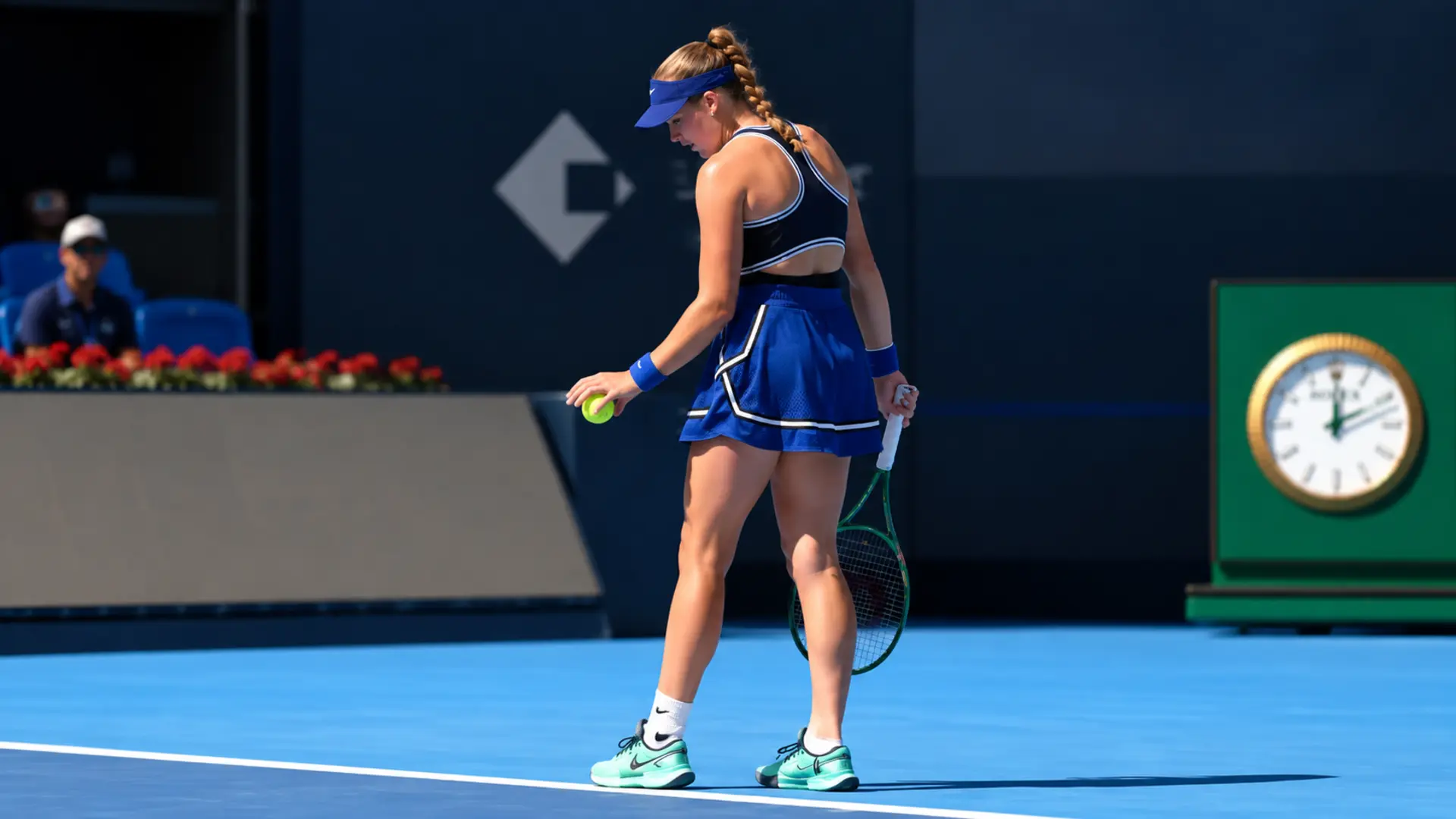
Mirra Andreeva vs. Daria Snigur — China Open 2026 Round-of-16 Match Report
Mirra Andreeva has found the cruise-control setting in Beijing.
The world No. 5 swept aside Daria Snigur 6-2, 6-2 to reach the China Open quarterfinals, producing another performance in which the scoreboard rarely suggested she was in any serious danger.
Since losing the opening set of her tournament to Yue Yuan, Andreeva has now gone 6-0, 6-0, 6-4, 6-1, 6-2, 6-2.
Snigur had already removed Jasmine Paolini earlier in the tournament, but Andreeva gave her almost nothing comparable to attack.
Six aces, no double faults, a 1.93 dominance ratio and only 17 unforced errors turned another Beijing match into a relatively brief exercise in control.
One Early Break Sets the Pattern
Andreeva immediately put Snigur under pressure.
She broke in the opening game and then consolidated for 2-0.
Snigur finally got onto the scoreboard with a hold for 1-2, but Andreeva answered comfortably and maintained the two-game cushion at 3-1.
The pattern continued through 2-4.
Snigur was staying close enough to prevent the set from becoming a rout, but she was not making any progress on Andreeva’s serve.
Then came the second break.
At 2-4, Snigur lost serve again, leaving Andreeva at 5-2 with the set on her racket.
She served it out for 6-2.
Snigur Briefly Pushes Back in the Second
The second set began even more ominously for Snigur.
Andreeva broke immediately, held for 2-0 and then broke again for 3-0.
This time Snigur produced a response.
She broke Andreeva for 1-3 — the only service game the No. 5 seed would lose all day — and then held for 2-3.
For a moment, the match had tightened.
Andreeva shut the door almost immediately.
She held for 4-2, broke again for 5-2 and then served out the match.
Another 6-2.
No extended wobble, no unnecessary third set and no invitation for Snigur to build momentum.
Six Aces, No Double Faults and a Huge First-Serve Edge
The most striking numbers came from Andreeva’s serve.
She hit six aces and no double faults, landed 72 percent of her first serves and won 76 percent of those points.
Snigur landed a similar percentage of first serves at 71 percent, but won only 51 percent behind them.
That is where the match separated sharply.
Andreeva also won 62 percent behind her second serve, while Snigur managed only 31 percent.
The overall dominance ratio finished at 1.93 to 0.52.
Andreeva won 63 of the 101 points, including five of nine break points.
Snigur produced 16 winners, but 32 unforced errors made it impossible to sustain enough resistance. Andreeva finished with 20 winners and only 17 errors.
Full Match Stats Daria Snigur vs Mirra Andreeva
| Snigur | Statistic | Andreeva |
|---|---|---|
| Full Match Duration: 1h03m | ||
| 0.52 | Dominance Ratio | 1.93 |
| 16 | Winners | 20 |
| 32 | Unforced Errors | 17 |
| 190 | Serve Rating | 304 |
| 0 | Aces | 6 |
| 1 | Double Faults | 0 |
| 71% (39/55) | 1st Serve % | 72% (33/46) |
| 51% (20/39) | 1st Serve Points Won | 76% (25/33) |
| 31% (5/16) | 2nd Serve Points Won | 62% (8/13) |
| 44% (4/9) | Break Points Saved | 0% (0/1) |
| 175 | Return Rating | 237 |
| 24% (8/33) | 1st Return Points Won | 49% (19/39) |
| 38% (5/13) | 2nd Return Points Won | 69% (11/16) |
| 1/1 | Break Points Won | 5/9 |
| 38 | Total Points Won | 63 |
Andreeva’s 15 Losses Reveal a Remarkable Floor
Her season record adds useful context to what is happening in Beijing.
Andreeva is now 49-15 in 2026, and those 15 defeats reveal something striking: she has not lost to a player ranked outside the Top 50 all season.
| Date | Event | Opponent | Opponent Rank | Score |
|---|---|---|---|---|
| 2026-9 | Singapore – QF | Leylah Fernandez | 31 | 6-2 7-5 |
| 2026-8 | US Open – QF | Coco Gauff | 4 | 2-6 7-6(7) 6-2 |
| 2026-8 | Cincinnati – R16 | Marta Kostyuk | 11 | 4-6 6-0 6-2 |
| 2026-8 | Toronto – R32 | Leylah Fernandez | 34 | 6-1 6-4 |
| 2026-6 | Wimbledon – R64 | Barbora Krejcikova | 38 | 4-6 7-5 6-4 |
| 2026-6 | Bad Homburg – R16 | Ekaterina Alexandrova | 19 | 6-3 6-4 |
| 2026-5 | Rome – QF | Coco Gauff | 4 | 4-6 6-2 6-4 |
| 2026-4 | Madrid – F | Marta Kostyuk | 23 | 6-3 7-5 |
| 2026-4 | Stuttgart – SF | Elena Rybakina | 2 | 7-5 6-1 |
| 2026-3 | Miami – R16 | Victoria Mboko | 9 | 7-6(4) 4-6 6-0 |
| 2026-3 | Indian Wells – R32 | Katerina Siniakova | 44 | 4-6 7-6(5) 6-3 |
| 2026-2 | Dubai – QF | Amanda Anisimova | 6 | 2-6 7-5 7-6(4) |
| 2026-2 | Doha – R16 | Victoria Mboko | 13 | 6-3 3-6 7-6(5) |
| 2026-1 | Australian Open – R16 | Elina Svitolina | 12 | 6-2 6-4 |
| 2026-1 | Brisbane – QF | Marta Kostyuk | 26 | 7-6(7) 6-3 |
In fact, the lowest-ranked player to beat her was No. 44 Katerina Siniakova at Indian Wells.
The rest of the defeats came against opponents ranked between No. 2 and No. 38.
There is another pattern in the list.
Marta Kostyuk has beaten Andreeva three times, while Coco Gauff, Leylah Fernandez and Victoria Mboko have each defeated her twice.
So Andreeva’s losses have not generally come from unexpected collapses against lower-ranked opposition. They have been concentrated against established or dangerous players who have repeatedly found solutions against her.
That consistency helps explain why her ranking has held so firmly near the top of the game.
She can even aim higher than 5th in China.
Beijing Is Becoming an Opportunity
With Elena Rybakina and Aryna Sabalenka already eliminated, the tournament has opened dramatically.
Andreeva has responded by doing exactly what a player chasing a new career high needs to do: keep winning the matches she is expected to win and do it without wasting energy.
Her Beijing progression since that opening-set loss to Yue Yuan has become increasingly emphatic.
No.46 Daria Snigur never found a way to interrupt it.
At the moment, Andreeva is not merely surviving the China Open draw.
She is cruising through it.
Can in-form Ekaterina Alexandrova stop her?