
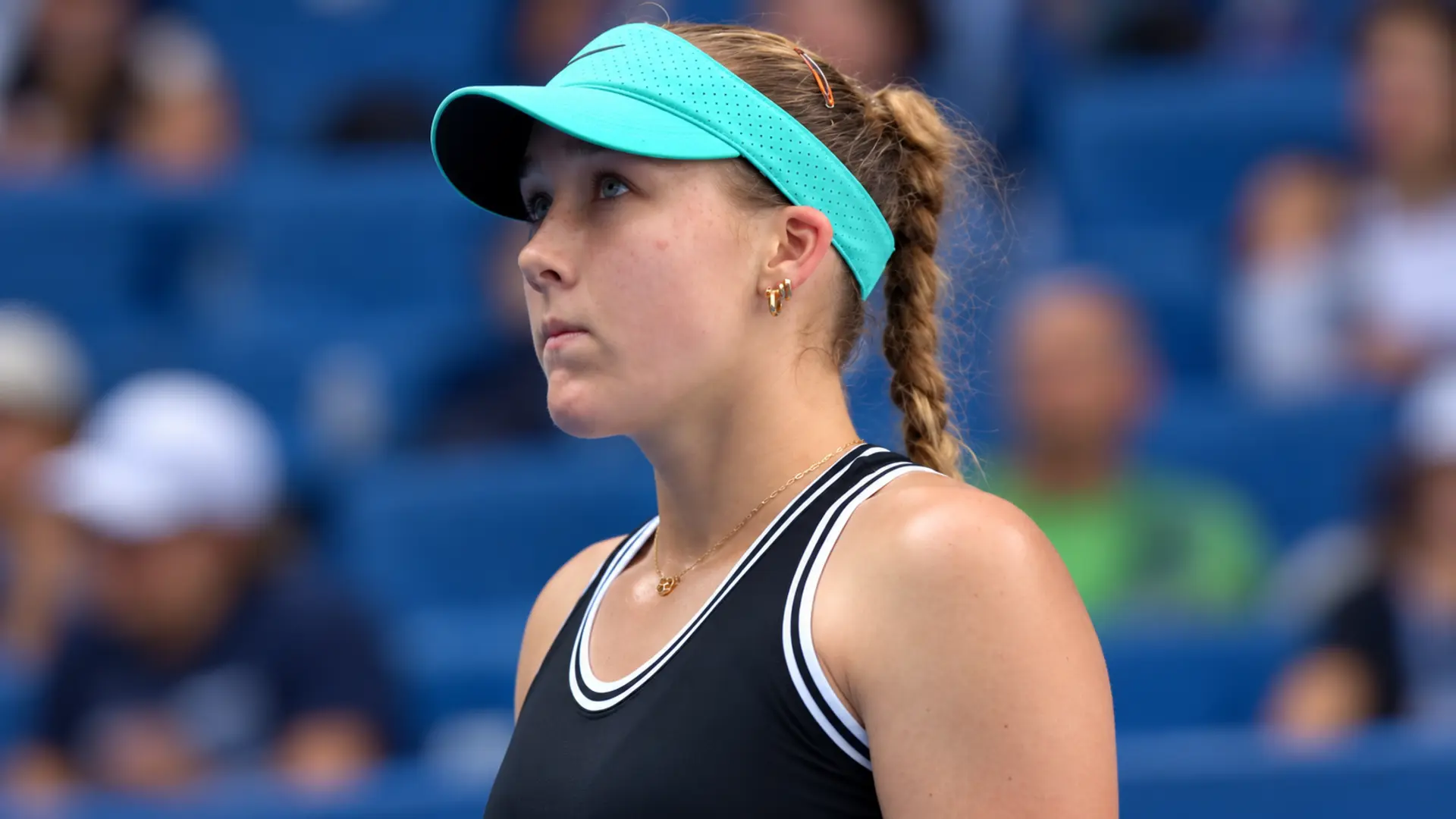
Mirra Andreeva did not merely recover from a poor opening set against Yue Yuan at the China Open. She produced one of the rarest scoreline reversals seen on the WTA Tour in the past decade.
The No. 4 seed lost the first set 6-3 to the Chinese wildcard in their Beijing second-round match before winning every game that followed: 3-6, 6-0, 6-0.
Based on the available results since 2016, only eight previous WTA matches had ended with a player losing the opening set and then taking the next two by identical 6-0 scores.
Andreeva has now made it nine.
The stranger part? The last three have all happened in Beijing.
Andreeva Turns 3-6 Into 12 Consecutive Games
For one set, Yue looked capable of producing one of the biggest Chinese victories of the tournament.
She took the opener 6-3 against Andreeva and put the Russian in immediate trouble.
There would not be another game for her.
Andreeva swept through the second set 6-0 and repeated the score in the decider, turning a one-set deficit into a 12-game winning streak.
A double bagel is already uncommon at WTA level. Producing one after actually losing the first set is something else entirely.
The result puts Andreeva alongside a small collection of prominent names who have pulled off the same statistical oddity over the past decade.
Only Nine Times Since 2016
Before Andreeva, the most recent occurrence came at exactly the same tournament.
Diane Parry lost the opening set 6-4 to En Shuo Liang in the first round of the 2024 China Open before winning 6-0, 6-0.
One year earlier, Veronika Kudermetova did it in Beijing too, recovering from a 6-3 first-set loss against Lesia Tsurenko to take the remaining sets without dropping a game.
And now Andreeva has completed the sequence in 2026.
The nine known instances since 2016 are:
| Date | Event | Winner | Winner Rank | Loser | Loser Rank | Score | Time |
|---|---|---|---|---|---|---|---|
| 2026-10 | Beijing R64 | Mirra Andreeva | 5 | Yue Yuan | 135 | 3-6 6-0 6-0 | 1h36m |
| 2024-9 | Beijing R128 | Diane Parry | 53 | En Shuo Liang | 260 | 4-6 6-0 6-0 | 1h36m |
| 2023-10 | Beijing R32 | Veronika Kudermetova | 16 | Lesia Tsurenko | 49 | 3-6 6-0 6-0 | 1h42m |
| 2022-6 | Berlin R32 | Karolina Pliskova | 7 | Kaia Kanepi | 41 | 6-7(5) 6-0 6-0 | 1h43m |
| 2021-8 | Cleveland R32 | Anett Kontaveit | 30 | Lauren Davis | 97 | 1-6 6-0 6-0 | 1h32m |
| 2019-6 | Nottingham SF | Donna Vekic | 22 | Tatjana Maria | 56 | 5-7 6-0 6-0 | 1h40m |
| 2019-4 | Istanbul R32 | Sorana Cirstea | 97 | Irina Bara | 186 | 2-6 6-0 6-0 | 1h51m |
| 2018-1 | Australian Open R64 | Lauren Davis | 76 | Andrea Petkovic | 98 | 4-6 6-0 6-0 | 1h40m |
| 2017-5 | Rome R16 | Elina Svitolina | 11 | Mona Barthel | 60 | 3-6 6-0 6-0 | 1h41m |
Beijing Has Somehow Claimed the Last Three
The geographical pattern is almost as peculiar as the scoreline itself.
From 2017 through 2022, the feat appeared in Rome, Melbourne, Istanbul, Nottingham, Cleveland and Berlin.
Then it moved to Beijing.
Kudermetova did it in 2023.
Parry followed in 2024.
Now Andreeva has done the same in 2026.
So the three most recent examples of a WTA player losing the first set before winning 6-0, 6-0 have all come at the China Open.
There is no tennis logic that says Beijing should specialize in this particular kind of comeback. That is precisely what makes the sequence so amusing.
Three occurrences in succession, at the same tournament, of a result that has appeared only nine times in a decade is quite the coincidence.
Lauren Davis Did It Both Ways Before Andreeva Joined the List
The historical names also underline how difficult the turnaround is.
Elina Svitolina, Karolina Pliskova and Anett Kontaveit all feature. Donna Vekic and Sorana Cirstea have done it.
Lauren Davis appears on both sides of the equation: she beat Andrea Petkovic this way at the 2018 Australian Open after having suffered the same fate against Kontaveit three years later.
Andreeva now joins them.
What began as a troublesome first set against Yue ended as one of the most unusual scorelines of the China Open — and the latest chapter in Beijing’s increasingly bizarre ownership of the lose-one-set, win-the-next-12-games comeback.