
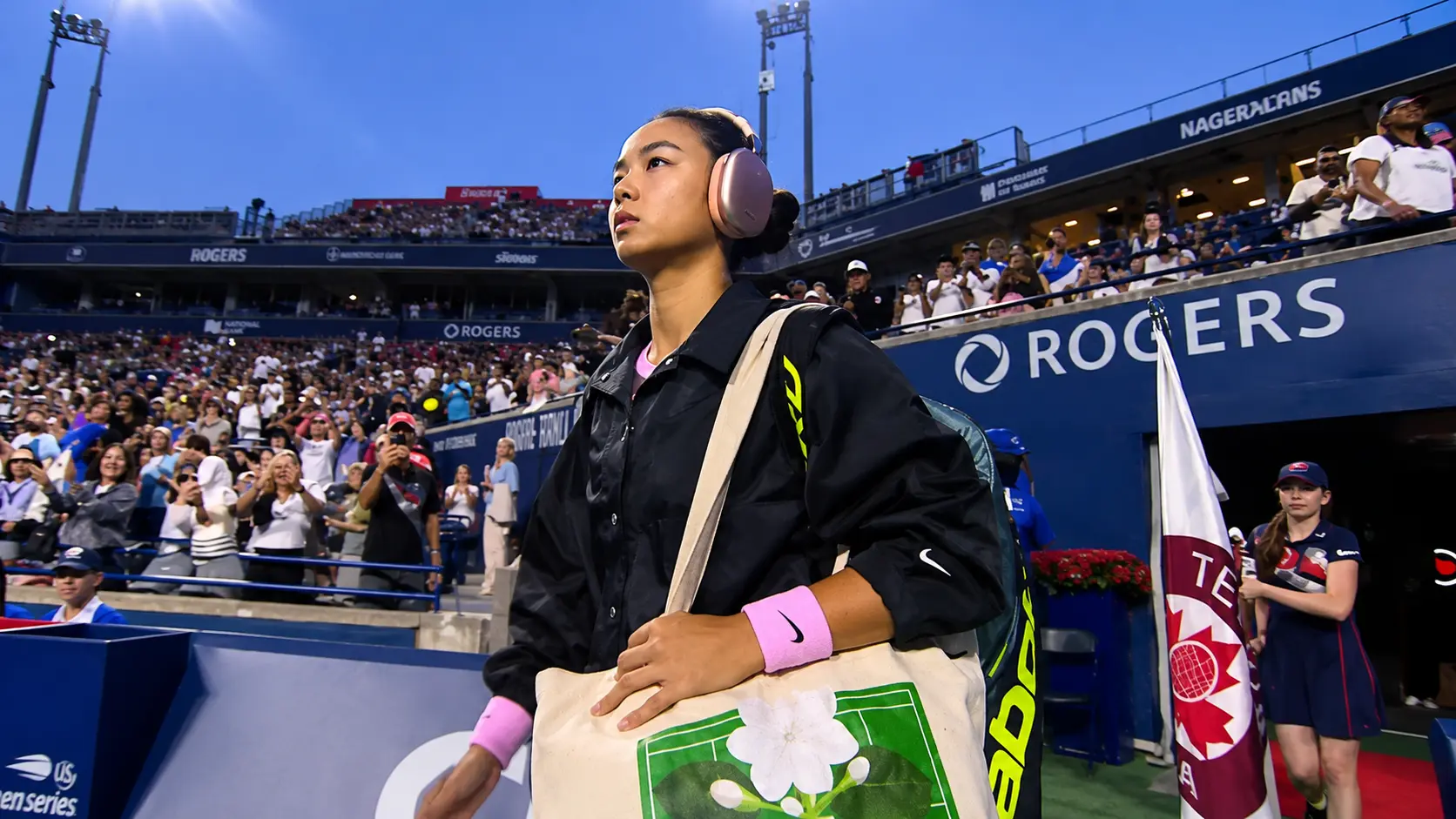
Alex Eala’s rise has brought something tennis always claims to want.
New fans.
New voices.
New national pride.
New people in the stands who may not have grown up with the sport’s strange little rituals: when to clap, when to stay quiet, when to move, when to sit, when to put the phone away, and why shouting between serves can feel louder than a full stadium chant in another sport.
That is why the Philippine Tennis Association’s tennis etiquette guide landed so sharply.
The poster was simple: stay quiet during play, clap respectfully, keep phones silent, turn off flash, move only during changeovers or breaks, do not talk while the ball is in play, do not cheer mistakes, and do not use selfie sticks.
It was useful. It was timely. It was needed.
But the wider reaction also revealed something else.
Some so-called neutral tennis fans and commentators were very quick to turn Filipino support for Eala into the whole problem. That is too easy.
Tennis crowd behavior did not suddenly become messy because Eala became popular. American crowds have crossed lines for decades when home players were involved. Argentine fans have always brought a different level of football-style intensity. Polish fans around Iga Swiatek can be wonderfully loyal, but some also pushed the edge during the Canadian Open.
So, yes, Filipino fans need to learn the rhythm of tennis if they are new to the sport.
But they are hardly the only ones.
PHILTA Did the Right Thing
PHILTA deserves credit because it did not pretend there was no issue.
That already puts it ahead of many associations, tournaments and fan cultures that prefer to treat bad crowd behavior as atmosphere.
The guide did not shame enthusiasm. It explained context. Tennis is not basketball. It is not football. It is not volleyball. Noise belongs in the sport, but it has to breathe with the point rather than run over it.
There is room to chant before a match.
There is room to cheer after a brilliant winner.
There is room to wave flags, wear colors, bring emotion and let a player feel that she is not alone.
There is not room to shout during a rally, distract a player before a second serve, block someone’s view with a selfie stick, or celebrate every routine error as if the opponent’s discomfort is part of the entertainment.
That is not passion.
That is a failure to read the sport.
Eala’s Fan Base Is Learning in Public
Eala’s success has created a rare moment for tennis in the Philippines.
A country without a deep WTA tradition suddenly has a player giving fans a reason to track draws, follow rankings, watch late-night matches and feel part of the tour. That is good for women’s tennis. It widens the sport. It changes the map.
But when a new fan base arrives quickly, it learns in public.
That can be messy.
Some fans will overdo it. Some will treat every opponent as an enemy. Some will mistake volume for loyalty. Some will assume that because other sports allow constant noise, tennis should absorb it too.
That is where PHILTA’s guide becomes useful.
It gives new fans a way in without humiliating them. It says: support Eala, but understand the stage she is playing on. Make her matches feel alive, but do not make them unfair. Bring pride, but not disruption.
That is a healthy message.
The Problem Is Not Only Filipino Fans
The uncomfortable part is how quickly some tennis fans framed this as a Filipino problem.
It is not.
Anyone who has watched enough tennis knows better.
The US Open has produced some of the most chaotic crowd behavior in the sport for years, especially when American players are involved.
Late-night New York can be thrilling, but it can also trample straight over tennis etiquette. Fans move at the wrong times, talk through points, cheer errors, shout between serves and treat the match as if the players are there to serve the crowd rather than compete within a fair environment.
That behavior has often been romanticized as “New York energy.”
Funny how etiquette becomes a bigger talking point when the noisy fans are new, foreign or attached to a rising player from outside the traditional tennis powers.
Argentina has also brought fan culture into tennis in ways that can be thrilling and uncomfortable at the same time. The color, noise and devotion are part of the spectacle. But the line between support and intimidation can get thin. That is not new either.
And during the Canadian Open, some Swiatek fans also seemed to tread close to that same line. In the final, only the umpire appeared to take notice. Luckily, Elena Rybakina did not seem too bothered.
Passion for a great player is understandable. Turning that passion into constant pressure around an opponent is something else.
So PHILTA’s guide should not be read as a Filipino-only correction.
It should be read as a reminder the sport could use almost everywhere.
“Applaud Skills, Not Errors” Should Travel
The best line in the PHILTA guide is the simplest one: applaud skills, not errors.
That line deserves a life beyond one federation’s social media post.
It should be shown at tournaments everywhere.
It does not mean crowds must sit on their hands when a player wins a crucial point because of an opponent’s mistake. Tennis is emotional. If someone double faults on break point in the final set, the crowd will react. Nobody needs to pretend otherwise.
But there is a difference between reacting to the score and enjoying someone’s mistake.
A routine double fault early in a match does not need a roar. A shanked forehand does not need mockery. A player already struggling with nerves does not need a crowd turning every error into a little public punishment.
The best spectators understand the difference.
They celebrate the player they support.
They do not feed on the player across the net falling apart.
Tennis Can Be Loud Without Becoming Careless
Tennis does not need to become quieter in personality.
There is room for flags, chants, joy, national pride and emotion. There is room for Filipino fans to make Eala matches feel different. There is room for a new audience to reshape the atmosphere around a player who has given them a reason to care.
But there is also room for other associations to remind their own fans of the same standards.
Why should PHILTA be the only one doing this?
If Filipino fans need a guide, then so do plenty of others.
American fans could use one before the US Open. Polish fans could use one when Swiatek matches become emotionally charged. Argentine fans could use one when national passion spills into tennis spaces. Every country with a loud, proud, fast-growing or intensely loyal fan base could use a reminder that tennis support works best when it respects the point.
The next few weeks move the tour into the United States. Over many decades, the US Open has shown how exciting a crowd can be, but also how careless it can become. Some fans there violate almost every unwritten rule tennis has: talking through points, moving at the wrong time, cheering errors too loudly, treating night sessions as a party with a match attached.
You would rarely see that kind of behavior in Germany.
That contrast says something.
Crowd culture is not fixed. It is taught, tolerated or corrected.
PHILTA chose correction.
Will the US Open ever do the same with the same clarity?
New Fans Are Not the Enemy
There is a lazy version of this debate that treats new fans as the problem.
That misses the point.
New fans are good. Tennis needs them. The WTA especially benefits when a player such as Eala brings in people who might not otherwise care about rankings, surfaces, draws or the long grind of the tour.
The problem is not new fans.
The problem is leaving them unguided, then mocking them when they get the code wrong.
A sport with unusual etiquette has some responsibility to explain itself. Tournaments should do it. Federations should do it. Broadcasters should do it. Fan communities should do it without turning every correction into a culture war.
PHILTA’s guide works because it is practical.
Eala Deserves Support That Does Not Shrink Her Opponents
There is another part of this conversation that goes beyond the stands.
Online fandom around Eala can sometimes drift into a familiar trap: every win becomes proof she is already better than established champions, and every loss becomes someone else’s fault.
That does not help her.
Eala is impressive. She is also still developing. Both things can be true at the same time. She can beat great players on a given day and still have holes in her game. She can be a future top player without already being better than everyone she defeats once.
Respecting Eala means allowing her career to breathe.
It also means respecting the women across the net.
Bencic does not lose her achievements because she beats Eala. Swiatek does not become irrelevant because Eala outplays her once. Noskova, Pegula, Gauff, Parks or any other opponent should not be dragged down just because they interrupt a preferred storyline.
Good fandom lifts a player.
Bad fandom turns every match into a moral contest.
PHILTA’s Guide Is a Start, Not a Scolding
PHILTA’s tennis etiquette guide should be welcomed.
Not because Filipino fans are uniquely guilty.
Not because Eala’s supporters need to be singled out as a special problem.
But because the guide says something tennis often avoids saying clearly: atmosphere is not an excuse for distraction. Passion is not a license to ignore the match. Supporting one player does not require disrespecting the other.
The guide is not a scolding.
It is a welcome sign with rules attached.
And for a sport trying to grow without losing what makes it fair, that may be exactly what new fans need.
It may also be what many old fans still need too.