
Editor’s note: Coverage was delayed because of an outage affecting our hosting provider in Phoenix. (Updated: August 14, 2026, 11:10 a.m.)
For two sets, there was only one player on court who actually looked like she knew what she was trying to do.
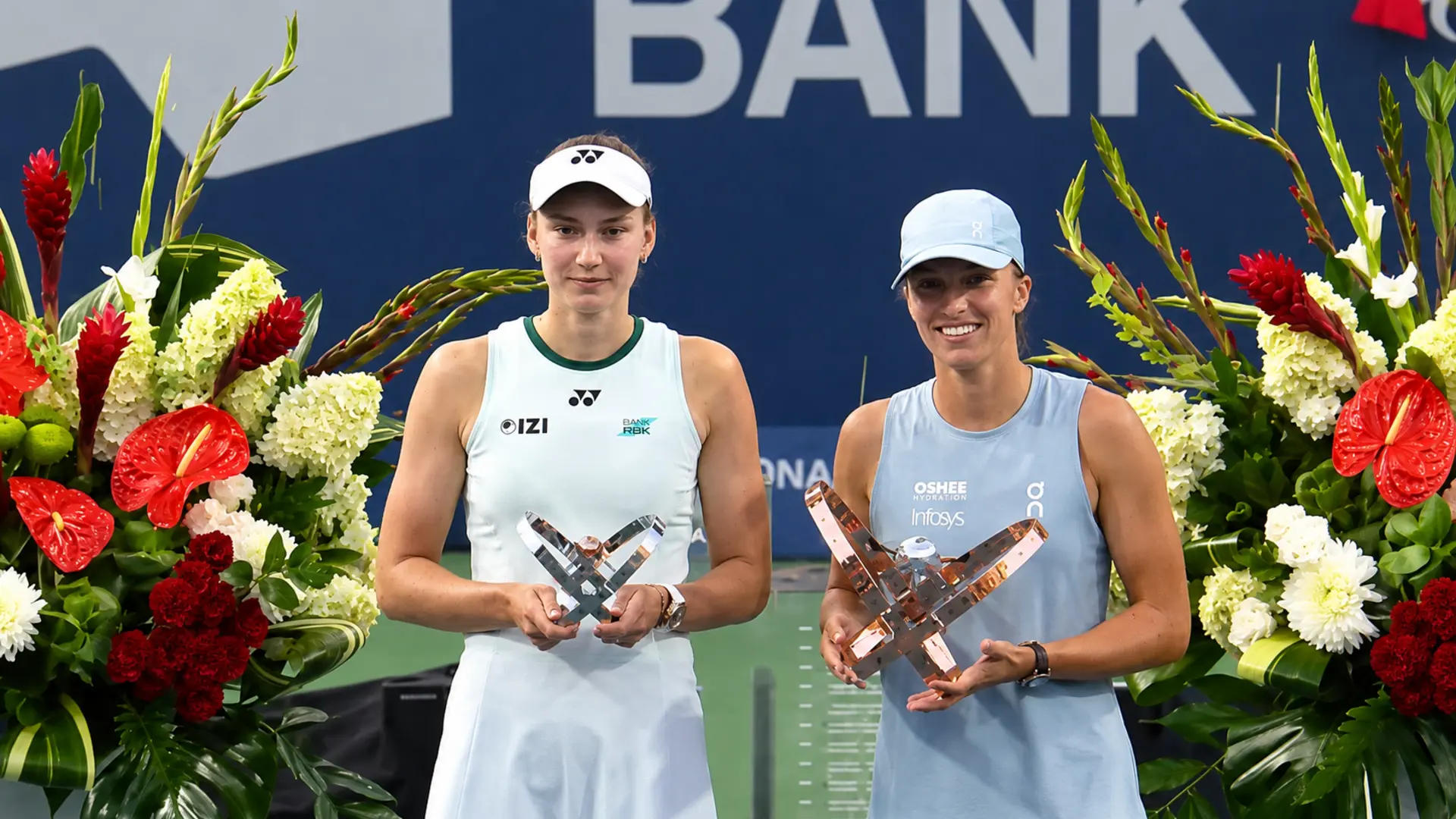
Swiatek beat Rybakina 6-2, 6-3 to win the Canadian Open.
The gap between the two performances was as clear live as it is on the stat sheet.
Swiatek was laser-sharp from the first ball, every decision made early and committed to.
Rybakina, by contrast, spent much of the early evening improvising, searching for a plan that never quite arrived.
The trouble with improvising against Iga Swiatek is that she’s one of the best improvisers in the sport herself. Rybakina picked the wrong final to try and out-think anyone off the cuff.
Swiatek Breaks Early, Survives One Scare, and Never Looks Back
The first set set the tone before either player had really settled into their seats.
Swiatek broke immediately to lead 1-0, then held to make it 2-0.
Rybakina got on the board with a hold of her own, but Swiatek pushed the lead back to 3-1.
Rybakina held again to close to 3-2, and for a moment it looked like she might actually be finding a foothold.
Then came the game that decided the set’s whole shape. Serving at 3-2, Swiatek fell behind 15-40, two break points down and facing real trouble. She saved both. Astonishingly, Rybakina missed three backhands in a row right when the opportunity was there.
Swiatek held for 4-2 on the back of it.
It was the kind of escape that swings momentum entirely, and Swiatek made sure it did.
A tentative backhand cost Rybakina her very next service game.
Swiatek broke after a long, patient rally to move ahead 5-2, then closed out the set at love, 6-2.
Key Set 1 Stats
- Swiatek won every pressure point (5/5) while Rybakina won none (0/5).
- Swiatek committed just 3 unforced errors compared with Rybakina’s 12.
- Swiatek converted both her break points (2/2) and saved both she faced (2/2), while Rybakina went 0/2 on each.
Full Set 1 Stats
| Swiatek | Statistic | Rybakina |
|---|---|---|
| Set 1 Duration: 0h30m | ||
| 1.44 | Dominance Ratio | 0.69 |
| 2 | Winners | 6 |
| 3 | Unforced Errors | 12 |
| 302 | Serve Rating | 201 |
| 0 | Aces | 1 |
| 1 | Double Faults | 3 |
| 83% (20/24) | 1st Serve % | 84% (16/19) |
| 80% (16/20) | 1st Serve Points Won | 69% (11/16) |
| 50% (2/4) | 2nd Serve Points Won | 0% (0/3) |
| 100% (2/2) | Break Points Saved | 0% (0/2) |
| 281 | Return Rating | 70 |
| 31% (5/16) | 1st Return Points Won | 20% (4/20) |
| 100% (3/3) | 2nd Return Points Won | 50% (2/4) |
| 2/2 | Break Points Won | 0/2 |
| 25 | Total Points Won | 18 |
By her own count, Swiatek produced only two truly spectacular points across the whole set. She didn’t need more than that.
Rybakina, despite finding four or five moments of real quality herself, looked out of sorts throughout. Swiatek looked like the only person in the building who knew exactly what was coming next.
The Same Problem Comes Back to Haunt Rybakina in the Second
Both players held through the opening exchanges of the second set, trading games to level at 2-2.
That’s when the issue that had been quietly there all match finally caught up with Rybakina in full. Her forehand returns on Swiatek’s second serve had been shaky from the start. At 2-2, they finally cost her, with Swiatek breaking through to lead 3-2 and holding again immediately for 4-2.
By the one-hour mark, the scoreboard read 6-2, 4-2. There was no sense anywhere on court that Rybakina had an answer coming.
The set moved quickly from there.
Swiatek held for 5-3. With Rybakina serving to stay competitive, Swiatek seized her chance, breaking through the serve again to close out the match 6-2, 6-3.
Key Set 2 Stats
- Swiatek won 31 total points to Rybakina’s 23.
- Swiatek landed 82% of first serves (18/22) compared with Rybakina’s 41% (13/32), a huge gap in serve consistency.
- Swiatek won her return games 40% of the time (2/5) while Rybakina failed to win any (0/4).
Full Set 2 Stats
| Swiatek | Statistic | Rybakina |
|---|---|---|
| Set 2 Duration: 0h46m | ||
| 1.72 | Dominance Ratio | 0.58 |
| 9 | Winners | 8 |
| 5 | Unforced Errors | 11 |
| 334 | Serve Rating | 209 |
| 0 | Aces | 0 |
| 0 | Double Faults | 1 |
| 82% (18/22) | 1st Serve % | 41% (13/32) |
| 72% (13/18) | 1st Serve Points Won | 62% (8/13) |
| 80% (4/5) | 2nd Serve Points Won | 47% (9/19) |
| – (0/0) | Break Points Saved | 33% (1/3) |
| 198 | Return Rating | 48 |
| 38% (5/13) | 1st Return Points Won | 28% (5/18) |
| 53% (10/19) | 2nd Return Points Won | 20% (1/5) |
| 2/3 | Break Points Won | – (0/0) |
| 31 | Total Points Won | 23 |
It was a set that never really let Rybakina establish anything close to control. That held true even in the stretches where the scoreboard still looked salvageable.
The Numbers Confirm What Was Obvious Live
Swiatek’s pressure points tell the story on their own: she won 86 percent of them, 6 of 7, to Rybakina’s 14 percent.
Swiatek held 8 for 8 of her own service games, and finished with a dominance ratio of 1.60 against Rybakina’s 0.63. The unforced error count explains the rest. Swiatek made just 8 all match. Rybakina made 23, nearly three times as many.
That total reflects exactly the kind of improvised, searching tennis that defined her afternoon. Rybakina actually hit more winners, 14 to Swiatek’s 11. She landed them, though, inside a performance far too loose everywhere else to make that count for much.
A First Iga-Title in Eleven Months, and It Showed
This was Swiatek’s first WTA title in eleven months. Read that again. Eleven.
The joy on court afterward was immense, and it’s easy to understand why.
This tournament alone had already produced a 32-point survival act and a vintage demolition in the quarterfinal, both signs that something was building.
Tonight was the payoff.
Swiatek moves back up to world No. 5, and after everything this season has thrown at her, she’ll be a favorite again almost immediately wherever she plays next. The dark, cold stretch of worry that defined so much of her 2026 is, for now at least, genuinely behind her.
Rybakina leaves Toronto with a heavy haul of ranking points and a performance that wasn’t quite worthy of a world No. 2 in a final, on its own merits.
One thing works in her favor, though. She’d already played five hours of top-level tennis less than 48 hours before this match even started. That’s a physical toll that’s hard to fully separate from how flat she looked today.
Whether both players show up in Cincinnati remains to be seen.
Swiatek already looks ready for the US Open.
Rybakina, for her part, will be watching closely what Aryna Sabalenka does over the next two tournaments, with the world No. 1 ranking still very much part of the conversation for whoever finishes the summer strongest.
Swiatek Dedicates the Title to Those Facing ‘Unfair Judgments and Hate’
After the match, Swiatek struck a more personal note as she reflected on the difficult period she has experienced in recent months and the scrutiny that has followed her online.
“The last few months haven’t been easy,” Swiatek said. “I’m really happy that I kept focusing on my progress, despite all the opinions that so many people express about me every day on the Internet. I want to dedicate this title to everyone who faces unfair judgments and hate.”
Rybakina, meanwhile, felt the match had been decided as much by her own lack of aggression as by Swiatek’s ability to turn points around.
“She can take the opportunity during the rally and turn it around,” Rybakina said. “As I said, for me, I feel like it was more from my side that I wasn’t playing aggressive enough.”
The Kazakh also acknowledged the physical and mental demands of trying to stay with Swiatek once the rallies were extended.
“I was not with the energy enough to play against her. We all know she’s a fighter, and she can run left and right much longer than me.”
Those comments neatly captured the contrast on court.
Rybakina felt she had allowed Swiatek too much time and too many opportunities to work her way into rallies, while Swiatek once again relied on her movement, resilience and ability to turn defensive positions into attacking ones.
For the Pole, however, the significance of the victory clearly extended beyond the tennis itself.