
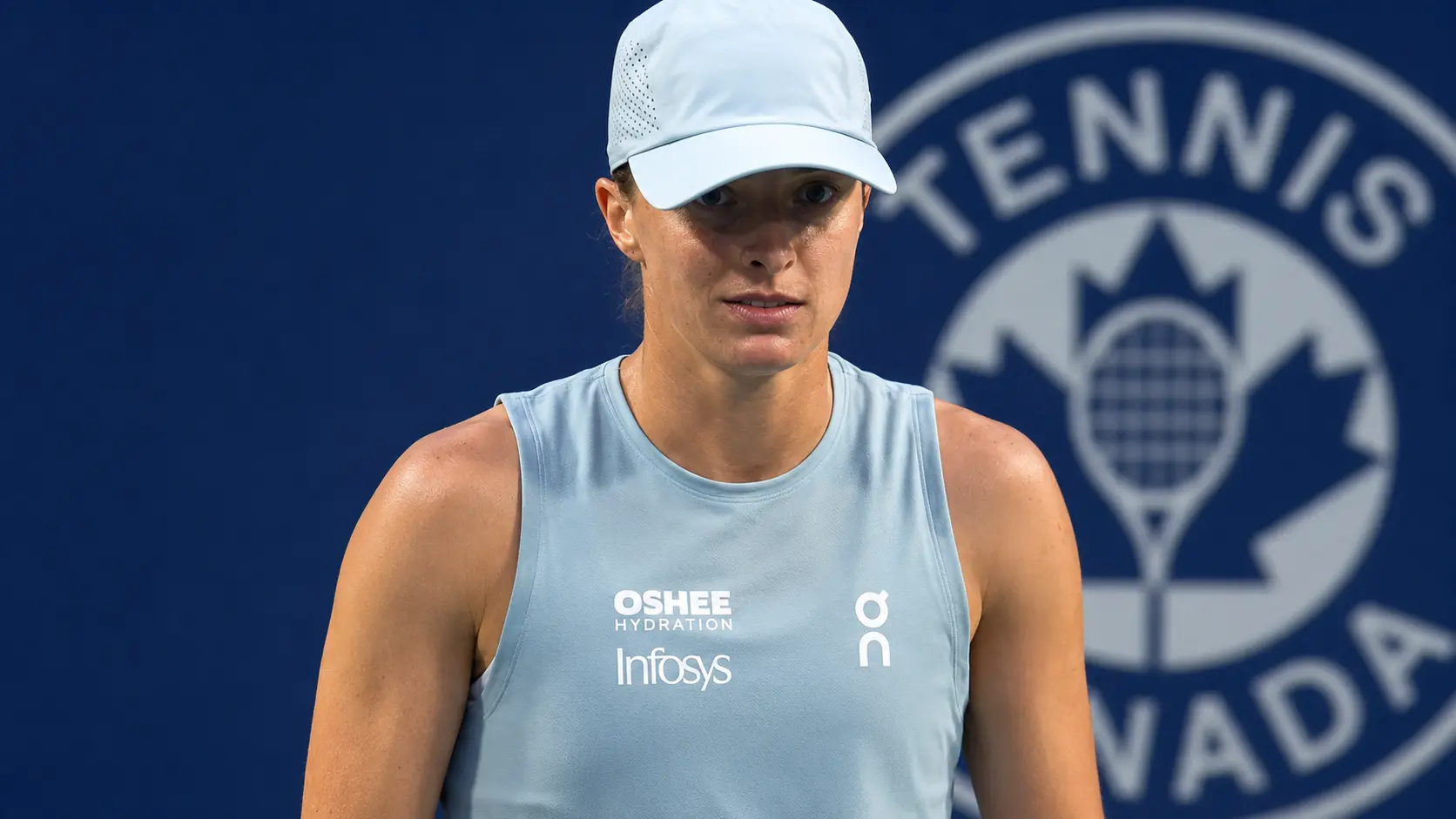
Iga Swiatek arrived in Cincinnati with a title, a reset and a familiar complaint.
Toronto gave her something she had been chasing for weeks: cleaner tennis, calmer decision-making and the feeling that her game was finally responding again. But the moment did not come with much room to enjoy it.
That was the tension in her Cincinnati press conference.
Swiatek sounded encouraged by the work that helped her win in Canada. She also sounded weary of a calendar that keeps asking players to move on before they have even absorbed what they just achieved.
For a player trying to rebuild confidence before the US Open, those two things now sit side by side: the tennis is coming back, but the schedule is still taking more than it gives.
Toronto Gave Swiatek the Reset She Needed
Swiatek did not describe Toronto as an accident.
She linked the title directly to the time she had before it. After Wimbledon, she had a rare chance to pause, reset and work. That mattered because her season had included too many moments when older habits returned under pressure.
“It was great. It was everything I needed,” Swiatek said. “I had time to reset after Wimbledon and returned to the court much fresher and much more open to trying new things. We had about two weeks, and then I arrived in Toronto. The work we did there was key to playing better in that tournament.”
Swiatek did not frame Toronto only as a confidence boost. She framed it as the product of space. Time to train. Time to adjust. Time to breathe between tournaments long enough for changes to stick.
For a player of her level, that is not a luxury. It is often the difference between patching a problem and actually solving it.
Patience Became the Word Behind the Title
Swiatek’s most important explanation was not about power, speed or aggression. It was about patience.
“I was able to find a way to be more patient and more solid. So it paid off,” she said. “I felt that my game was better, especially in practice, than in some matches. Old habits were coming back in some tournaments, so I knew I needed time and a calm period to work.”
That line says plenty about where her head has been.
Swiatek has built a career on intensity, but when that intensity tilts too far, her tennis can become rushed. Toronto appeared to pull her back toward a cleaner rhythm. Fewer panicked patterns. Fewer matches where she looked as if she was trying to solve too much at once.
“Everything was quite clean in Toronto,” she said.
That is the phrase Cincinnati opponents will notice.
When Swiatek’s tennis is clean, the rest of the draw usually feels it.
The Calendar Complaint Has Not Gone Away
The Toronto title did not soften Swiatek’s view of the tour schedule.
If anything, it sharpened the contrast. She had just won a major title-level event, regained energy and found better tennis, but there was almost no time to sit with it before Cincinnati demanded her attention.
“The calendar is intense,” Swiatek said. “I’ve been talking about it for years, and I don’t want to repeat myself. Of course, there’s no time to celebrate. You don’t have time after Grand Slams. It’s intense, but it’s fine.”
That was the professional answer.
Then came the more human one.
“I will find my moment to appreciate what has happened. Because without that, it doesn’t make sense to do it again and seek those moments.”
That is the real headline.
Players spend their lives chasing titles, breakthroughs and hard-earned proof that the work is still worth it. If the calendar becomes so crowded that those moments cannot be enjoyed, the chase starts to feel strangely hollow.
Swiatek is not the first player to say it.
She is one of the few with enough status to keep saying it.
Recovery Comes Before Another Heavy Training Block
Swiatek also made clear that her team will manage the next few days carefully.
She is not treating Cincinnati as a place to overtrain after Toronto. The priority is recovery, then short, precise work to adjust to the courts.
“I have my team around me,” she said. “They know what’s best for me and also watch over me. They know when it’s time to focus more on recovery or training. We’ll take it day by day. Recovery is more important.”
The plan sounds deliberately limited.
“I’ll probably train a maximum of 90 minutes tomorrow, and I need to use every minute of that training to feel the sensations on these courts.”
That is modern WTA life in one quote.
A player wins Toronto, travels to Cincinnati, gets little time to reset, and then has to squeeze court adaptation into a carefully managed window because her body cannot simply be asked for more.
Swiatek may be smiling again, but she is not pretending the schedule is gentle.
Swiatek Wants the Noise Outside Her Process
The other key theme was control.
Not control of the draw, not control of the calendar, not control of public expectation. Swiatek spoke about controlling her own process and refusing to let outside noise define her.
“I think the goal is to focus on growing because it’s simply the world we live in, and it shouldn’t be this way,” she said. “My goal was for that not to interrupt my process or define who I am, to be confident in my decisions, and not let anything disrupt my focus on continuing to grow.”
That sounds like a player trying to protect the quieter parts of a career lived under constant measurement.
Swiatek’s standard is different because of what she has already won. A good season can still be framed as a problem. A title can become a question about the next title. A win can be treated as proof only until the next draw begins.
Her answer in Cincinnati was to stay present.
“Right now, I just want to be present and take advantage of every opportunity and every moment.”
Cincinnati Arrives at the Right and Wrong Time
From a tennis point of view, Cincinnati may be arriving at a perfect moment.
Swiatek has just rediscovered confidence. She is coming off a clean Toronto run. Her patience and solidity have improved. The US Open is close enough for every good match to feel like part of a larger build.
From a human point of view, Cincinnati arrives too quickly.
That is the contradiction Swiatek is living with. The schedule gives her another chance to prove the work is real, but barely gives her time to appreciate the title that showed it in the first place.
That is why her press conference felt more interesting than a simple champion’s update.
Swiatek is not only trying to win again.
She is trying to find a way to keep winning without losing the ability to feel what those wins mean.