
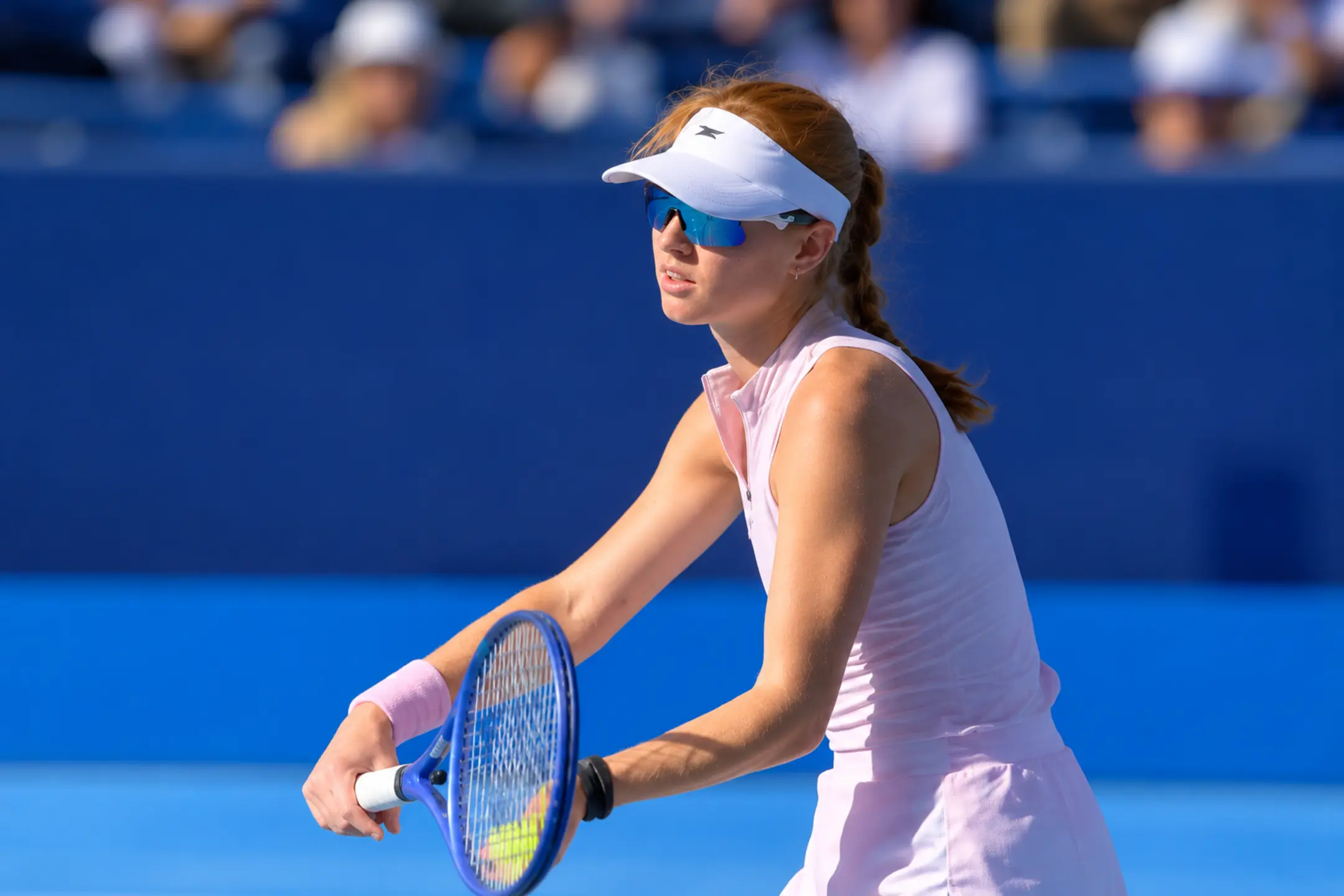
Maya Joint vs. Cristina Bucsa — Pan Pacific Open 2026 Round-of-16 Match Report.
A qualifier against a lucky loser in a WTA 500 quarterfinal? Tokyo has delivered exactly that.
Maya Joint continued her impressive run at the Pan Pacific Open on Wednesday, October 28, defeating Cristina Bucsa 6-1, 2-6, 6-4 to reach the last eight.
The 20-year-old Australian, ranked No. 94, had already eliminated sixth seed Sorana Cirstea in the opening round. But the victory over Bucsa required something different: a recovery from 3-1 down in the deciding set.
Her reward is an unexpected quarterfinal against Kamilla Rakhimova, who produced a Tokyo upset of her own by defeating Ekaterina Alexandrova in a nearly three-hour battle.
And for Joint, there is another incentive. One more victory could send her soaring roughly 20 places in the rankings, potentially into the world’s top 75.
Joint Races Through the Opening Set
Joint started confidently, holding serve before exchanging another pair of games with Bucsa.
At 2-1, the Australian began to take control.
She broke Bucsa for 3-1, consolidated for 4-1 and then broke again to establish a commanding 5-1 advantage.
Bucsa struggled to make an impression on Joint’s service games, while the Australian repeatedly found opportunities on return.
Joint closed out the opener 6-1, having won five consecutive games.
After her convincing victory over Cirstea, it appeared that her excellent form had carried straight into the second round.
But Bucsa had other ideas.
Bucsa Turns the Match Around
The Spaniard responded with an impressive second set.
She held her opening service game before breaking Joint to establish a 2-0 lead.
Another hold made it 3-0, and a second break pushed Bucsa ahead 4-0.
Suddenly, the player who had struggled throughout the opening set was firmly in control.
Joint finally interrupted the run by breaking Bucsa for 4-1, but the recovery was short-lived.
Bucsa held for 5-2 before breaking Joint again to take the second set 6-2.
It was a remarkable reversal. Joint had dominated the opener, only to find herself on the receiving end of an almost identical scoreline.
Everything would now depend on the deciding set.
From 3-1 Down, Joint Finds Another Gear
Bucsa carried her improved form into the third set, holding serve before Joint levelled at 1-1.
The Spaniard moved ahead 2-1 and then struck first on return, breaking Joint for a 3-1 advantage.
With the momentum on Bucsa’s side, Joint needed an immediate response.
She found one.
The Australian broke straight back for 3-2, held to level at 3-3 and then broke Bucsa again to move ahead 4-3.
Another hold brought the score to 5-3.
Joint had won four consecutive games and was suddenly serving for nothing more complicated than a place in the quarterfinals — provided she could finish the job.
Bucsa refused to surrender quietly.
Serving at 3-5, the Spaniard survived a lengthy game and saved match points before holding for 4-5.
Joint still had her chance to serve out the contest.
This time she made no mistake, holding for 6-4 to complete another impressive victory.
Joint’s Second Serve Makes the Difference
The statistics reveal how closely contested the match became after Joint’s dominant opening set.
| Bucsa | Statistic | Joint |
|---|---|---|
| Full Match Duration: 1h52m | ||
| 0.88 | Dominance Ratio | 1.14 |
| 14 | Winners | 22 |
| 7 | Unforced Errors | 3 |
| 216 | Serve Rating | 247 |
| 0 | Aces | 0 |
| 7 | Double Faults | 3 |
| 72% (67/93) | 1st Serve % | 66% (57/87) |
| 58% (39/67) | 1st Serve Points Won | 58% (33/57) |
| 35% (9/26) | 2nd Serve Points Won | 57% (17/30) |
| 69% (11/16) | Break Points Saved | 71% (10/14) |
| 145 | Return Rating | 180 |
| 42% (24/57) | 1st Return Points Won | 42% (28/67) |
| 43% (13/30) | 2nd Return Points Won | 65% (17/26) |
| 4/14 | Break Points Won | 5/16 |
| 85 | Total Points Won | 95 |
The Australian finished with 22 winners against just three recorded unforced errors, while Bucsa produced 14 winners and seven errors.
Neither player struck an ace, but Bucsa committed seven double faults compared with Joint’s three.
Both won 58% of their first-serve points, making the second delivery particularly important.
Joint won 57% of her second-serve points, compared with only 35% for Bucsa.
The Australian also won 65% of the points when returning Bucsa’s second serve, allowing her to maintain pressure even when the Spaniard landed her delivery.
There were plenty of break-point opportunities for both players.
Joint converted five of 16, while Bucsa took four of her 14 chances.
Interestingly, Bucsa had a marginal advantage in pressure points, winning 25 of the 49 played.
But Joint finished with the better overall figures.
Her dominance ratio was 1.14, compared with Bucsa’s 0.88, and she won 95 of the 180 points, leaving the Spaniard with 85.
There was not much separating them. Joint simply produced the stronger finish.
Joint’s Long Road From Seoul to Tokyo
Maya Joint’s route to the quarterfinals has been anything but straightforward.
After reaching the Korea Open final in Seoul, she endured disappointing results in China before travelling to Japan.
She qualified for the Osaka Open, only to lose in the opening round. Then came Tokyo, where she had to negotiate another two qualifying matches.
Victories over Viktorija Golubic and Mai Hontama earned her a place in the main draw.
From there, the Australian defeated world No. 16 Sorana Cirstea 6-3, 7-6(4) before overcoming Bucsa in three sets.
The 20-year-old has certainly earned her place among Tokyo’s final eight.
And now, an even bigger reward could be within reach.
A Qualifier Against a Lucky Loser — With a Top-75 Ranking in Sight
Joint’s next opponent has an equally interesting story.
Kamilla Rakhimova, who now represents Uzbekistan, lost to Aliaksandra Sasnovich in qualifying.
Her tournament appeared to be over, but a lucky-loser place gave her another opportunity.
She made the most of it.
Rakhimova defeated Ekaterina Alexandrova 6-4, 4-6, 7-6(5) in a marathon encounter lasting close to three hours, securing an unlikely quarterfinal appearance.
That sets up a fascinating contest between two players who weren’t originally among Tokyo’s direct main-draw entrants.
For Joint, the stakes extend beyond reaching her next semifinal.
A victory could lift the Australian approximately 20 places in the rankings, potentially taking her into the world’s top 75.
Not bad for someone who began the tournament in qualifying.
And there is an entertaining twist to the quarterfinal.
Maya Joint had to win her way into the main draw. Rakhimova got a second chance after losing. Now one of them is guaranteed a place in a WTA 500 semifinal.