
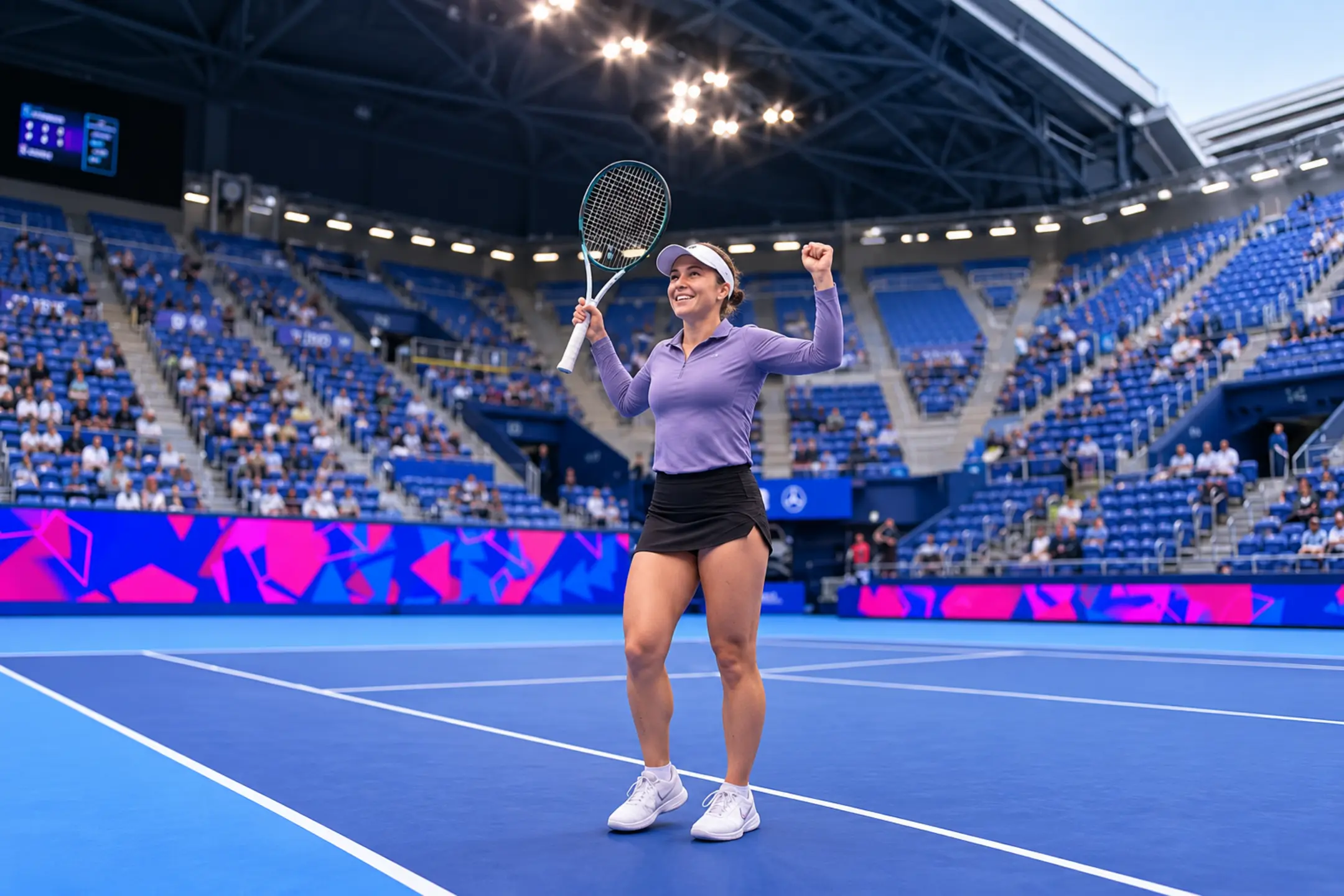
Yulia Putintseva vs. Maria Sakkari — Pan Pacific Open 2026 First-Round Match Report.
Maria Sakkari struck nine more winners than Yulia Putintseva. Unfortunately for the Greek, she also committed 17 more unforced errors. And when the match entered its deciding set, the difference became painfully obvious.
Yulia Putintseva defeated Sakkari 6-4, 3-6, 6-1 in the opening round of the Tokyo Pan Pacific Open, ending the world No. 30’s campaign after two hours and 27 minutes.
The Kazakh qualifier, ranked No. 67, survived an eventful first set, lost her advantage in the second and then completely took over the decider.
It was quite a turnaround for a player who had recently suffered two defeats against Diana Shnaider during the Asian swing.
Sakkari, meanwhile, arrived in Tokyo following an encouraging quarterfinal appearance in Wuhan. But that improvement would not carry her beyond the opening round in Japan.
Putintseva Turns a Difficult Start Into a First-Set Victory
Sakkari began confidently, holding the opening game before breaking Putintseva for a 2-0 lead.
But the Kazakh responded immediately.
She broke back for 2-1, held to level the score and then broke Sakkari again to establish a 3-2 advantage.
The Greek had gone from leading by two games to trailing by one in a matter of minutes.
Putintseva consolidated for 4-2, although Sakkari continued to apply pressure.
At 5-3, the Greek held serve to force her opponent to close out the set.
Putintseva did exactly that, taking the opener 6-4.
It was an important recovery after an uncertain beginning, but there was little to suggest the second set would be any less unpredictable.
Sakkari Fights Back to Force a Decider
The second set opened with another exchange of breaks.
Putintseva struck first to take a 1-0 lead, only for Sakkari to break straight back.
The Greek moved ahead 2-1, but Putintseva levelled at 2-2.
Sakkari then found another opening, holding for 3-2 before breaking the Kazakh to establish a 4-2 advantage.
Putintseva responded with another break of her own, reducing the deficit to 4-3.
But the momentum swung back towards Sakkari.
The Greek broke again for 5-3 and successfully served out the set 6-3.
After splitting the opening two sets, both players had opportunities to claim the match.
Yet the final set would prove surprisingly one-sided.
Four Games Gone Before Sakkari Can Respond
Putintseva started the decider with renewed purpose.
She held her opening service game, broke Sakkari for 2-0 and consolidated for 3-0.
Another break followed.
At 4-0, the Kazakh had established complete control, leaving Sakkari facing an increasingly difficult task.
The Greek did manage one response, breaking Putintseva to reduce the deficit to 4-1.
But the recovery stopped there.
Putintseva immediately broke back for 5-1 before serving out the match 6-1.
After the uncertainty of the second set, she had delivered an emphatic finish.
The Numbers Explain Sakkari’s Frustration
Sakkari’s attacking tennis produced 35 winners, considerably more than Putintseva’s 26.
However, the Greek also committed 39 unforced errors, compared with just 22 for her opponent.
That difference proved costly.
Putintseva was considerably more consistent on serve, landing 74% of her first deliveries against Sakkari’s 66%.
She also won 59% of her first-serve points and 52% behind her second serve, outperforming the Greek in both categories.
Sakkari struggled particularly on her second delivery, winning just 41% of those points.
Putintseva took full advantage, converting seven of her 16 break-point opportunities. Sakkari managed five breaks from 10 chances.
The Kazakh also won 48% of points against Sakkari’s first serve and 59% against her second.
Her dominance ratio of 1.22, compared with Sakkari’s 0.82, reflected that overall advantage.
Putintseva finished with 95 points won against 80, underlining the difference despite the competitive opening two sets.
Sakkari had produced more outright winners. But Putintseva had been far more effective at keeping the ball in play and taking advantage of her opponent’s mistakes.
Full Match Stats Putintseva vs Sakkari
| Putintseva | Statistic | Sakkari |
|---|---|---|
| Full Match Duration: 2h27m | ||
| 1.22 | Dominance Ratio | 0.82 |
| 26 | Winners | 35 |
| 22 | Unforced Errors | 39 |
| 244 | Serve Rating | 200 |
| 1 | Aces | 0 |
| 0 | Double Faults | 5 |
| 74% (61/82) | 1st Serve % | 66% (62/94) |
| 59% (36/61) | 1st Serve Points Won | 52% (32/62) |
| 52% (11/21) | 2nd Serve Points Won | 41% (13/32) |
| 50% (5/10) | Break Points Saved | 56% (9/16) |
| 205 | Return Rating | 181 |
| 48% (30/62) | 1st Return Points Won | 41% (25/61) |
| 59% (19/32) | 2nd Return Points Won | 48% (10/21) |
| 7/16 | Break Points Won | 5/10 |
| 95 | Total Points Won | 80 |
A Different Ending to Their Asian-Swing Stories
Putintseva’s recent weeks have involved plenty of tennis, much of it through qualifying.
In Wuhan, she defeated Ashlyn Krueger and Zeynep Sonmez before losing to Diana Shnaider in the second round.
The same opponent stopped her again in Ningbo, this time 7-5, 7-6(4), after Putintseva had qualified with victories over Yihan Qu and Alycia Parks.
Tokyo presented another qualifying assignment.
The Kazakh defeated Hayu Kinoshita and Sayaka Ishii to reach the main draw, where she made those victories count against Sakkari.
Maria Sakkari had taken a rather different route through the Asian swing.
In Beijing, she defeated Storm Hunter before losing to Elina Svitolina.
Wuhan brought more encouraging results, including victories over Donna Vekic, Marta Kostyuk and Mia Pohankova.
Her quarterfinal against Maja Chwalinska was particularly dramatic. After losing the opening set 6-0, Sakkari fought back to take the second 6-3 before eventually losing 7-5 in the decider.
That run suggested her form was improving.
Yet against Putintseva, the familiar problem of inconsistency resurfaced.
Sakkari had the attacking game to force a third set. She simply could not sustain it.
Putintseva, by contrast, responded to losing the second set by winning six of the next seven games.
And her reward is an especially intriguing one: a second-round meeting with fellow Kazakh Elena Rybakina, who arrives in Tokyo fresh from winning the Ningbo title.
Judging by Putintseva’s delighted reaction, she could hardly be happier about the prospect, although today’s excitement likely has more to do with the bad blood between her and Maria Sakkari in the past.
Facing an in-form Rybakina is hardly the easiest reward for surviving a two-hour-and-27-minute battle.