
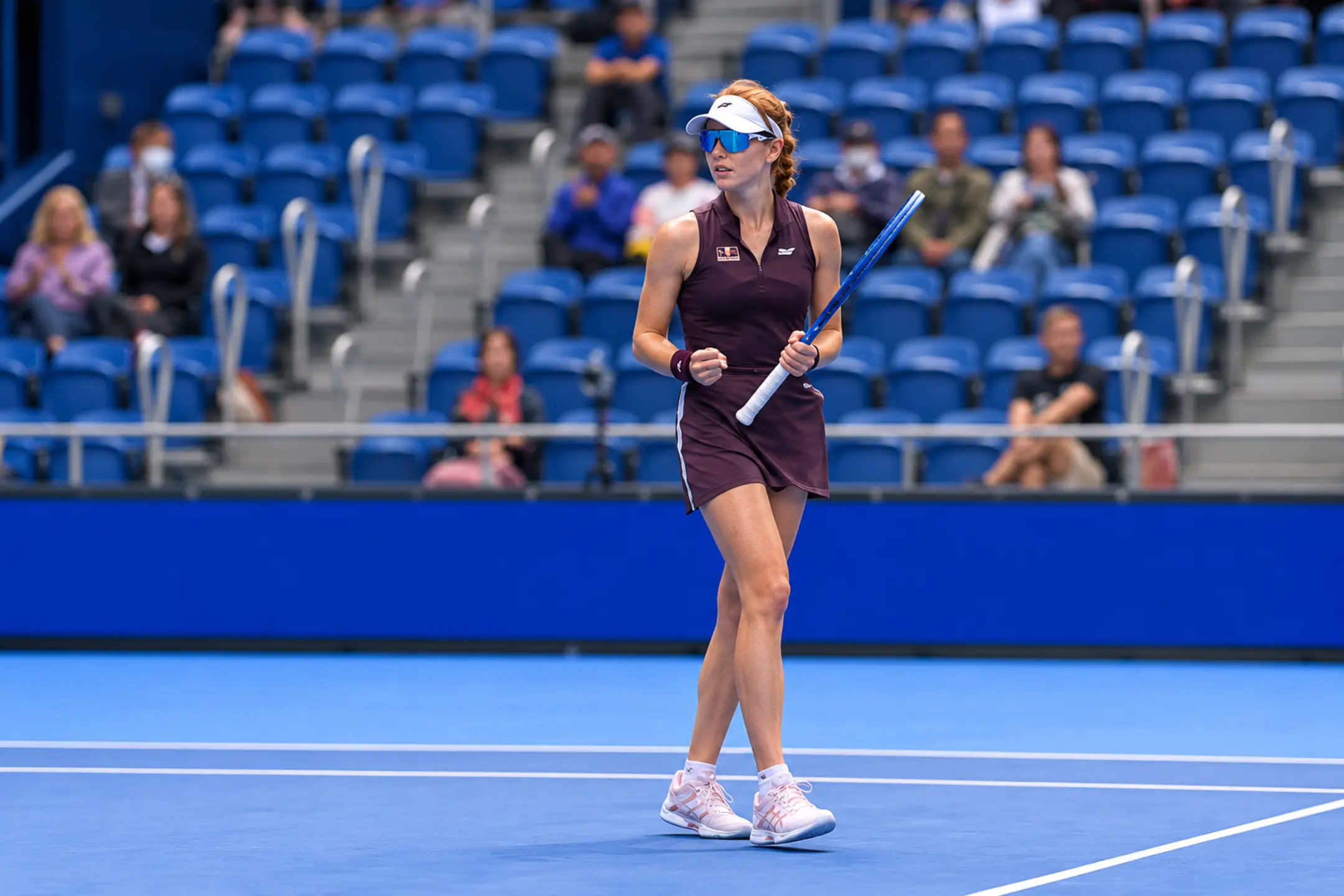
Maya Joint vs. Sorana Cirstea — Pan Pacific Open 2026 First-Round Match Report.
Maya Joint knew the Tokyo courts rather well by the time Sorana Cirstea arrived for her opening match. And that familiarity may have proved rather useful.
The Australian qualifier defeated the sixth-seeded Romanian 6-3, 7-6(4) on Tuesday, October 27, securing an impressive straight-sets victory over the world No. 16.
Joint, ranked No. 94, had already played five matches in Japan, including two victories in Tokyo qualifying. Instead of arriving cold, she entered the main draw with valuable competitive experience on the tournament’s courts.
And against Cirstea, she looked comfortable from the start.
From Seoul Finalist to Tokyo Qualifier
Joint began her Asian swing in excellent form, reaching the Korea Open final in Seoul before losing to compatriot Kimberly Birrell.
China proved less rewarding.
She suffered a narrow three-set defeat against Sinja Kraus in Beijing before losing another deciding set to Mananchaya Sawangkaew in Wuhan qualifying.
Those setbacks brought her to Japan earlier than planned.
At the Osaka Open, Joint defeated Kyoka Okamura and Kayla Day in qualifying before losing to Zeynep Sonmez in the opening round.
She then travelled to Tokyo, where victories over Viktorija Golubic and Mai Hontama secured another place in the main draw.
The Golubic encounter was particularly demanding, lasting two hours and 31 minutes before Joint prevailed 6-7(4), 6-4, 7-5.
By the time she faced Cirstea, Joint had already contested five matches in Japan and, crucially, two on the Tokyo courts.
That preparation appeared to serve her well.
Joint Starts Quickly, but Cirstea Refuses to Disappear
Joint immediately took control of the opening set.
She held serve and broke Cirstea for a 2-0 lead, although the Romanian responded with a break of her own.
The Australian recovered quickly.
After moving ahead 3-2, she broke again for 4-2 and consolidated for 5-2.
Cirstea saved a set point on her next service game, but Joint comfortably served out the opener 6-3.
The second set initially followed an even more convincing pattern.
Joint broke twice to race into a 3-0 lead, putting herself within three games of victory.
But Cirstea was far from finished.
The Romanian fought back with four consecutive games, turning a seemingly hopeless position into a 4-3 advantage.
Suddenly, the sixth seed was threatening to force a deciding set.
Joint steadied herself, however, and the remaining games went with serve.
At 6-6, a tiebreak would settle matters.
The Australian established a 4-2 advantage and eventually reached 6-3, giving herself three match points.
Cirstea saved the first, but Joint converted the second to win the tiebreak 7-4.
The comeback had been impressive. Joint’s response was even more important.
Key Stats: Joint Finds the Better Balance
The statistics revealed a relatively close contest, although Joint held the advantage in several important areas.
The Australian struck 25 winners against 27 unforced errors, compared with Cirstea’s 18 winners and 24 errors.
Joint also landed an impressive 78% of her first serves, considerably more than Cirstea’s 61%.
Both players won similar proportions of points behind their first deliveries, but the Romanian’s second serve proved vulnerable.
Cirstea won just 35% of her second-serve points, allowing Joint to claim 65% of the points when returning those deliveries.
The Australian converted four of eight break points and saved four of the seven she faced.
Her dominance ratio of 1.12, compared with Cirstea’s 0.89, reflected a modest but meaningful advantage.
Joint finished with 74 of the 140 points played, including 13 of the 25 pressure points.
Those figures help explain why she prevailed despite Cirstea’s spirited second-set recovery.
Full Match Stats Joint vs Cirstea
| Joint | Statistic | Cirstea |
|---|---|---|
| Full Match Duration: 1h32m | ||
| 1.12 | Dominance Ratio | 0.89 |
| 25 | Winners | 18 |
| 27 | Unforced Errors | 24 |
| 257 | Serve Rating | 220 |
| 1 | Aces | 2 |
| 1 | Double Faults | 3 |
| 78% (58/74) | 1st Serve % | 61% (40/66) |
| 62% (36/58) | 1st Serve Points Won | 65% (26/40) |
| 44% (7/16) | 2nd Serve Points Won | 35% (9/26) |
| 57% (4/7) | Break Points Saved | 50% (4/8) |
| 190 | Return Rating | 164 |
| 35% (14/40) | 1st Return Points Won | 38% (22/58) |
| 65% (17/26) | 2nd Return Points Won | 56% (9/16) |
| 4/8 | Break Points Won | 3/7 |
| 74 | Total Points Won | 66 |
A Head Start Worth Taking
There is an interesting contrast between Joint’s results in Seoul and those in China.
Reaching the Korean final demonstrated her ability to compete deep into a tournament. The early defeats that followed in Beijing and Wuhan threatened to interrupt that momentum.
But they also meant the Australian reached Japan with time to compete in both Osaka and Tokyo.
Qualifying is rarely a player’s preferred route into a tournament. Yet it can offer something seeded players do not necessarily enjoy: competitive matches on the very courts where the main draw will be played.
Joint had two such opportunities in Tokyo, and she made good use of them.
Against an opponent ranked 78 places above her, she started confidently, survived a strong comeback and finished the match in straight sets.
Sorana Cirstea’s 2026 Tokyo campaign ended after one match.