
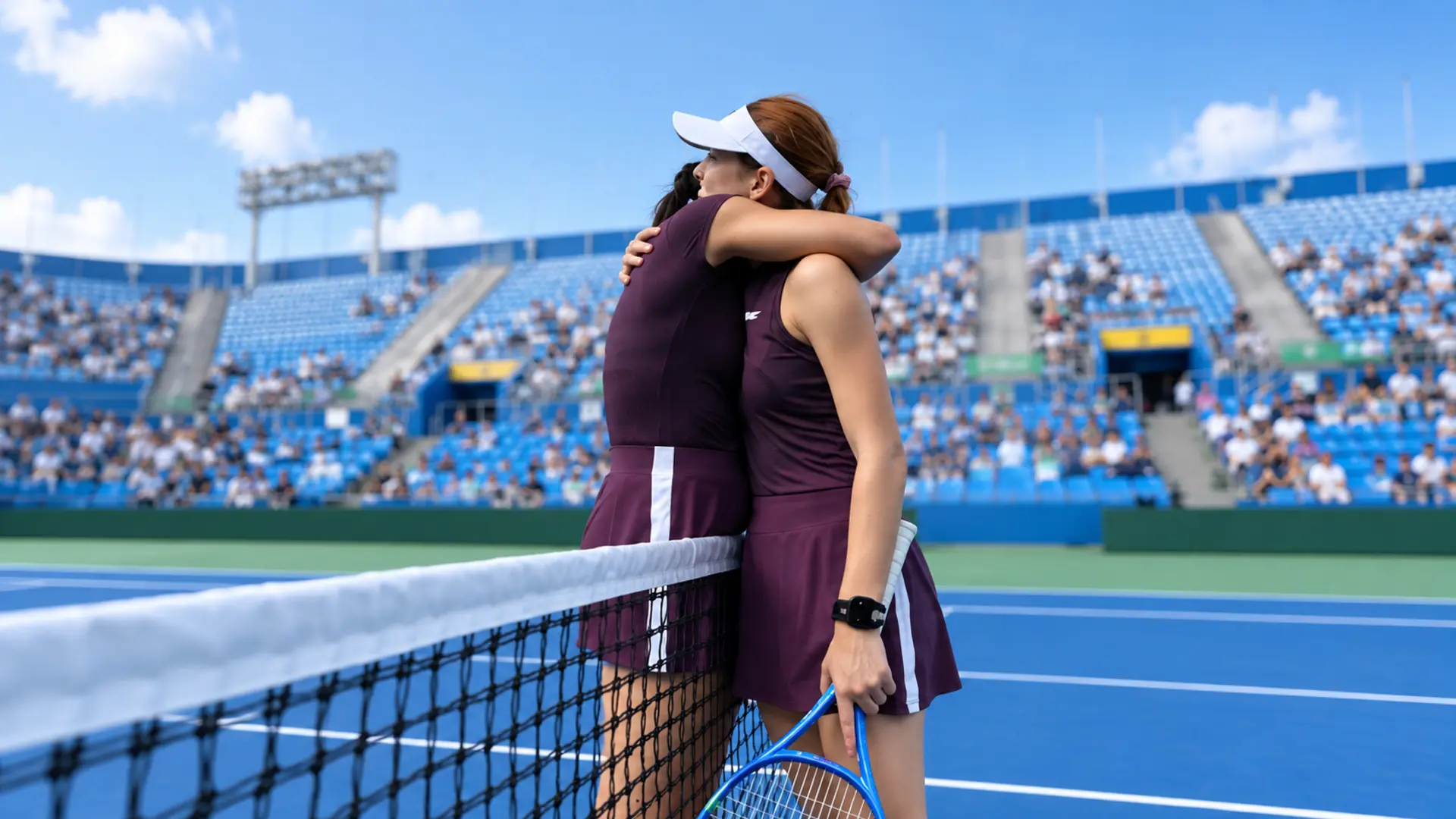
Kimberly Birrell vs. Maya Joint — Korea Open 2026 Final Match Report
Kimberly Birrell had already learned what it felt like to reach a WTA final and leave without the trophy.
Not this time.
At 28, the Australian defeated compatriot Maya Joint 6-4, 6-2 in the all-Australian Korea Open final to claim the biggest singles title of her career and, crucially, her first big WTA Tour title.
Joint actually made the faster start in Seoul. Birrell simply refused to let it become her story.
Joint Leads Early Before Birrell Changes the Match
Joint opened with a hold and immediately put pressure on Birrell, breaking to lead 2-0.
The response came straight away.
Birrell broke back for 2-1 and then held to erase the entire deficit.
From there, the set changed direction.
Joint lost serve again at 2-2, giving Birrell her first lead at 3-2. The 28-year-old consolidated for 4-2 and kept the advantage through the next sequence of holds.
Joint stayed close enough to make Birrell serve it out at 5-4.
Birrell did exactly that, taking the first set 6-4 after recovering from the early break.
She had won six of the final eight games.
Set 1 at a Glance
- Joint hit twice as many winners as Birrell (10 to 5), but she also made twice as many unforced errors (24 to 12), and those errors cost her more than the winners gained.
- The second serve made the difference. Birrell won 69% of the points on Joint’s second serve (9/13), while Joint won only 4 of 13 points behind her own second delivery.
- Joint actually won more of the pressure points (6 of 10). Even so, Birrell converted 2 of her 5 break points and was broken only once, and she took 55% of the total points (34/62).
Full Set 1 Stats
| Joint | Statistic | Birrell |
|---|---|---|
| Set 1 Duration: 0h45m | ||
| 0.73 | Dominance Ratio | 1.37 |
| 10 | Winners | 5 |
| 24 | Unforced Errors | 12 |
| 225 | Serve Rating | 283 |
| 4 | Aces | 0 |
| 3 | Double Faults | 1 |
| 62% (21/34) | 1st Serve % | 71% (20/28) |
| 71% (15/21) | 1st Serve Points Won | 70% (14/20) |
| 31% (4/13) | 2nd Serve Points Won | 63% (5/8) |
| 60% (3/5) | Break Points Saved | 0% (0/1) |
| 188 | Return Rating | 178 |
| 30% (6/20) | 1st Return Points Won | 29% (6/21) |
| 38% (3/8) | 2nd Return Points Won | 69% (9/13) |
| 1/1 | Break Points Won | 2/5 |
| 28 | Total Points Won | 34 |
Birrell Keeps Breaking in the Second Set
The second set immediately became a return battle.
Birrell broke Joint in the opening game, but Joint answered for 1-1.
That was as close as she would get.
Birrell broke again for 2-1, held for 3-1 and then took Joint’s serve once more to open a 4-1 advantage.
Joint recovered one of the breaks for 2-4, only for Birrell to strike again immediately.
Another break made it 5-2.
This time there was no hesitation. Birrell held to finish the match 6-2 and finally had the WTA trophy that had eluded her in previous tour-level finals.
Set 2 at a Glance
- Joint’s first serve stopped working. She won just 1 of 10 first-serve points, and Birrell won 9 of 10 of those points on return.
- Birrell broke in all four of Joint’s service games, converting 4 of 5 break points. Joint held none of her own.
- Joint made 20 unforced errors to Birrell’s 9, and Birrell won 65% of the points (30/46), including 8 of the 12 pressure points.
Full Set 2 Stats
| Joint | Statistic | Birrell |
|---|---|---|
| Set 2 Duration: 0h38m | ||
| 0.58 | Dominance Ratio | 1.73 |
| 4 | Winners | 5 |
| 20 | Unforced Errors | 9 |
| 88 | Serve Rating | 213 |
| 0 | Aces | 0 |
| 2 | Double Faults | 2 |
| 50% (10/20) | 1st Serve % | 62% (16/26) |
| 10% (1/10) | 1st Serve Points Won | 63% (10/16) |
| 30% (3/10) | 2nd Serve Points Won | 40% (4/10) |
| 20% (1/5) | Break Points Saved | 60% (3/5) |
| 188 | Return Rating | 340 |
| 38% (6/16) | 1st Return Points Won | 90% (9/10) |
| 60% (6/10) | 2nd Return Points Won | 70% (7/10) |
| 2/5 | Break Points Won | 4/5 |
| 16 | Total Points Won | 30 |
Forty-Four Errors Leave Joint With Too Much to Repair
The winner count did not explain the result.
Joint actually hit more of them, 14 to 10.
The unforced-error column did.
Joint finished with 44 unforced errors, more than double Birrell’s 21. That gap repeatedly undermined the younger Australian whenever she appeared capable of changing the momentum.
Birrell’s dominance ratio finished at 1.48, compared with 0.68 for Joint.
She won 64 of the 108 points played, giving her 59 percent of the total.
It was control rather than spectacular shot-making that separated them.
Birrell allowed Joint to take the greater risks, defended her own position more efficiently and collected the mistakes that followed.
Birrell Finds the Bigger Serve Without Hitting an Ace
There was another unusual feature in the numbers.
Birrell did not hit a single ace.
She did not need one.
She landed 67 percent of her first serves and won 67 percent of those points. Joint landed only 57 percent and won 52 percent behind the first delivery.
The difference became greater on second serve.
Birrell won 50 percent of those points.
Joint managed just 30 percent.
That weakness gave Birrell repeated opportunities to attack. She created 10 break points and converted six of them, winning 67 percent of Joint’s return games.
Joint broke three times herself, but she spent too much of the afternoon trying to recover ground she had already surrendered.
Full Match Stats Joint vs Birrell
| Joint | Statistic | Birrell |
|---|---|---|
| Full Match Duration: 1h23m | ||
| 0.68 | Dominance Ratio | 1.48 |
| 14 | Winners | 10 |
| 44 | Unforced Errors | 21 |
| 171 | Serve Rating | 248 |
| 4 | Aces | 0 |
| 5 | Double Faults | 3 |
| 57% (31/54) | 1st Serve % | 67% (36/54) |
| 52% (16/31) | 1st Serve Points Won | 67% (24/36) |
| 30% (7/23) | 2nd Serve Points Won | 50% (9/18) |
| 40% (4/10) | Break Points Saved | 50% (3/6) |
| 166 | Return Rating | 245 |
| 33% (12/36) | 1st Return Points Won | 48% (15/31) |
| 50% (9/18) | 2nd Return Points Won | 70% (16/23) |
| 3/6 | Break Points Won | 6/10 |
| 44 | Total Points Won | 64 |
A Long Route to the Trophy
Birrell’s first WTA title means more because the road to it has included plenty of finals at lower levels — and two previous chances on the main tour that ended in defeat.
She reached the Osaka final in 2024 as a qualifier before losing to Suzan Lamens. A year later, Janice Tjen beat her in the Chennai final.
Around those runs were titles on the ITF circuit, including Brisbane, Fukuoka, Cantanhede, Orlando, Playford and Darwin.
| Date | Tournament | Surface | Opponent | Result | Score |
|---|---|---|---|---|---|
| 09/2026 | Seoul | Hard | Maya Joint | W | 6-4, 6-2 |
| 10/2025 | Chennai | Hard | Janice Tjen | L | 4-6, 3-6 |
| 02/2025 | W75 Brisbane | Hard | Maddison Inglis | W | 6-2, 4-6, 7-6(2) |
| 10/2024 | Osaka | Hard | Suzan Lamens | L | 0-6, 4-6 |
| 05/2024 | W75 Fukuoka | Carpet | Emina Bektas | W | 6-2, 6-4 |
| 07/2023 | W25 Cantanhede | Carpet | Arina Rodionova | W | 4-6, 6-3, 6-1 |
| 02/2023 | W60 Orlando | Hard | Rebecca Peterson | W | 6-3, 6-0 |
| 10/2022 | W60 Playford | Hard | Maddison Inglis | W | 3-6, 7-5, 6-4 |
| 10/2022 | W25 Cairns | Hard | Priscilla Hon | L | 6-4, 6-7(6), 4-6 |
| 07/2022 | W25+H Figueira da Foz | Hard | Jamie Loeb | L | 5-7, 4-6 |
| 09/2018 | Darwin $60K | Hard | Ellen Perez | W | 6-3, 6-3 |
Seoul is the one that changes the scale.
Seoul Finally Changes the Label
There is a substantial difference between being a player who has reached WTA finals and being a WTA champion.
Birrell knows that better than most.
She had already built a long professional career, won titles beneath tour level and twice reached WTA finals without getting across the line.
At 28, the breakthrough has therefore arrived later than it does for many first-time champions.
That hardly makes it smaller.
If anything, the years behind it give the moment more weight.
Joint may have entered this all-Australian final as part of the country’s younger wave, but Seoul belonged to the player who had waited longer.
Kimberly Birrell no longer has to chase her first WTA title.
She now has a big one.