
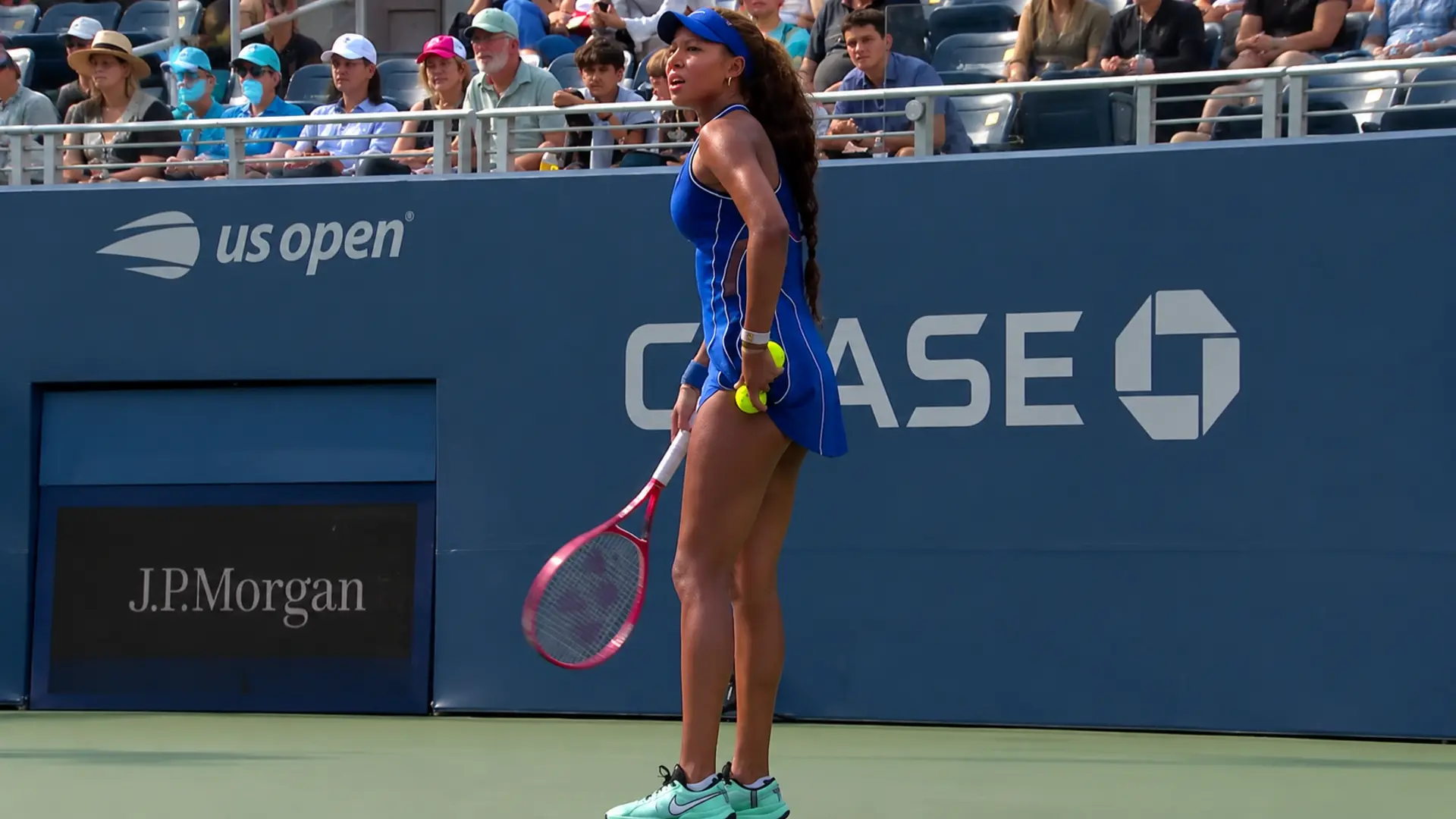
Thea Frodin vs. Elena Rybakina — US Open 2026 First-Round Match Report
Elena Rybakina was supposed to be the story.
Coming off the injury that ended her Cincinnati run, the virtual World No. 1 needed to show that the ankle would withstand a Grand Slam match. She did exactly that, beating 17-year-old American wildcard Thea Frodin 6-3, 6-2 without dropping serve and without showing an obvious restriction in her movement.
But New York may remember something else from this match too.
Frodin, ranked No. 585, walked onto a major court against one of the most powerful players in women’s tennis and did not shrink from it. She struck 11 aces, hit with genuine weight and, astonishingly, produced five aces in her final service game alone while trying to stay in the match.
The score says routine Rybakina.
Frodin’s tennis and smile said: remember my name.
Frodin Stays With Rybakina Until One Break Changes the Set
The opening exchanges offered little sign that Rybakina was going to run away with it.
Rybakina held, Frodin answered, and they moved together through 2-2 and 3-2.
For a 17-year-old facing this level of opponent, there was plenty to like. The first serve already carried serious pace, and Frodin was prepared to trade hard from the baseline rather than retreat into survival mode.
The first separation came with Frodin serving at 2-3.
Rybakina broke for 4-2, then held for 5-2.
Frodin kept the set alive at 5-3, but Rybakina closed it on serve for 6-3.
One break had been enough.
Frodin had shown that she could live with the pace. Rybakina had shown why living with it and actually taking a set from her are very different jobs.
Set 1 at a Glance
- Rybakina won 20 of 23 service points, well ahead of Frodin’s 14 of 24.
- Rybakina won her service games at a perfect 5 of 5, while Frodin managed 3 of 4.
- Rybakina won 30 of 47 total points, committing far fewer unforced errors, 4 to Frodin’s 11.
Full Set 1 Stats
| Frodin | Statistic | Rybakina |
|---|---|---|
| Set 1 Duration: 0h33m | ||
| 0.31 | Dominance Ratio | 3.19 |
| 6 | Winners | 6 |
| 11 | Unforced Errors | 4 |
| 242 | Serve Rating | 329 |
| 3 | Aces | 4 |
| 2 | Double Faults | 1 |
| 46% (11/24) | 1st Serve % | 52% (12/23) |
| 82% (9/11) | 1st Serve Points Won | 92% (11/12) |
| 38% (5/13) | 2nd Serve Points Won | 82% (9/11) |
| 0% (0/1) | Break Points Saved | – (0/0) |
| 26 | Return Rating | 205 |
| 8% (1/12) | 1st Return Points Won | 18% (2/11) |
| 18% (2/11) | 2nd Return Points Won | 62% (8/13) |
| – (0/0) | Break Points Won | 1/1 |
| 17 | Total Points Won | 30 |
Rybakina Takes Away the Second Set Early
The second set became much more difficult for the teenager almost immediately.
Rybakina broke in the opening game and held for 2-0. Frodin got herself on the board for 2-1, but another stretch of controlled tennis from the Kazakh pushed the lead to 3-1.
Then came the second break.
Rybakina moved ahead 4-1 and held for 5-1, leaving Frodin serving to remain in her first US Open main-draw match.
What followed was probably the most memorable game she played.
Match points came and went. Frodin kept swinging.
And serving.
She produced five aces in that one game, somehow finding her biggest weapon when elimination was directly in front of her. She eventually held for 5-2.
Rybakina ended the resistance in the next game, serving out the match 6-2.
The teenager had delayed the inevitable.
She had also given everyone watching one final demonstration of why her name may not remain unfamiliar for very long.
Set 2 at a Glance
- Rybakina won her service games at a perfect 4 of 4, while Frodin managed 2 of 4.
- Rybakina won her return games 2 of 4, while Frodin failed to win any (0 of 4).
- Rybakina won 36 of 64 total points, despite Frodin hitting 8 aces to Rybakina’s 2.
Full Set 2 Stats
| Frodin | Statistic | Rybakina |
|---|---|---|
| Set 2 Duration: 0h44m | ||
| 0.73 | Dominance Ratio | 1.37 |
| 13 | Winners | 11 |
| 10 | Unforced Errors | 7 |
| 207 | Serve Rating | 289 |
| 8 | Aces | 2 |
| 4 | Double Faults | 2 |
| 42% (14/33) | 1st Serve % | 58% (18/31) |
| 79% (11/14) | 1st Serve Points Won | 67% (12/18) |
| 32% (6/19) | 2nd Serve Points Won | 64% (9/14) |
| 60% (3/5) | Break Points Saved | 100% (2/2) |
| 69 | Return Rating | 179 |
| 33% (6/18) | 1st Return Points Won | 21% (3/14) |
| 36% (5/14) | 2nd Return Points Won | 68% (13/19) |
| 0/2 | Break Points Won | 2/5 |
| 28 | Total Points Won | 36 |
Eleven Aces Offer a Glimpse of What Frodin Could Become
The full-match numbers make Frodin’s performance more interesting than six games won might suggest.
She finished with 11 aces, nearly twice Rybakina’s six, and struck 19 winners to the Kazakh’s 17.
The raw ingredients are obvious.
Frodin’s first serve averaged 181 km/h, actually faster than Rybakina’s 178 km/h, and she won 80 percent of the points when that first delivery landed.
The problem was getting enough of them in.
Only 44 percent of Frodin’s first serves found the box. Behind the second serve, Rybakina attacked relentlessly: the teenager won only 34 percent of those points.
There were also the inevitable signs of inexperience. Frodin committed 21 unforced errors and six double faults, and some of the shot selection still looked like that of a player discovering when her considerable power needs to be used and when a rally requires a safer ball.
Rybakina gave her very little time to learn those lessons.
She won 66 of the 111 points, saved both break points she faced and converted three of her six opportunities.
The dominance ratio finished at 1.76 to 0.57.
The established player won comfortably.
The teenager still left plenty behind to think about.
Rybakina’s Ankle Passes Its First New York Test
There was another important question running underneath the match.
How healthy was Rybakina?
Her Cincinnati tournament had ended with an injury, creating an immediate concern over what shape she would be in for the US Open.
On the evidence of this match, there was little obvious cause for alarm.
Rybakina served with conviction, struck six aces, pushed off the left foot without visible hesitation and moved around the court freely enough to handle Frodin’s heavier exchanges. There was no obvious sign during the match that the ankle was restricting either her serving action or her court coverage.
Her concentration was equally encouraging.
Rybakina never allowed the match to drift. Even when Frodin produced flashes of the power that could have made individual games awkward, the No. 2 seed remained intent on finishing the job in two sets.
For a player arriving in New York after an injury scare, that was about as useful an opening round as she could have asked for.
Rybakina Moves On, but Frodin Leaves Something Behind
Rybakina will next face Dominika Vidmanova or Jessica Bouzas Maneiro.
She moves forward with the result she wanted and, perhaps more importantly, with her body having passed its first competitive examination since Cincinnati.
Frodin goes home from the singles draw.
But imagine the assignment from her side.
Seventeen years old. Ranked No. 585. A wildcard into the US Open. Across the net stands a player effectively knocking on the door of World No. 1.
And in the final service game of your tournament, with match points arriving, you respond by firing five aces.
There is power there.
Heavy hitting.
There are also decisions that only more matches at this level can teach.
Give her that time.
Martina Navratilova agreed.
Years from now, this may be remembered less as the night Rybakina won her first match of the 2026 US Open than as one of the first times a much wider tennis audience saw Thea Frodin on a big court.
We are likely to hear the name again.