
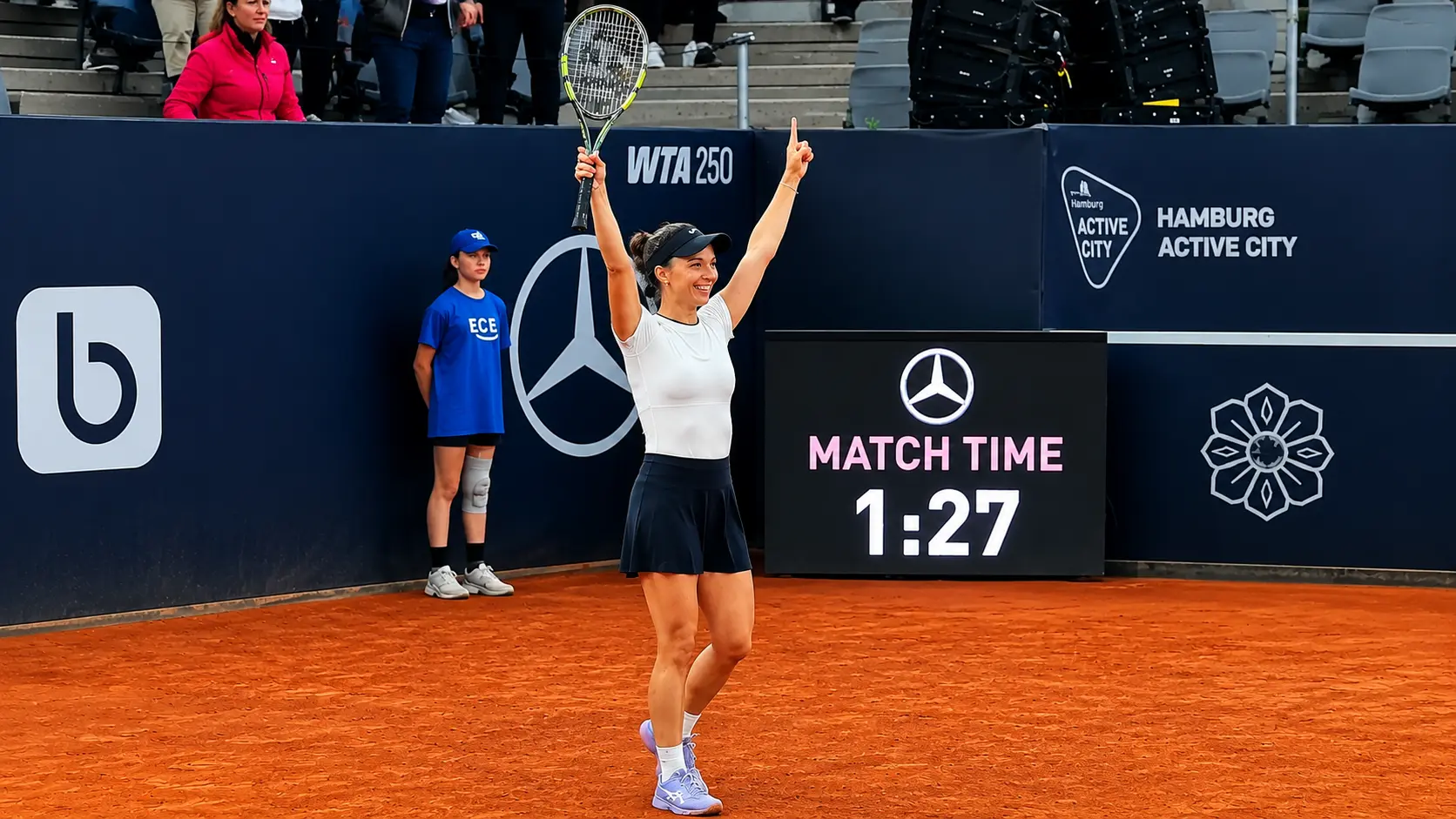
Tamara Korpatsch did not only win a WTA title in Hamburg.
She gave the tournament back a German champion.
The 31-year-old, born in Hamburg and shaped by the clay-court habits of a player who knows how to suffer through long rallies, beat Anna Bondar 6-3, 6-3 in the Hamburg Open 2026 final. It was her second career WTA singles title, but this one landed in a different emotional register.
A German had not won the women’s title at the Rothenbaum since Steffi Graf in 1992.
That is 34 years of waiting.
Korpatsch ended it with a performance that was not loud, not flashy, and not built on easy sentiment. She broke early, absorbed Bondar’s one real comeback push, then took control again with the kind of patient, varied clay-court tennis that suits Hamburg more than any speech could.
The trophy stayed home.
And for Korpatsch, it could hardly have been more personal.
Korpatsch Starts Like She Knows the Moment
The first set began with a jolt.
Bondar served first and was broken immediately to love. Korpatsch then held a difficult game for 2-0 and broke again for 3-0. Within minutes, the final had already moved away from the Hungarian and toward the home player.
That start set the emotional setting.
Korpatsch was not just trying to win a WTA 250 final. She was playing in her home city, in front of a German crowd, with a piece of tournament history waiting if she could keep her nerve.
For a while, she looked completely settled.
Bondar stopped the opening run with a love hold for 1-3, then began to edge her way into the match. At 2-4, she saved a break point. At 3-4, she broke back after Korpatsch’s first real loose patch.
That was the one moment when the final could have changed shape.
Korpatsch made sure it did not.
The Break Back Kills Bondar’s Best Chance
After Bondar pulled the set back to 3-4, Korpatsch had to answer quickly.
She did.
The German broke straight back for 5-3, then took the set 6-3 with a love break. It was a ruthless little sequence: lose the cushion, win it straight back, then close the door before the crowd could get nervous.
Bondar had worked hard to get close.
Korpatsch punished the effort.
That is where the final began to look like a contest of control. Bondar could produce strong passages, but Korpatsch kept finding the cleaner path out of them.
Bondar vs Korpatsch – Set 1 Key Stats
| Statistic | Bondar | Korpatsch |
|---|---|---|
| Dominance Ratio | 0.70 | 1.44 |
| Winners | 11 | 10 |
| Unforced Errors | 6 | 5 |
| Serve Rating | 218 | 303 |
| Aces | 0 | 2 |
| Double Faults | 0 | 0 |
| 1st Serve % | 69% (18/26) | 89% (25/28) |
| 1st Serve Points Won | 61% (11/18) | 72% (18/25) |
| 2nd Serve Points Won | 38% (3/8) | 60% (3/5) |
| Break Points Saved | 33% (1/3) | 50% (1/2) |
| Service Games | 50% (2/4) | 80% (4/5) |
| Ace % | 0% | 7.1% |
| Double Fault % | 0% | 0% |
| Return Rating | 138 | 219 |
| 1st Return Points Won | 28% (7/25) | 39% (7/18) |
| 2nd Return Points Won | 40% (2/5) | 63% (5/8) |
| Break Points Won | 50% (1/2) | 67% (2/3) |
| Return Games | 20% (1/5) | 50% (2/4) |
| Pressure Points | 38% (3/8) | 63% (5/8) |
| Service Points | 54% (14/26) | 68% (19/28) |
| Return Points | 32% (9/28) | 46% (12/26) |
| Total Points | 43% (23/54) | 57% (31/54) |
| Set Duration | 0h41m | |
Bondar Breaks First in the Second, but Korpatsch Refuses the Twist
The second set briefly offered Bondar another opening.
After holding for 1-0, she broke for 2-1. It was her chance to force the final into a more complicated place. If she could consolidate, the pressure would swing back toward Korpatsch.
Instead, the German broke back immediately for 2-2.
That game changed the set.
Korpatsch held for 3-2, then started to move Bondar around with more authority. The rallies became more German than Hungarian in feel: more patient, more angled, more shaped by Korpatsch’s ability to make Bondar hit from less comfortable positions.
At 3-3, Korpatsch held. At 4-3, she broke again. At 5-3, she served for the title and converted her first match point.
No late drama.
No final wobble.
Just a clean finish to a week that had not always been simple.
Bondar vs Korpatsch – Set 2 Key Stats
| Statistic | Bondar | Korpatsch |
|---|---|---|
| Dominance Ratio | 0.76 | 1.31 |
| Winners | 9 | 11 |
| Unforced Errors | 5 | 8 |
| Serve Rating | 235 | 293 |
| Aces | 0 | 0 |
| Double Faults | 0 | 1 |
| 1st Serve % | 66% (21/32) | 63% (17/27) |
| 1st Serve Points Won | 67% (14/21) | 71% (12/17) |
| 2nd Serve Points Won | 42% (5/12) | 60% (6/10) |
| Break Points Saved | 50% (2/4) | 100% (1/1) |
| Service Games | 60% (3/5) | 100% (4/4) |
| Ace % | 0% | 0% |
| Double Fault % | 0% | 3.7% |
| Return Rating | 69 | 181 |
| 1st Return Points Won | 29% (5/17) | 33% (7/21) |
| 2nd Return Points Won | 40% (4/10) | 58% (7/12) |
| Break Points Won | 0% (0/1) | 50% (2/4) |
| Return Games | 0% (0/4) | 40% (2/5) |
| Pressure Points | 44% (4/9) | 56% (5/9) |
| Service Points | 56% (18/32) | 67% (18/27) |
| Return Points | 33% (9/27) | 44% (14/32) |
| Total Points | 46% (27/59) | 54% (32/59) |
| Set 2 Duration | 0h48m | |
Korpatsch’s Route Was Messy, Useful and Very Hamburg
Korpatsch’s title run had enough turbulence to make the final feel earned rather than gifted.
She opened with a 4-6, 7-5, 1-0 retirement win over Victoria Jimenez Kasintseva, then survived a strange three-set match against German wild card Julia Stusek. In the quarter-finals, she beat second seed Anhelina Kalinina 6-3, 1-6, 6-1, a result that gave her run real weight.
The semi-final was shorter, with Mayar Sherif retiring while Korpatsch led 6-1, 2-0.
Then came the final.
| Round | Result | Score |
|---|---|---|
| SF | (5) Korpatsch d. Mayar Sherif [EGY] | 6-1, 2-0 RET |
| QF | (5) Korpatsch d. (2) Anhelina Kalinina [UKR] | 6-3, 1-6, 6-1 |
| R16 | (5) Korpatsch d. (WC) Julia Stusek [GER] | 6-0, 3-6, 6-3 |
| R32 | (5) Korpatsch d. Victoria Jimenez Kasintseva [AND] | 4-6, 7-5, 1-0 RET |
This was not a week of smooth scorelines from start to finish.
It was a week of recovery, adjustment and clay-court persistence. In that sense, it fitted Korpatsch perfectly.
Bondar’s Run Was Stronger Than the Final Looked
Bondar’s final defeat should not flatten her week.
The Hungarian had already done plenty to reach the title match. She beat Moyuka Uchijima in straight sets, fought through Noma Noha Akugue in three, handled Alina Charaeva in the quarter-finals, then survived a three-hour, 29-minute semi-final against qualifier Elina Avanesyan.
That semi-final was a serious test.
Bondar saved 13 of 19 break points and came through 7-6(3), 4-6, 7-6(2). It was the kind of match that can lift a player into a final but also leave a mark in the legs.
| Round | Result | Score |
|---|---|---|
| SF | (4) Bondar d. (Q) Elina Avanesyan [ARM] | 7-6(3), 4-6, 7-6(2) |
| QF | (4) Bondar d. Alina Charaeva [RUS] | 6-1, 7-6(3) |
| R16 | (4) Bondar d. Noma Noha Akugue [GER] | 6-1, 3-6, 7-5 |
| R32 | (4) Bondar d. Moyuka Uchijima [JPN] | 7-5, 6-4 |
Bondar, born in Szeghalom, Hungary, has built much of her profile through patience and smaller-stage success. She has been a WTA 125 champion in singles and a WTA doubles title winner, but a tour-level singles trophy still remains just out of reach.
Hamburg gave her another final.
Korpatsch made sure it did not give her the title.
The Match Stats Show Korpatsch’s Control
The final was not decided by a huge gap in winners.
Korpatsch hit 21. Bondar hit 20. The error count was also low on both sides, with Korpatsch making 13 unforced errors and Bondar 11.
The difference came in the shape of the points.
Korpatsch served better, returned better and protected her service games far more often. She won 63 of the 113 total points and posted a dominance ratio of 1.37 to Bondar’s 0.73.
| Statistic | Bondar | Korpatsch |
|---|---|---|
| Dominance Ratio | 0.73 | 1.37 |
| Winners | 20 | 21 |
| Unforced Errors | 11 | 13 |
| Serve Rating | 225 | 287 |
| Aces | 0 | 2 |
| Double Faults | 0 | 1 |
| 1st Serve % | 66% (38/58) | 76% (42/55) |
| 1st Serve Points Won | 63% (24/38) | 71% (30/42) |
| 2nd Serve Points Won | 40% (8/20) | 54% (7/13) |
| Break Points Saved | 43% (3/7) | 67% (2/3) |
| Service Games | 56% (5/9) | 89% (8/9) |
| Ace % | 0% | 3.6% |
| Double Fault % | 0% | 1.8% |
| Return Rating | 119 | 198 |
| 1st Return Points Won | 29% (12/42) | 37% (14/38) |
| 2nd Return Points Won | 46% (6/13) | 60% (12/20) |
| Break Points Won | 33% (1/3) | 57% (4/7) |
| Return Games | 11% (1/9) | 44% (4/9) |
| Pressure Points | 40% (4/10) | 60% (6/10) |
| Service Points | 55% (32/58) | 67% (37/55) |
| Return Points | 33% (18/55) | 45% (26/58) |
| Total Points | 44% (50/113) | 56% (63/113) |
| Match Duration | 1h28m |
Korpatsch won 71 percent of her first-serve points and held eight of her nine service games. Bondar held only five of nine. That gap explains the scoreline better than the winners column.
The German also converted four of seven break points, while Bondar converted one of three.
In a final played on clay, that was the difference between pushing and controlling.
A Family Title in Every Sense
After the match, Korpatsch made the moment even more personal.
Her first thanks went to her family, and the details were not decorative. Her father has coached her since she started playing tennis. Her mother travels with her on tour and looks after her dog, Stella.
“My father is my coach, since I started playing tennis,” Korpatsch said. “He is there for every match, he is always on court with me. My mother travels with me on tour and looks after my dog Stella.”
Then she turned the moment toward the crowd.
“I did not win this title alone,” she said.
That line landed because it felt true.
This was not a neutral title in a neutral city. It was a Hamburg-born player winning in Hamburg, with family woven into the story and a 34-year German wait ending in front of the people who understood what it meant.
Hamburg Gets Its German Champion at Last
Steffi Graf was the last German woman to win Hamburg in 1992.
Since then, German players had come close and fallen short in finals. Korpatsch ended that line with a straight-sets win that was more controlled than spectacular and more emotional than the score suggested.
It also says something about late-career rewards.
Korpatsch is 31, not a teenager being rushed into a hype cycle. She is a player who has lived through the less glamorous parts of the tour, built a career, won her first WTA title in Cluj-Napoca in 2023, and now added something much more rooted to her story.
A second WTA title.
A home title.
A Hamburg title.
That is a rare combination.