
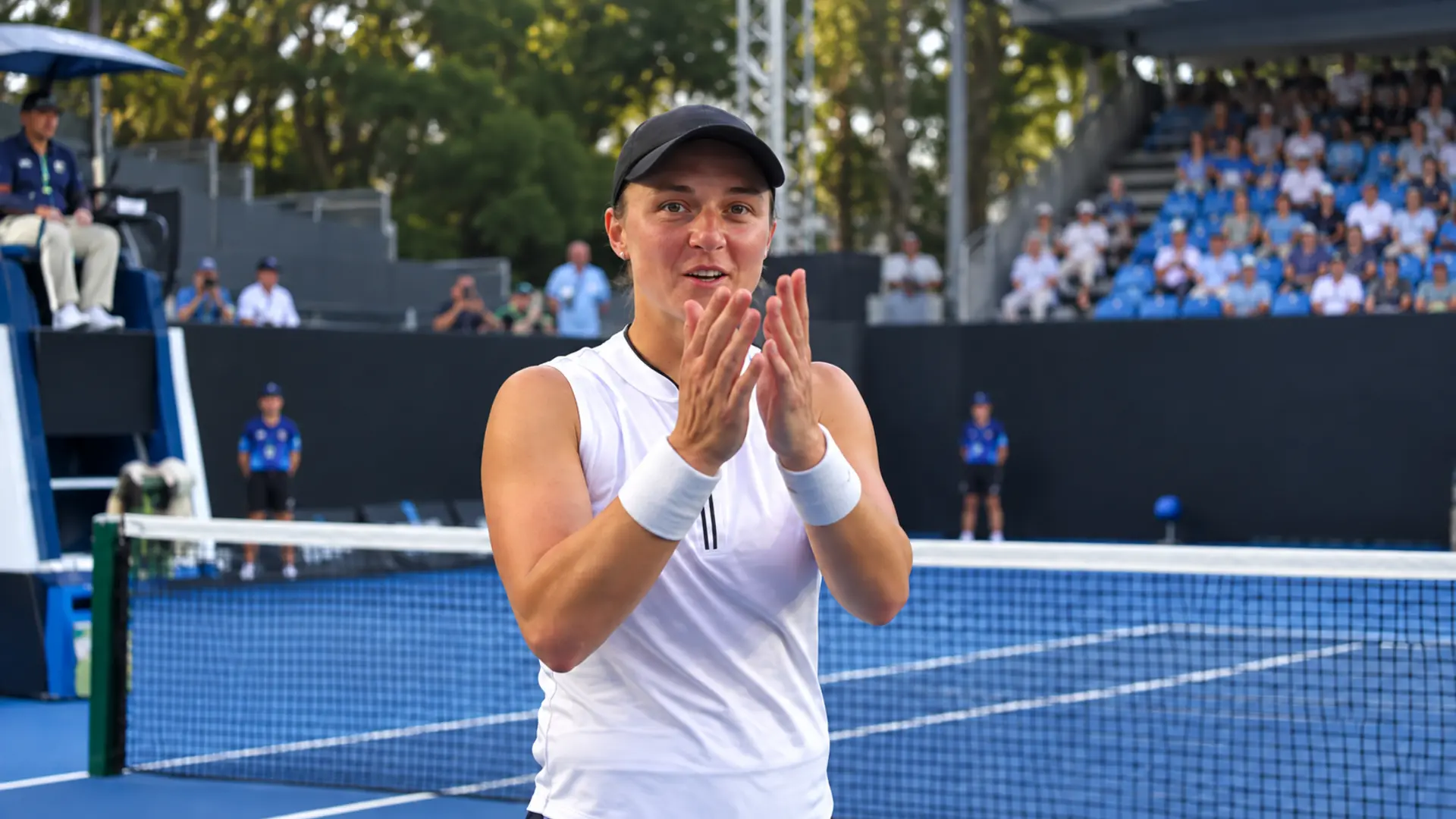
The São Paulo Open started the weekend with three seeded players still standing and Paula Badosa carrying the biggest name in the draw.
By Saturday evening, none of that mattered.
No. 7 seed Kaitlin Quevedo first survived Anna Blinkova in a three-set semifinal that could hardly have been closer. Then unseeded Nadia Podoroska (as pictured) removed No. 2 seed Badosa to complete a final nobody would have predicted when the tournament began.
So Sunday’s championship match will be Quevedo against Podoroska.
One is a 20-year-old Spaniard trying to turn an already breakthrough week into something much bigger.
The other is the lone unseeded player who reached the semifinals and has now gone one step further.
Between them stands one trophy.
And São Paulo is guaranteed a second champion very different from its first after Tiantsoa Rakotomanga Rajaonah won the inaugural edition in 2025.
Quevedo and Blinkova Produce a Semifinal With Almost Nothing Between Them
Quevedo’s 6-4, 2-6, 6-4 victory over Blinkova took 2 hours 23 minutes, and the statistics explain just how little separated them.
They finished with exactly the same number of points.
Quevedo 97. Blinkova 97.
Their dominance ratios were almost identical too: 0.99 for Quevedo and 1.01 for Blinkova.
Both won 10 of their 14 service games. Both broke four times.
Blinkova even held the statistical edge in several areas. She landed 66 percent of first serves compared with Quevedo’s 53 percent, won 68 percent of first-serve points and saved nine of the 13 break points she faced.
Quevedo, though, found more success when the first serve disappeared.
She won 47 percent of second-serve points, compared with Blinkova’s 38 percent, and attacked the Russian’s second delivery particularly well, taking 20 of 32 return points behind it.
In a match this even, those margins mattered.
Quevedo had also needed to overcome seven double faults, compared with only two from Blinkova. Yet she remained composed enough to take the deciding set 6-4 and close out the biggest opportunity of her week.
There was no statistical domination here.
Just one player finding two more games when she needed them.
Quevedo’s São Paulo Run Has Kept Growing
Quevedo’s path through the draw has already contained several different kinds of tests.
Her first-round situation changed after the withdrawal chaos surrounding Leylah Fernandez and Whitney Osuigwe, with lucky loser Alevtina Tikhonova ultimately appearing opposite her.
Quevedo dismissed her 6-0, 6-2.
Brazilian wildcard Nauhany Vitoria Leme Da Silva came next, and Quevedo won 6-2, 6-1.
The quarterfinal brought Teodora Kostovic, who had reached that stage without losing a set. Quevedo won again, 6-3, 6-4.
Blinkova was different.
The No. 4 seed had looked one of the strongest players in the tournament and had not dropped a set before the semifinal. She had beaten Claire Liu, Vendula Valdmannova and Alina Charaeva on her way through.
Quevedo finally forced her into a third.
Then she beat her there.
The Spaniard entered São Paulo as the No. 7 seed. She will leave with either the runner-up trophy or the biggest title of her week.
Podoroska Knocks Out the Biggest Name Left
The other semifinal carried an entirely different dynamic.
Badosa was the No. 2 seed and, after Fernandez’s pre-tournament withdrawal, the obvious star attraction left in the draw.
Podoroska had no seeding at all.
Yet the Argentine was the stronger player across their 1 hour 28 minute semifinal.
The numbers are clear.
Podoroska won 70 of 129 points, compared with Badosa’s 59, and finished with a 1.19 dominance ratio against Badosa’s 0.84.
The return battle was particularly important.
Podoroska won 44 percent of points against Badosa’s first serve and 66 percent against the second. She converted six of 11 break points, while Badosa managed three from seven.
Neither woman produced a particularly clean serving performance.
Podoroska committed nine double faults.
Badosa made eight.
But Podoroska repeatedly recovered from her own serving problems by doing more damage on return making her backhand work hard. Her return rating finished at 225, well ahead of Badosa’s 172.
Against the biggest remaining name in the tournament, the unseeded player simply created more pressure and mixed things up with plenty of variety. In the end, Paula Badosa had to capitulate.
Podoroska Has Been the Draw’s Persistent Disruptor
Podoroska’s run did not suddenly begin against Badosa.
She had already spent the week dismantling the expected order.
Lucrezia Stefanini went first, 6-3, 6-4.
Then came No. 5 seed Eva Lys, whom Podoroska beat 7-5, 6-2.
Suzan Lamens pushed her considerably harder in the quarterfinals, but Podoroska survived 7-6(5), 3-6, 6-3.
By the time she reached Badosa, she was the only unseeded player among the final four.
Podoroska now gets the chance to finish the week with the title.
Badosa’s Exit Changes the Shape of Sunday
Quevedo is seeded, but only seventh.
Podoroska is unseeded, but has already beaten stronger-ranked opposition during the week and dispatched Badosa in the semifinal.
Their routes have also been very different.
Quevedo has moved through most of the tournament efficiently before needing every bit of resolve against Blinkova.
Podoroska has spent more time breaking up the seeded hierarchy.
One has youth, momentum and a first major opportunity at this level.
The other has spent the week making the draw irrelevant.
São Paulo Will Crown a Very Different Second Champion
The inaugural São Paulo Open belonged to Tiantsoa Rakotomanga Rajaonah.
The second edition will belong either to Kaitlin Quevedo or Nadia Podoroska.
São Paulo has lost its expected final.
What it gained instead is a much better story.