
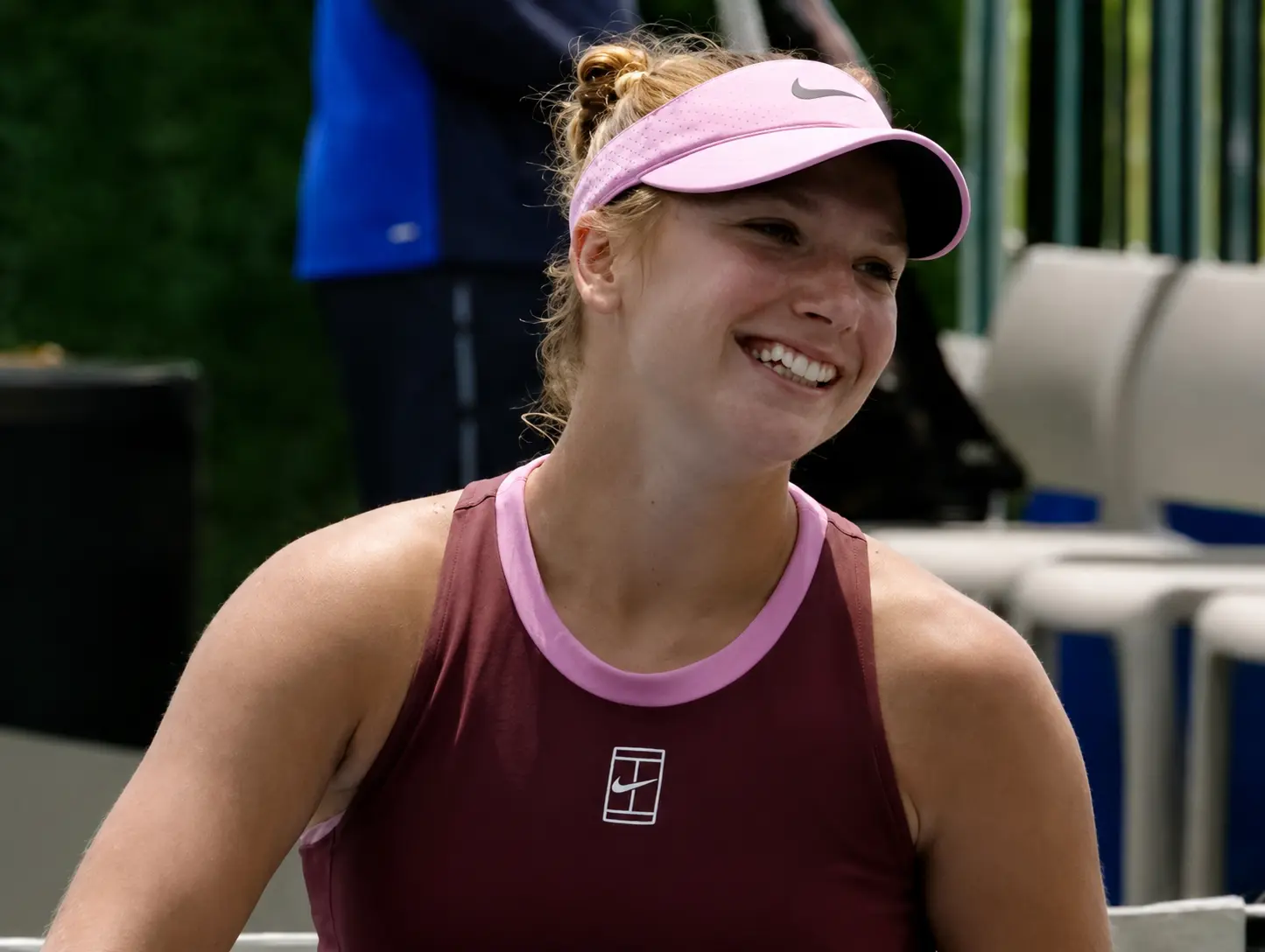
Kristina Liutova’s first week on the WTA Tour was already strange enough.
Then she beat Maya Joint.
The 16-year-old Russian qualifier continued one of the most eye-catching runs of the summer by defeating Joint 3-6, 6-3, 6-3 in the Memphis Classic Round of 16.
Joint is no soft checkpoint. She is the player who beat Serena Williams at Wimbledon earlier this season, and she arrived in Memphis with far more tour-level weight than Liutova.
Yet the Moscow-born teenager ranked outside the Top 200 did not look swallowed by the moment.
She lost the first set, stayed close enough to keep asking questions, then turned the match into something Joint could no longer hit her way out of.
By the end, Joint still owned the louder strokes, but Liutova had changed the weather of the match. The rallies grew tighter, the errors gathered, and the teenager who had looked under pressure in the first set was suddenly the one deciding how the afternoon would end.
Liutova Had Already Earned Attention Before Memphis
Liutova’s name did not appear from nowhere.
Her 2026 season had already been moving fast below the main-tour surface. In May, she won the W100 Indian Harbour Beach title at 16 years and 97 days old, becoming the second-youngest women’s player in history to win a W100 title, behind only Alina Korneeva. The ITF also noted that she had previously won her first professional title at W35 Las Vegas and had reached junior world No. 29.
Then came another jump.
In June, Liutova won W100 Sumter, becoming the youngest player ever to win multiple W100 titles and the only 16-year-old to do so. That run gave her three ITF titles for the season and lifted her to a career-high ranking of No. 216 at the time.
Those results gave the Memphis run some context.
Liutova may still be a new name for many WTA fans, but the lower-tour results had already started shouting. Her WTA profile listed her at 16 years old, with a current singles ranking of No. 228 and a 27-4 win-loss record for 2026 before the full effect of Memphis could settle in.
Memphis is where the wider audience began to hear it.
The Alexandrova Match Was Dramatic, but Joint Made It About Tennis
Liutova’s first tour-level win came in difficult circumstances.
In the previous round, top seed Ekaterina Alexandrova retired after collapsing in extreme Memphis heat, with reports describing Liutova as a 16-year-old debutante who was left in tears after the incident.
That kind of win can be hard to process.
It gives a young player a result, but not the clean emotional satisfaction of finishing the match on her own terms. It also risks making the story about the incident rather than the teenager’s tennis, which is exactly the angle most corporate media followed.
The Joint match changed that.
This time, there was no ambiguity. No retirement. No frightening medical scene. Just a three-set match against a dangerous opponent, and Kristina Liutova finding the better answers after losing the first set.
That is why this win feels important.
It lets the Memphis story move from shock to substance.
Joint Takes the First Set, but the Warning Signs Are Already There
Maya Joint won the opening set 6-3, and at first the match seemed to be moving toward the more established player.
Liutova was broken early for 1-2. Joint pushed the lead to 4-1. The Australian had the larger weaponry and the scoreboard to match. Even when Liutova fought back to 3-4, Joint broke again and then served out the set.
But the first set was not as comfortable as the score suggested.
The 3-5 game was long and difficult, with Liutova forcing Joint through repeated pressure before the Australian finally held. That detail mattered because it hinted at what was coming. Liutova was not yet winning enough of the big games, but she was already making Joint work.
For a 16-year-old playing one of her first WTA main-draw weeks, that is not a small thing.
She stayed in the match emotionally.
Then she changed it.
The Match Flips Because Joint Starts Giving Too Much Away
The second set was where Liutova’s maturity began to show.
She needed to keep the ball in the right places often enough for Joint to feel rushed, irritated or tempted into another low-percentage swing.
That is exactly what happened.
Liutova broke in the middle of the second set, found steadier service games and used the scoreboard pressure to turn Joint’s aggression into risk. The 6-3 second set looked like a young player understanding that she did not have to win the match on Joint’s terms.
That is usually the difference between a prospect and a player.
The Third Set Shows Why This Run Could Travel
Liutova’s best passage came after the match became dangerous again.
She broke at the start of the third set and moved ahead 2-0. Joint, though, did not disappear. She held for 1-2, then even broke back for 3-3 after Liutova had briefly held a 3-1 lead.
That was the moment when many teenagers wobble.
Liutova broke straight back to love for 4-3.
Then she held for 5-3.
Then she broke again to love for the match.
The final three games told the story better than any ranking line could. Joint had dragged the deciding set back level. Liutova answered not with panic, but with a clean, ruthless finish.
A player can win one upset by catching fire. A player can win another because an opponent falls away. But closing a deciding set with three straight games after being pulled back to 3-3 says something more durable.
The Stats Show a Teenager Who Managed the Match
The full match stats reveal a fascinating contrast.
Joint hit 42 winners to Liutova’s 17. In many matches, that would be enough to dominate. Here, it was not even enough to win more points.
Liutova won 99 of the 189 total points. Joint won 90.
The reason is obvious in the error column. Joint made 66 unforced errors, while Liutova made 28. That is the match’s central math. Joint produced the fireworks. Liutova controlled enough of the damage.
| Statistic | Liutova | Joint |
|---|---|---|
| Dominance Ratio | 1.12 | 0.89 |
| Winners | 17 | 42 |
| Unforced Errors | 28 | 66 |
| Serve Rating | 267 | 219 |
| Aces | 3 | 4 |
| Double Faults | 3 | 8 |
| 1st Serve % | 74% (69/93) | 61% (59/96) |
| 1st Serve Points Won | 57% (39/69) | 56% (33/59) |
| 2nd Serve Points Won | 67% (16/24) | 51% (19/37) |
| Break Points Saved | 63% (5/8) | 50% (5/10) |
| Service Games | 77% (10/13) | 64% (9/14) |
| Return Rating | 179 | 137 |
| Break Points Won | 50% (5/10) | 38% (3/8) |
| Pressure Points | 56% (10/18) | 44% (8/18) |
| Total Points | 52% (99/189) | 48% (90/189) |
Liutova’s second serve was especially impressive. She won 67 percent of those points, compared with Joint’s 51 percent. She also put 74 percent of her first serves in, giving herself a steadier base.
For a teenager in a comeback win, those numbers matter.
They show structure.
Why This Is More Than a Cute Breakthrough
The temptation with a 16-year-old is always to rush the story.
New star. Future champion. Next big thing. Tennis loves those labels, and most of them age badly.
Liutova deserves something better than hype.
What she has earned is attention.
The results are already real: multiple W100 titles at 16, a rapid ranking climb, a WTA debut week that included a difficult first-round scene against Alexandrova and then a proper three-set win over Joint. The level is not theoretical anymore.
The Joint match also gave her a more complete calling card.
She did not simply hit harder than a higher-ranked player. She absorbed pressure, let an opponent overplay, served with discipline and finished the third set with authority. That is a much more interesting profile than a teenager who just swings freely.
It suggests a player whose game may mature quickly because the decision-making is already present.
On to Kristina Liutova’s tennis academy, proudly shared on Facebook.
Memphis May Be the First Public Marker
Liutova is still far from a finished WTA player. That should be kept in view. Sixteen is still sixteen. Her junior Grand Slam file is not the loudest part of her resume; the stronger evidence comes from the way the Redmond-based teenager has already been winning outside the junior spotlight.
She reached No. 29 in the ITF junior rankings, won big junior events such as J300 Bradenton and J300 College Park, then accelerated even faster on the professional circuit. The tour will still study her. Opponents will test her movement, her second serve, her patience, her recovery after travel, and her ability to handle weeks when nobody is surprised by her anymore.
But Memphis looks like the first public marker.
The lower-tour watchers already knew about Indian Harbour Beach and Sumter. The ITF already had the numbers. The ranking had already jumped. Now the main tour has a reason to look properly.
The win over Joint does not make Liutova a star by itself.
It makes the question impossible to ignore.
What happens when a 16-year-old with this kind of lower-tour record starts winning WTA matches before the tour has had time to learn her?
That is where the story becomes exciting.
A New Talent on the Horizon, Perhaps More Than That
“Perhaps” is still the right word for now.
Perhaps Kristina Liutova is the next teenager who flashes and fades. Perhaps she is a player whose early results arrive before the full game catches up. Perhaps Memphis is just a hot summer week that looks bigger because of the age attached to it.
But perhaps it is also the beginning of something serious.
The evidence is no longer thin.
Two W100 titles at 16. A 27-4 season record entering the Memphis spotlight. A WTA debut win in strange circumstances. Then a cleaner statement against Maya Joint, the Wimbledon Serena Williams killer, in a match where Liutova lost the first set and still solved the problem.
That is why this feels like more than a match report.
It feels like the first chapter of a player file WTA fans may need to keep open.