
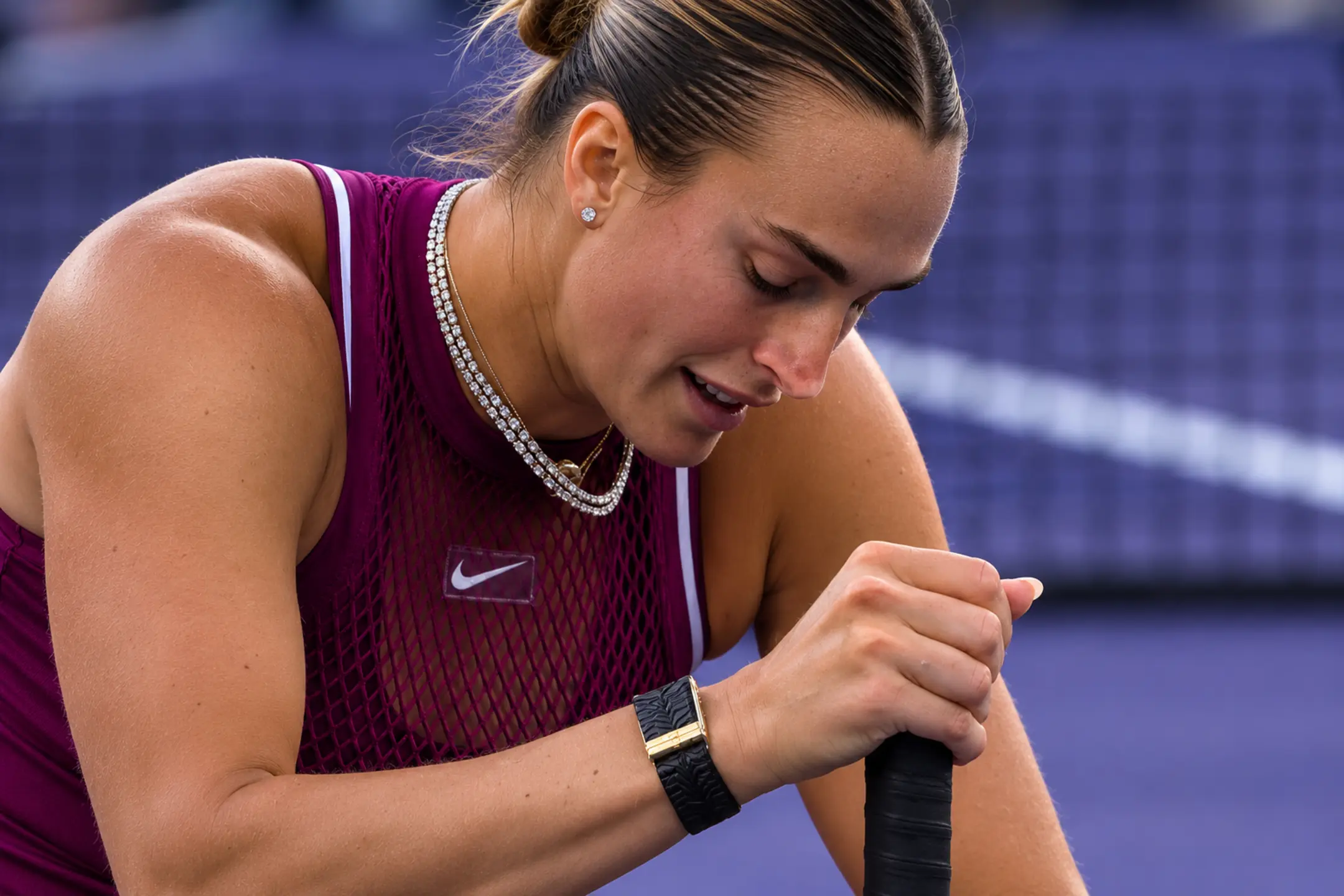
Aryna Sabalenka’s problems may not have begun in 2026. They may have started with a defeat at the end of 2025 that fundamentally changed her understanding of where she stood in women’s tennis.
Former world No. 1 Kim Clijsters believes the Belarusian’s struggles are rooted in her mindset. That is a reasonable assessment. But it leaves a much more interesting question unanswered.
What happened to make one of the most dominant players in women’s tennis suddenly so vulnerable to doubt?
At RallyHer, we believe the evidence points towards Elena Rybakina, and particularly their confrontation in the 2025 WTA Finals championship match.
It was more than a defeat. It may have been the moment Sabalenka discovered that another player had not merely caught up with her, but moved beyond her.
The WTA Finals Defeat That Changed Everything
Sabalenka entered the 2025 WTA Finals playing the sort of tennis that had made her the world’s leading player.
She defeated Jasmine Paolini and Coco Gauff in straight sets, then overcame Jessica Pegula and Amanda Anisimova in deciding sets, winning both 6-3.
But those latter victories concealed something important.
Her dominance ratios against Pegula and Anisimova were just 1.08 and 1.04, respectively. Sabalenka was winning, but not overwhelming her opponents.
Across the other group, Rybakina was operating at a different level.
The Kazakh defeated Iga Swiatek, Ekaterina Alexandrova, Anisimova and Pegula, producing substantially stronger dominance figures.
Her 6-3, 6-1 victory over Anisimova was particularly revealing.
Rybakina struck 36 winners and 13 aces, won an extraordinary 73% of points behind her second serve and recorded a return rating almost twice Sabalenka’s.
The match ended in straight sets, with Rybakina taking the second-set tiebreak 7-0.
For a player accustomed to imposing her own power on opponents, that was an extraordinary reversal.
Sabalenka had encountered someone who could match her aggression, absorb her best shots and still produce superior tennis.
Our interpretation is that this was the first serious crack in Sabalenka’s previously formidable sense of superiority.
The Australian Open Confirmed It Was No Accident
One defeat can be dismissed as a bad day.
A second defeat against the same opponent, on another major stage, is harder to explain away.
Rybakina defeated Sabalenka again in the 2026 Australian Open final.

The significance was not simply that the Belarusian lost another championship match. It was that the player responsible was once again Rybakina.
And unlike a challenger enjoying a brief surge, the Moscow-born Kazakh had been improving steadily under coach Stefano Vukov.
His demanding coaching approach has attracted attention, but strict coaching relationships are hardly unprecedented in elite women’s tennis. Justine Henin‘s career provides another example of how exacting standards can help develop exceptional champions. Just ask her coach, Carlos Rodriguez.
Whatever the merits of those methods, Rybakina had developed a game capable of challenging Sabalenka in precisely the areas where the Belarusian had previously enjoyed her greatest advantage.
That required more than a tactical adjustment.
It demanded a different way of approaching opponents.
The Sunshine Double Offered Hope but Not a Solution
Sabalenka certainly did not spend the entire season losing.
She produced an outstanding response during the American spring, defeating Rybakina in the Indian Wells final after saving a championship point.
She then won Miami, completing the prestigious Sunshine Double.
For a while, the old Sabalenka appeared to have returned.
The victories demonstrated that her highest level remained formidable. They also offered an opportunity to rebuild her confidence.
But the underlying problem may not have disappeared.
As the season progressed, Sabalenka became increasingly vulnerable to opponents capable of striking freely and refusing to retreat.
In August, she suffered a third consecutive tour-level tournament exit before the quarterfinals, something no reigning world No. 1 had experienced since 2019.
Then came another painful encounter with Rybakina in the US Open final.
The Kazakh won again.
Sabalenka’s Indian Wells triumph had proved she could beat her greatest rival. It had not established that she could consistently stay ahead of her.
Clijsters Sees a Player Trapped in Negative Thinking
Speaking on the Served podcast, four-time Grand Slam champion Kim Clijsters identified what she considers Sabalenka’s central difficulty.
“I think it starts with the mind. I think it’s an issue with the mindset of where she is at,” Clijsters explained.
She suggested Sabalenka now slips into negative thinking more quickly and remains there longer.
Clijsters also questioned whether changes within the Belarusian’s support team might reveal broader uncertainty.
Sabalenka parted ways with doubles specialist Max Mirnyi before the WTA Finals, despite the improvements he had helped bring to her net game.
Clijsters additionally referred to changes involving people who had worked with Sabalenka for years, including her longtime physiotherapist.
“There are a lot of changes happening,” she observed, while acknowledging that outsiders cannot know precisely what is taking place within the team.
Neither Clijsters nor RallyHer can establish Sabalenka’s private psychological state from match results alone.
But the competitive pattern deserves examination.
When opponents take away Sabalenka’s usual advantages, her game appears increasingly vulnerable to frustration.
And the final tournament of 2026 provided another uncomfortable illustration.
The WTA Finals Exposed the Problem Once Again
Sabalenka arrived at the WTA Finals in Indian Wells with the opportunity to finish a difficult season strongly.
Rybakina’s withdrawal removed the opponent who had caused her so much trouble.
Yet the Belarusian still failed to reach the semifinals.
She began by defeating Karolina Muchova 7-6(2), 7-5, but was subsequently beaten 6-4, 6-0 by Mirra Andreeva and 6-3, 3-6, 6-1 by Elina Svitolina.
The Andreeva defeat was particularly striking.
The teenager recovered from an early deficit, won 11 consecutive games and finished the match playing with the freedom and authority that once distinguished Sabalenka herself.
Svitolina then subjected the Belarusian to another difficult examination, turning defense into attack and repeatedly forcing her to play an extra shot.
By the end of the tournament, Sabalenka had also lost her world No. 2 ranking to Andreeva.
And there was no Rybakina across the net to explain those defeats.
Sabalenka 2.0 Must Begin With Acceptance
Clijsters is probably right that Sabalenka needs to address her mindset.
But simply identifying negative thinking does not explain its origins.
Our reading of the past two seasons suggests that Rybakina’s emergence has forced Sabalenka to confront something she had rarely experienced during her period of dominance: an opponent who can consistently beat her at her own game.
Rybakina’s serving, clean ball-striking and increasingly complete tennis have established her, in our assessment, as the most accomplished player in the current field.
Just imagine a fully fit, injury-free Elena Rybakina. The challenge she would pose, not just to Aryna Sabalenka but to the entire WTA field, would be even more formidable.
Andreeva’s remarkable progress has added another challenge.
Sabalenka’s response cannot simply be to hit harder, change another member of her team or assume that her previous dominance will eventually return.
She needs to recognize that the competition has improved.
That does not mean accepting permanent inferiority. It means acknowledging that opponents have narrowed, and in some areas reversed, the technical advantages she once enjoyed.
It also means rediscovering the pleasure of competing without treating every opponent’s outstanding shot as evidence that something is going wrong.
A stronger Sabalenka will require renewed respect for the quality of her rivals, greater acceptance of difficult moments and the freedom to enjoy winning again.
And that brings us back to Rybakina.
The Kazakh has not simply taken Sabalenka’s No. 1 ranking. She has presented her with a challenge that cannot be solved by expecting the old hierarchy to restore itself.
Sabalenka 2.0 will begin when she stops trying to recover the player who once dominated everyone else and starts building one capable of beating the opponents who have learned how to dominate her.