
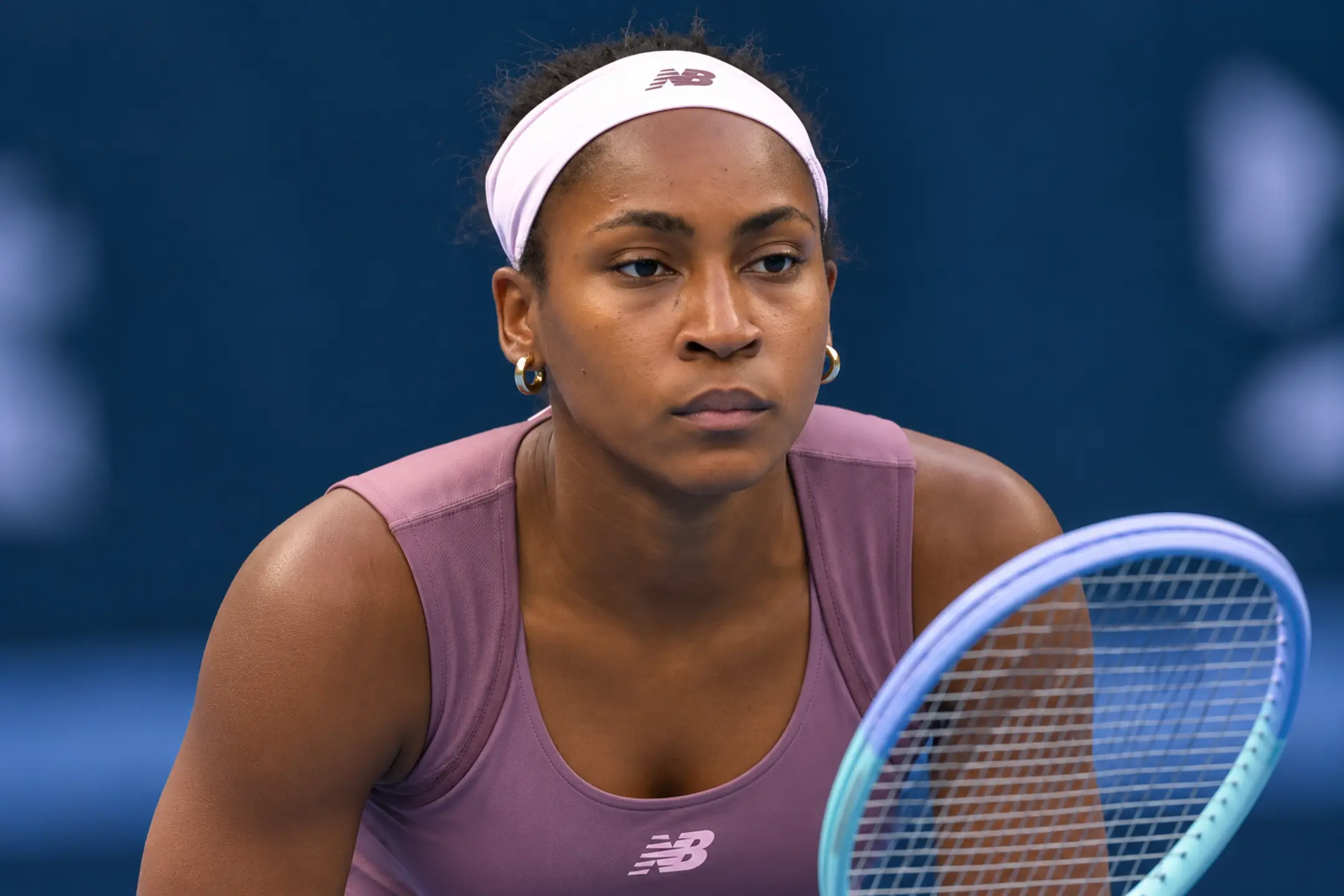
Coco Gauff’s trip through China frayed gradually.
First came the controversy against 16-year-old Xinran Sun in Beijing. Then came the racist abuse Gauff said followed online. Two days later, against Elise Mertens, the American looked physically spent and told her team she could barely see the ball.
Now she has stepped away from Wuhan.
Gauff has withdrawn from the Wuhan Open, where she was due to return as defending champion, saying her body needs time to recover after a long season.
It is a costly decision in ranking terms.
It may also be the sensible one.
The Xinran Sun Match Changed the Tone of Beijing
Gauff’s 7-5, 6-1 victory over Xinran Sun had initially looked like another example of her composure under pressure.
Sun played more than 10 games of fearless tennis, mixing aggressive baseline hitting, overheads and confident serving in front of a crowd eager to see China’s biggest teenage prospect push one of the world’s leading players.
Then came the moment that changed the atmosphere.
Late in the first set, Gauff stopped during a rally after believing the advertising boards beside the court had changed as she struck the ball. Sun appeared to have hit a winning passing shot, but Gauff immediately asked for the incident to be reviewed.
The review confirmed that the billboard had indeed changed during the point. The point was replayed.
Gauff stayed composed, held serve and eventually took control of the match.
Online, the argument did not end there.
Criticism Turns Into Racist Abuse
The debate over the point quickly crossed a line.
Gauff later wrote:
“Hey everyone, you can dislike me or disagree about what happened without being racist. The amount of racist comments/dms I’ve received in the last few hours is insane. Lastly, I’m not a cheater or a thief.”
Her statement separates two things that should never have been confused.
Fans were entitled to disagree with the decision.
Racial abuse was something else entirely.
By the time Gauff returned to court against Mertens, the mood around her Beijing campaign had changed completely.
Mertens Finds a Player Running on Empty
Gauff lost to Elise Mertens 6-3, 6-3 in the fourth round.
The scoreline alone did not show the full concern.
Gauff committed 34 unforced errors and eight double faults, but the most telling moment came while she trailed 6-3, 4-1 and spoke toward her team.
“I have no energy. I’m trying, I have no energy. I can’t see the ball, I feel like I’m going to pass out. I’m going to just try to finish the match.”
Four games later, it was over.
Mertens deserved full credit for the victory. She served superbly, stayed composed and repeatedly punished Gauff’s loose play.
But Gauff’s words made clear that this was not simply an ordinary bad day at the office.
She was struggling to get through the match.
Wuhan Becomes the Tournament Gauff Is Willing to Give Up
Gauff has now decided not to defend the Wuhan title she won last season.
Her statement was direct:
“I’m disappointed to withdraw from Wuhan, especially as the defending champion. I always love playing there. After a long year, my body needs some time to rest and recover. I look forward to returning next year.”
That choice carries consequences.
As defending champion, Gauff has 1,000 ranking points attached to last year’s title. Wuhan is also a mandatory WTA 1000 event, so her absence may bring further consequences unless covered by an exemption.
But the ranking cost is only one side of the decision.
The other is what Beijing looked like by the end.
A player talking openly about dizziness, exhaustion and feeling close to passing out is giving a fairly clear indication of where the priority needs to be.
The Far East Swing Turned Sour Quickly
What makes the ending striking is how different the trip looked only days earlier.
Gauff had survived a difficult three-set match against Camila Osorio.
She then dealt with the fever around Sun, the home crowd and the controversial review without allowing the match to run away from her.
From 5-5 in the opening set against Sun, she won eight of the final nine games.
That looked like control.
Then came the online abuse.
Then came Mertens.
Then came the withdrawal.
The progression explains why this is better understood as Gauff drawing a line than simply losing another tournament opportunity.
Rybakina Also Steps Away From Wuhan
Gauff is not the only major name removing Wuhan from her immediate schedule.
Elena Rybakina has also withdrawn because of health issues, meaning another leading player from the Beijing field will not make the quick turnaround into the next WTA 1000.
It adds to the broader strain of this part of the calendar.
Beijing is still unfolding while Wuhan waits almost immediately behind it.
For players already carrying a long season in their legs, there is very little room to reset.
Choosing Rest Over a Title Defence
There will be ranking consequences.
There will be questions about the WTA Finals race.
And there will be disappointment that Gauff will not return to defend a title she won so convincingly last year.
But none of those things changes the sequence Beijing produced.
A difficult controversy.
Racist abuse.
A physically worrying defeat.
Then a decision to stop.
Gauff’s China swing did not end the way she wanted.
Choosing not to force another week may be the most important decision she made on it.