
The China Open always carries weight. This year, some players are carrying far more of it than others.
Coco Gauff arrives in Beijing with 1,380 points coming off, Linda Noskova has 759 to replace and Jasmine Paolini 594. All three at least have the chance to repair the damage on court.
Amanda Anisimova and Jessica Pegula do not.
Anisimova’s left wrist injury has forced the defending champion out of Beijing, while Pegula is also absent. That leaves both facing four-figure ranking losses with no possibility of replacing a single point at this tournament.
Some players are defending territory at the China Open. Others have already lost it.
Anisimova Will Drop 1,000 Points Without Defending Her Title
No player illustrates the danger better than Amanda Anisimova.
She begins this ranking cycle with 3,363 points, but the 1,000 points from her 2025 Beijing title are coming off.
That leaves her projected at 2,363.
Anisimova will not be in Beijing to respond. The defending champion withdrew before the tournament because of a left wrist injury, guaranteeing that the China Open will have a new winner in 2026.
Her arithmetic is unforgiving:
3,363 → 2,363
The entire 1,000-point title haul disappears.
For a player who started this season much higher up the rankings, it is one of the most damaging weeks imaginable without actually losing a match.
Pegula Faces an Even Bigger Drop
Jessica Pegula is in much the same position.
She starts from 7,265 points, but 1,040 are scheduled to disappear.
That takes her projected total to 6,225.
Again, there is no Beijing result waiting to soften the blow.
7,265 → 6,225
Pegula therefore loses even more points than Anisimova in absolute terms, although she begins from a much stronger ranking position.
The bigger problem is the same: no tournament, no replacement points, no route back during this ranking cycle.
Gauff Has the Biggest Defense of All
The largest single deduction among the Top 40 belongs to Coco Gauff.
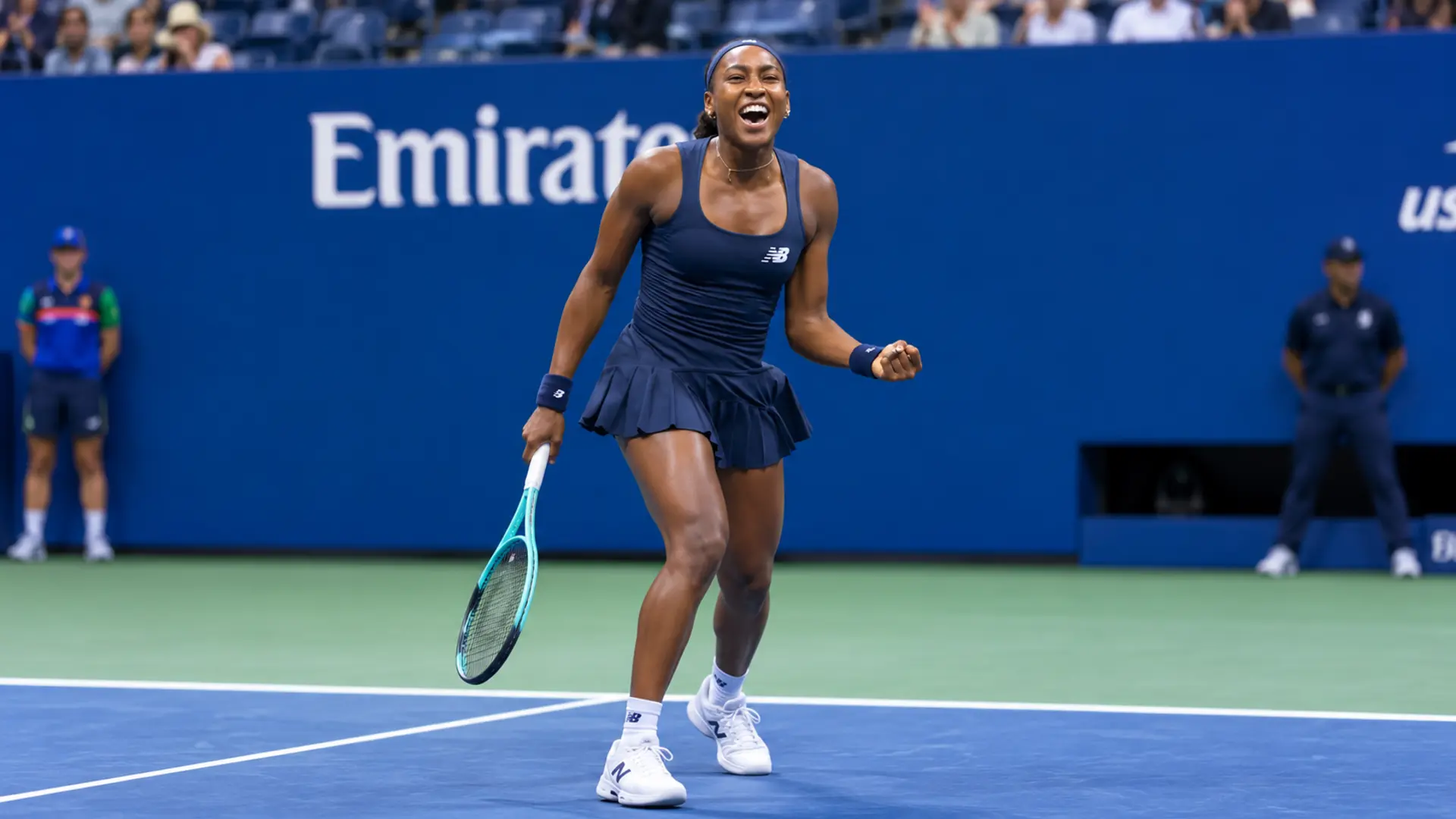
Coco Gauff faces the largest points drop around the Beijing ranking update, but most of it does not come from the China Open. Her 390 points from last year’s Beijing semifinal are joined by the 1,000 points from her 2025 Wuhan title, which are also reaching their expiry window because of the calendar.
She starts from 7,244 points and has 1,380 coming off, which drops her to a projected 5,864 before anything she earns in Beijing is added.
7,244 → 5,864
That looks brutal.
The difference is that Gauff is still alive.
She is the No. 3 seed in Beijing and, like the other 31 seeds, receives a first-round bye before entering in Round 2.
So while Pegula and Anisimova can only absorb their losses, Gauff can rebuild.
A deep run would matter enormously.
A short one would not.
Noskova Needs More Than a Routine Week
Linda Noskova also enters Beijing with substantial ground to defend.
Her total falls from 5,328 to 4,569 once 759 points come off.
That is a serious hit for a player sitting around the lower end of the Top 10.
Noskova is seeded No. 5 and has a bye into the second round, so she controls what happens next.
Still, this is not a week where one or two routine wins necessarily solve the problem.
The deeper she goes, the more of that 759-point hole she can fill.
Paolini Has More at Stake Than the Ranking Number Suggests
The danger becomes even sharper further down.
Jasmine Paolini starts with 2,122 points and loses 594.
Her projected total falls to 1,528.
That is a much larger proportion of her overall ranking base than the raw number may suggest.
Paolini is seeded No. 14 and begins in Round 2.
She therefore has a chance to rebuild, but an early exit would leave one of the more significant percentage drops in the Top 40.
Sabalenka and Swiatek Have Manageable Defenses
Not every prominent name faces the same level of stress.
Aryna Sabalenka drops 325 points, moving from 7,810 to a projected 7,485.
Iga Swiatek loses the same amount, going from 4,119 to 3,794.
Both are in the Beijing draw and both receive first-round byes. Sabalenka is seeded No. 2, while Swiatek is No. 8.
Compared with Gauff, Noskova or Paolini, their burden is much lighter.
A reasonably deep run could erase most or all of the damage.
Rybakina Starts From the Strongest Position
At No. 1, Elena Rybakina has relatively little to fear.
She starts from 9,901 points and loses only 205, leaving a projected 9,696 before Beijing adds anything new.
Rybakina is the top seed and enters in Round 2.
That makes her position dramatically more comfortable than those of Gauff, Pegula or Noskova. Yet her draw could not have been more difficult.
Mirra Andreeva and Karolina Muchova are similarly well protected, with only 110 and 115 points coming off respectively.
Emma Navarro Is Another Quiet Loser
Emma Navarro should not be overlooked.
She begins with 2,024 points, loses 220 and drops to a projected 1,804.
There is no Beijing round beside her name.
That makes the loss unavoidable.
It is nowhere near the four-figure damage facing Pegula or Anisimova, but around this section of the rankings, 220 points make a noticeable difference.
The Players in the Most Danger
The ranking pressure is easiest to understand by separating those who can still fight back from those who cannot.
| Player | Points Before Beijing Drop | Points Coming Off | Projected Total | Can Replace Points in Beijing? |
|---|---|---|---|---|
| Coco Gauff | 7,244 | -1,380 | 5,864 | Yes |
| Jessica Pegula | 7,265 | -1,040 | 6,225 | No |
| Amanda Anisimova | 3,363 | -1,000 | 2,363 | No |
| Linda Noskova | 5,328 | -759 | 4,569 | Yes |
| Jasmine Paolini | 2,122 | -594 | 1,528 | Yes |
| Aryna Sabalenka | 7,810 | -325 | 7,485 | Yes |
| Iga Swiatek | 4,119 | -325 | 3,794 | Yes |
| Belinda Bencic | 2,925 | -220 | 2,705 | Yes |
| Emma Navarro | 2,024 | -220 | 1,804 | No |
| Elena Rybakina | 9,901 | -205 | 9,696 | Yes |
That is where the real ranking drama lies.
Gauff has the largest defense, but at least she gets to play for it (partly) as can be seen in the table below.
Pegula and Anisimova do not.
| Player | Points Before Beijing |
Points Coming Off |
China Open Maximum |
Maximum Net Change |
Maximum Total |
|---|---|---|---|---|---|
| Elena Rybakina | 9,901 | -205 | 1,000 | +795 | 10,696 |
| Aryna Sabalenka | 7,810 | -325 | 1,000 | +675 | 8,485 |
| Jessica Pegula | 7,265 | -1,040 | — | -1,040 | 6,225 |
| Coco Gauff | 7,244 | -1,380 | 1,000 | -380 | 6,864 |
| Mirra Andreeva | 5,841 | -110 | 1,000 | +890 | 6,731 |
| Elina Svitolina | 4,809 | 0 | 1,000 | +1,000 | 5,809 |
| Linda Noskova | 5,328 | -759 | 1,000 | +241 | 5,569 |
| Karolina Muchova | 4,683 | -115 | 1,000 | +885 | 5,568 |
| Marta Kostyuk | 4,040 | -130 | — | -130 | 3,910 |
| Iga Swiatek | 4,119 | -325 | 1,000 | +675 | 4,794 |
Beijing Is About More Than the Trophy This Time
By the time the China Open reaches its second week, the ranking picture could look very different.
Gauff can still turn a 1,380-point exposure into a respectable defense.
Noskova and Paolini can limit their losses with deep runs.
Rybakina begins from a position of relative safety.
Pegula and Anisimova, meanwhile, will watch from outside Beijing as four-figure totals disappear.
That makes this China Open unusually unforgiving.
The most vulnerable players are not simply those defending the most points.
They are the ones who have the most to lose and no chance to win any of it back.