
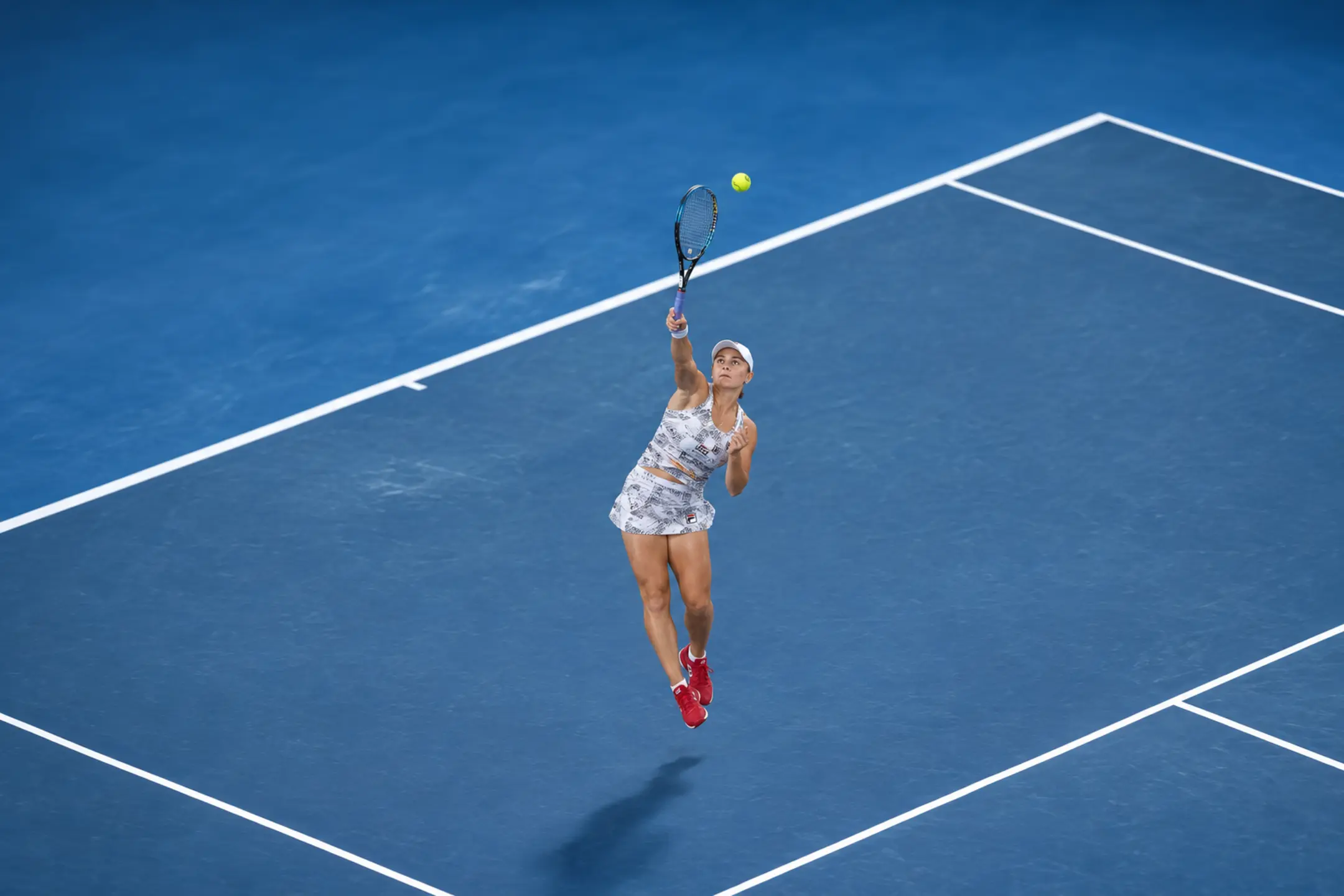
Earlier this month, Australian schoolchildren were celebrating Ashleigh Barty’s remarkable tennis career. They had been learning about her achievements, reading her books and competing for the chance to meet their sporting hero.
Back home in Queensland, however, two rather important people remain completely unaware of those achievements.
Barty’s own children don’t even know their mother played tennis.
And next August, the former world No. 1 will take her place alongside the greatest names in tennis history when she is inducted into the International Tennis Hall of Fame.
It is a wonderfully Australian contrast. A country celebrates one of its most accomplished champions, while the woman herself is perfectly happy being a mother who has long since put her racket away.
Another Aussie in the Hall of Fame
Barty, now 30, has been elected to the International Tennis Hall of Fame’s Class of 2027 alongside Japanese wheelchair tennis legend Shingo Kunieda.
The announcement came during a surprise video call hosted by Hall of Fame co-presidents Kim Clijsters and Patrick McEnroe.
What followed was a series of personal messages from almost 20 established Hall of Famers, including Roger Federer, Martina Navratilova, Pat Rafter, Tracy Austin and Pam Shriver.
Navratilova greeted the news with characteristic humour.
“Another Aussie in the Hall of Fame, really?” she joked, before explaining how much she had enjoyed watching Barty play and compete.
Rafter, Australia’s two-time US Open champion, was rather more direct.
“Ash Barty, you legend,” he declared, suggesting that her eventual induction had never really been in doubt.
Austin remembered something beyond the titles.
She particularly admired Barty’s creativity and the obvious enjoyment she brought to her tennis.
Barty’s game stood apart in an era increasingly dominated by powerful baseline hitting.
Her slice backhand, variations of spin, excellent movement and tactical intelligence made her one of the most entertaining players of her generation.
She could defeat opponents without trying to hit every ball harder than they did.
A Champion Who Still Wonders Whether She Belongs
For all the congratulations, Barty’s reaction was not quite what one might expect from someone who had spent 121 weeks at world No. 1.
She admitted to feeling a degree of impostor syndrome.
Speaking to Reuters from Queensland, she questioned whether she truly belonged among the game’s greatest legends.
Coming from Barty, that modesty feels familiar.
But her record offers little reason for uncertainty.
She won:
- Roland-Garros in 2019
- Wimbledon in 2021
- Australian Open in 2022
She also captured the 2018 US Open doubles championship and won the 2019 WTA Finals.
Her 2022 Australian Open triumph was especially significant.
Barty ended a 44-year wait for an Australian woman to win the singles championship at Melbourne Park.
She retired less than two months later, still ranked world No. 1 and only 25 years old.
There was no long farewell tour, no gradual decline and no desperate attempt to extend a career that had already delivered everything she wanted.
She simply decided that tennis was no longer the most important thing in her life.
From Evonne Goolagong Cawley to Ash Barty
Barty will become the 35th Australian inducted into the International Tennis Hall of Fame and the first Australian woman to receive the honour since 2013.
She will also become the second Indigenous Australian to enter the Hall, following her mentor Evonne Goolagong Cawley.
Their connection remains one of the most meaningful stories in Australian tennis.
Goolagong Cawley famously presented Barty with the Australian Open trophy in 2022, a carefully arranged surprise that brought together two generations of Indigenous champions.
For Barty, that moment represented something more substantial than a Grand Slam victory.
It connected her achievements with a tradition she had admired throughout her career.
Her induction now extends that legacy.
And she has continued encouraging young Australians to discover tennis since retiring.
On November 9, Barty visited St Bede’s Primary School in Canberra after it won the national Ash Barty Schools Challenge.
More than 3,000 entries had been submitted from around Australia.
The initiative encourages children to learn about tennis through Barty’s story, including her attitude towards competition, resilience and enjoyment.
The irony is rather lovely.
Children in Australian classrooms are learning about her extraordinary career while her own son and daughter remain blissfully unaware of it.
Retirement Was Never a Temporary Arrangement
Barty’s decision to retire in March 2022 caused understandable disbelief.
She was the reigning Australian Open champion, the best-ranked player in women’s tennis and seemingly capable of adding several more Grand Slam titles.
Speculation about a comeback has followed her ever since.
Yet Barty has consistently rejected the idea.
During her latest interviews, she was asked whether her original retirement decision had hardened into an absolute refusal to return.
Her answer was unmistakable.
“No, mate, it was always never.”
There are no regrets, either.
She has two children, a son born in July 2023 and a daughter born in June 2025, and speaks enthusiastically about family life.
She has also maintained her interest in golf and occasionally returns to tennis for exhibitions, including an appearance alongside Roger Federer earlier this year.
But professional competition no longer holds the same attraction.
Barty has already experienced the demands of being world No. 1. She knows what is required to remain there.
And she has made it clear that she has no interest in exchanging her current happiness for another attempt at tennis glory.
A Different Kind of Tennis Legacy
The official induction will take place in Newport, Rhode Island, from August 26 to 28, 2027.
Barty will share the occasion with Kunieda, whose extraordinary wheelchair tennis career produced 50 major titles, including 28 in singles, and four Paralympic gold medals.
For Barty, the celebrations will bring another opportunity to reconnect with the players, coaches and friends who shaped her career.
She has repeatedly emphasized that her achievements belonged to the people who helped her, not simply to herself.
That is entirely consistent with the player Australia remembers.
Next August, two little Aussies may finally begin to understand why their mother still holds such a special place in the hearts of tennis fans around the world.
And while Ash Barty still wonders whether she deserves a place among the sport’s immortals, the rest of us have considerably less difficulty making up our minds.