
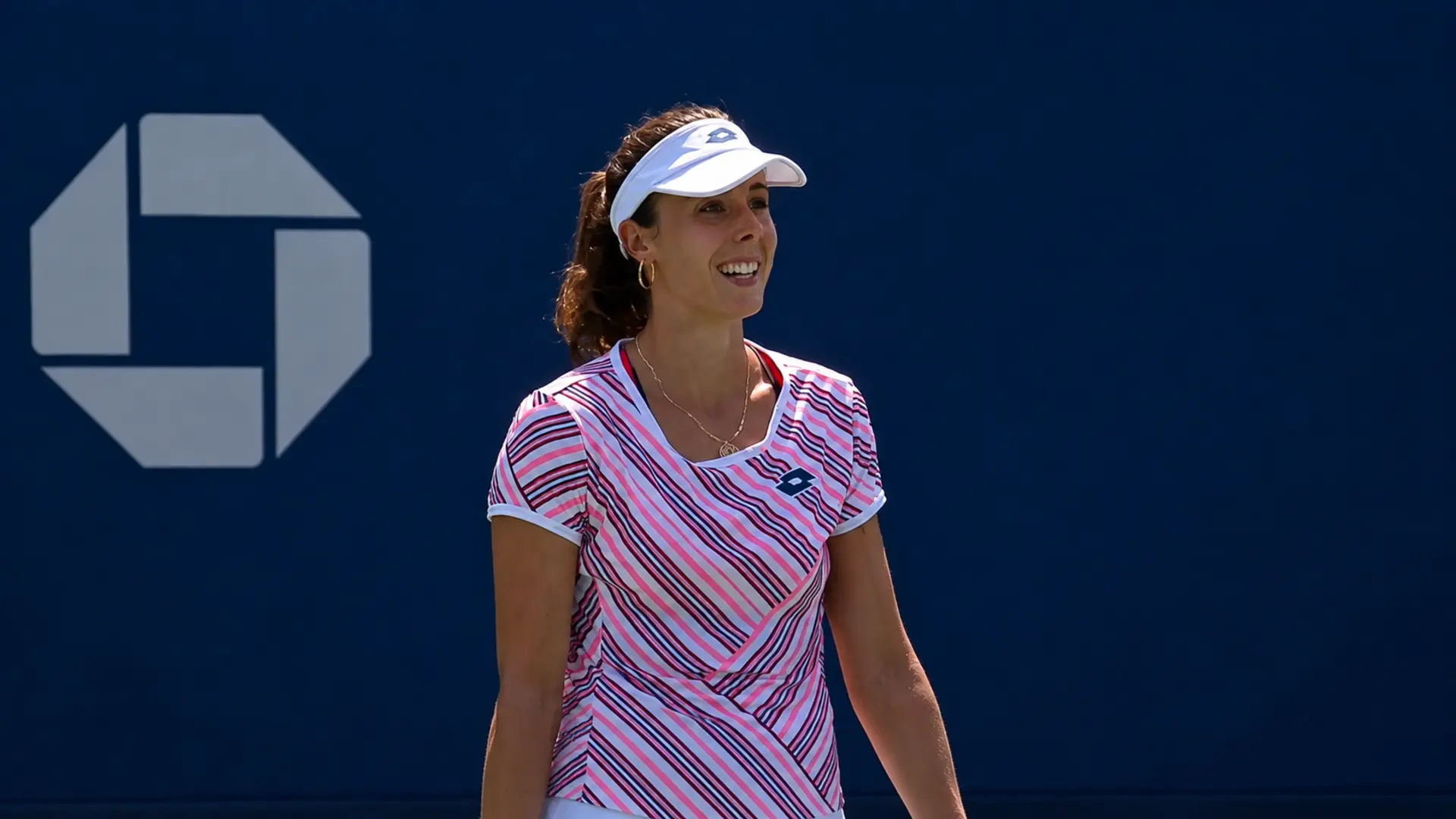
Alizé Cornet was never particularly interested in blending quietly into the background.
During a career that took her to No. 11 in the world, the Frenchwoman brought plenty of personality to the court, and her meetings with Serena Williams rarely passed without some degree of commotion. Cornet had opinions, character and very little difficulty showing either.
Retirement has not changed that.
Now she has turned her attention to the US Open’s revamped mixed doubles event, and her objection is blunt: if the tournament wants a star-driven spectacle built largely around singles players, why continue presenting it as traditional mixed doubles?
“Why not organize an exhibition?” Cornet asked.
That question goes to the heart of her criticism.
Cornet Says Doubles Specialists Are Paying the Price
The redesigned event has undoubtedly delivered star power.
The early results have also complicated any simple singles-stars-versus-doubles-specialists narrative.
Aryna Sabalenka and Novak Djokovic were beaten by doubles specialists Katerina Siniakova and Henry Patten, a result that lends weight to Cornet’s argument about the particular skills required in doubles.
But the opposite happened when Mirra Andreeva and Andrey Rublev defeated established doubles champions Sara Errani and Andrea Vavassori 1-4, 4-1, [11-9].
The revamped event may disadvantage some specialists at the entry stage, but once the matches begin, the results are already showing that neither group has an automatic advantage.
But the route into the tournament increasingly runs through singles rankings and wildcards rather than the doubles rankings that ordinarily reward players who spend the season competing in the discipline.
That is where Cornet draws the line.
“There are still doubles players who dedicate themselves to this discipline,” she said. “It is their livelihood throughout the year, and they work hard for it.”
Her argument is not that Alcaraz, Williams, Djokovic or Sabalenka should somehow be barred from sharing a court. It is that constructing an event around famous singles names inevitably leaves established doubles players squeezed out of something that is still officially a Grand Slam discipline.
For Cornet, calling the competition mixed doubles while reshaping almost everything around it risks having it both ways.
‘It Is Really Just a Strategy to Make Money’
The new format makes the commercial logic difficult to miss.
The event takes place before the singles main draw, giving leading singles players the chance to participate without carrying a traditional doubles schedule through the tournament. Matches are condensed, Fan Week provides the stage, and the winning team receives $1 million.
It has succeeded in creating attention before the main event begins.
Cornet is not persuaded that attention alone justifies the transformation.
“We mustn’t mix everything together,” she said. “It is really just a strategy to make money. It is no longer the US Open mixed doubles. It doesn’t look anything like what it used to be.”
That is a particularly Cornet way of putting it: less interested in whether the spectacle works than in what had to be displaced to create it.
“It penalizes doubles players. It’s unfair. We should keep the two disciplines separate.”
The US Open Has Created a Hit, but Also an Identity Problem
There is an obvious counterpoint to Cornet’s criticism.
The revamped event has made mixed doubles one of the most talked-about parts of Fan Week. Pairings involving Williams, Alcaraz, Djokovic and Sabalenka create immediate interest among spectators who might otherwise pay considerably less attention to the discipline.
That is precisely why the US Open changed it.
But Cornet’s objection is more fundamental than whether the experiment attracts viewers.
If the primary goal is to put superstar singles players together in unusual combinations and create a high-profile spectacle before the singles tournament begins, then her question remains difficult to dismiss:
Why not simply call it an exhibition?
The US Open has found a way to make mixed doubles louder.
Cornet wants to know whether, in doing so, it can still be called a Grand Slam title.
Source: RMC Sport