
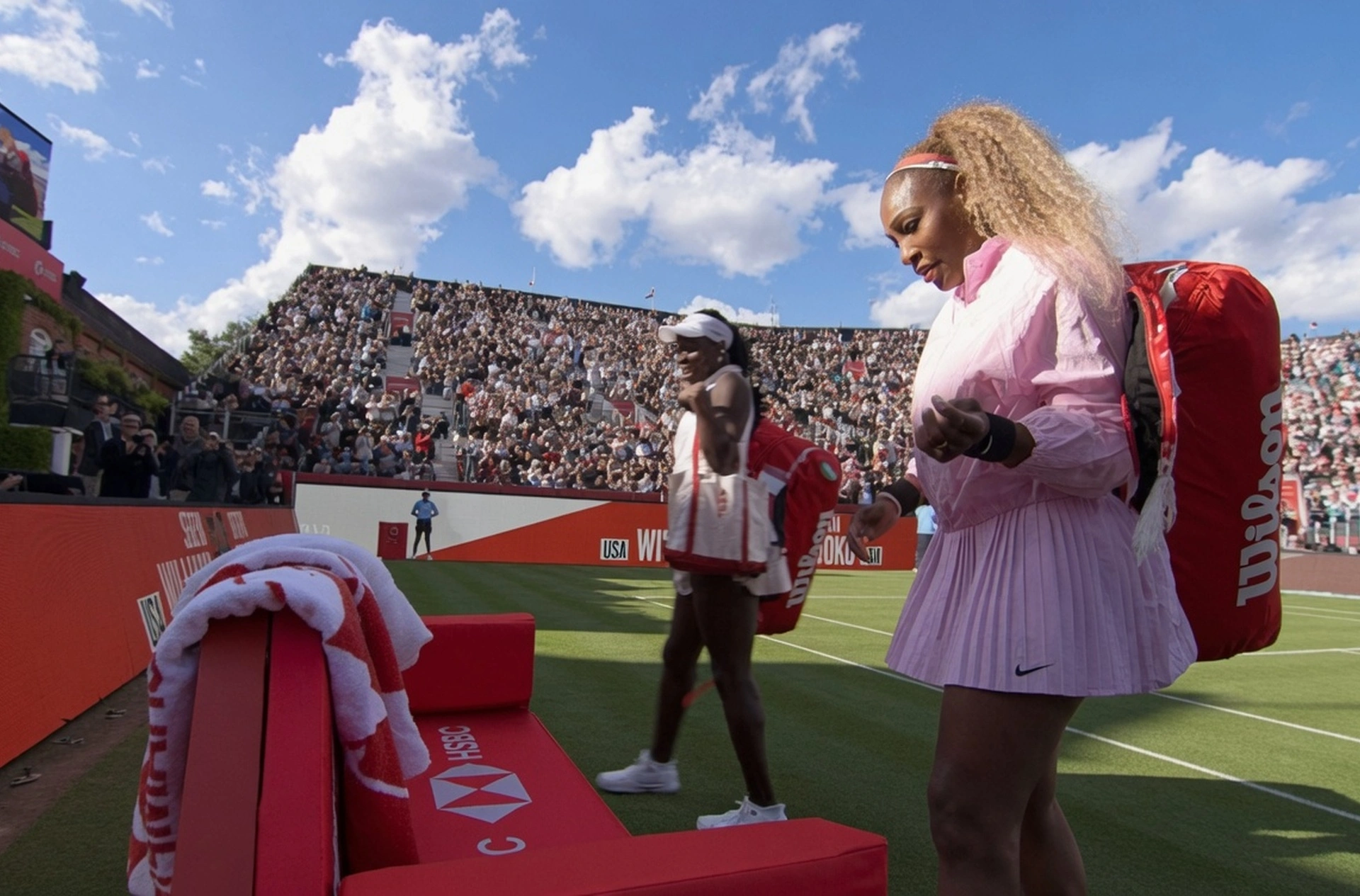
Serena Williams did not walk back into tennis alone.
She returned with Olympia in the stands, Adira nearby, Alexis Ohanian watching too, and an entire arena rising before she had struck a meaningful ball.
That was the picture at Queen’s Club: not just the 23-time Grand Slam singles champion stepping into competition after almost four years away, but a mother allowing her daughters to see the version of her the sport already knew by heart.
For Olympia, aged eight, there were memories to collect. For Adira, born after Williams had already stepped away from tennis, there was something more unusual: a first chance to see her mother not as an archive, not as a highlight reel, but as a player in real time.
Then Williams reminded everyone why the archive is so large.
Partnering 19-year-old Canadian Victoria Mboko, the 44-year-old American beat third seeds Nicole Melichar-Martinez and Erin Routliffe 7-6(2), 6-2 in the first round of the Queen’s Club Championships.
The match lasted 92 minutes, gave Williams her first professional win since the 2022 US Open, and turned what could have been a ceremonial comeback into something far more competitive.
The ovation was about nostalgia.
The tennis was not.
Williams and Mboko Survive the First Set and Take Control
The opening set had all the strange energy of a comeback match.
Williams’ first notable contact with the ball included a missed close-range volley, the sort of moment that briefly reminded everyone how long she had been away from tour tennis. But the rust did not define the set. The more the match settled, the more Williams and Mboko began to understand their shape as a pair.
They moved ahead 3-0, only for Melichar-Martinez and Routliffe to pull the set back to 4-4. The third seeds had enough doubles craft to make the match awkward, and the first set became a test of whether Williams and Mboko could hold their nerve before the late afternoon became too complicated.
They could.
At 6-6, the tie-break belonged almost entirely to the comeback pair. Williams and Mboko took it 7-2, turning a tense first set into the kind of platform that changed the match.
Mboko’s movement and court coverage mattered. Williams’ presence at the net mattered too. So did the serve, still heavy enough to make opponents react rather than dictate.
At one stage, Williams reportedly struck a 113mph ace.
Some things had not gone anywhere.
The Second Set Becomes a Proper Upset
Once the first set was secured, the match loosened in Williams and Mboko’s favour.
Melichar-Martinez and Routliffe held for 1-0 in the second set, but the advantage did not last. Williams and Mboko levelled, broke for 2-1, held for 3-1 and never really let the seeded pair back in.
There was a brief hold from the third seeds for 3-2, but Williams and Mboko immediately moved again. They held for 4-2, broke for 5-2 after two break-point chances, then served out the match.
The final game was clean enough to feel symbolic. Williams and Mboko moved to 40-15 and closed on the first match point.
After nearly four years away from professional tennis, Serena Williams had not returned merely to wave.
She had returned and won.
A Comeback Framed by Family Rather Than Proof
Williams had spent the build-up trying to lower the emotional temperature around the comeback.
She said she had “nothing to prove,” a phrase that can sound like a slogan until you remember who is saying it. Williams has spent nearly three decades bending the sport around her power, personality and competitive appetite. She does not need another doubles win at Queen’s Club to justify anything.
That is why the family context felt so important.
Her daughters were not decorative details in the story. They were part of the reason the return carried weight. Williams has spoken about the possibility of them seeing her play, and Queen’s gave her that stage: grass court, London crowd, packed Andy Murray Arena, standing ovation, and then a win that kept the experiment alive.
This felt more personal than just a comeback.
Williams has described her departure from tennis in 2022 as “evolving away” rather than retiring. At Queen’s, that language made more sense. This was not a player pretending the last four years had not happened. This was a different Serena returning on different terms.
A mother of two. A 44-year-old champion. A figure still capable of changing the temperature of a tournament simply by appearing in the draw.
Mboko Gets Her Own Part in the Moment
The partnership also gave the match another layer.
Mboko is 19, an emerging Canadian talent, and she was sharing a court with one of the defining athletes in tennis history. That could have swallowed a young player whole. Instead, she gave the team exactly what it needed.
She covered space. She absorbed pressure. She allowed Williams to pick her moments. The pairing looked more functional as the match went on, and by the second set there was a clear division of work: Mboko bringing legs and rhythm, Williams bringing weight, instinct and authority.
It would have been easy for the day to become only about Serena.
Mboko made sure the tennis had balance.
That matters in doubles, where reputation alone cannot cover the middle of the court or save a badly timed poach. Against a seeded team, Williams and Mboko had to earn the win as a pair.
They did.
Berlin Next as Wimbledon Question Stays Open
Williams is scheduled to play doubles again at the Berlin Open next week, though her partner there has not yet been publicly confirmed.
The larger question is Wimbledon.
The tournament begins on June 29, and Williams has not confirmed whether she will appear there. She has also refused to rule out singles entirely, though she has made clear that would require more training and may not be her current path.
“I can’t say no right now,” she said when asked about singles. “I feel like I probably need to train a little bit more if I want to play singles, and we will see if I get there, and if not… that’s not my journey right now.”
That is a careful answer, and probably the right one.
Queen’s showed that Williams can still serve, still volley, still compete and still hold a crowd in the palm of her hand. It did not prove that she is ready for singles, nor did it need to. Doubles gives her a way back into the competitive air without pretending time has stood still.
The next opponents at Queen’s will come from the section featuring Leylah Fernandez and Laura Siegemund, or Alexandra Panova and Demi Schuurs.
For now, though, the bigger image is already set.
Serena Williams walked back onto a tennis court after so many years, with her family watching and the crowd standing.
It was not 2012. It was not 2015. It was not even September 2022.
It was Serena in 2026.
Still different from everyone else.