
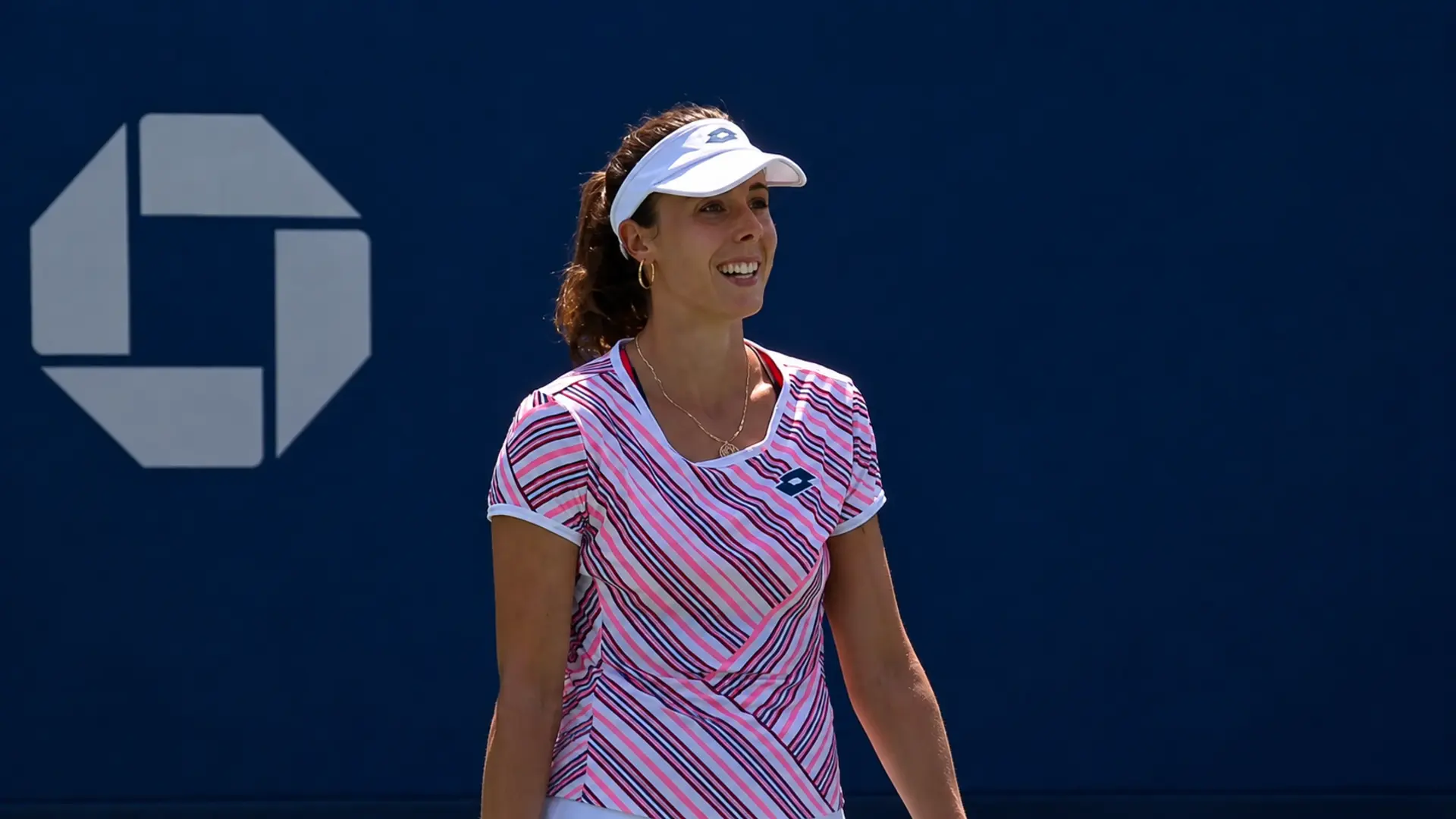
France does not lack professional tennis players. It has ten women inside the WTA Top 250, seven of them ranked among the world’s leading 150.
Yet when Australia arrived in Le Portel for the Billie Jean King Cup Play-offs, Alize Cornet’s team failed to win a single set across four matches.
The 4–0 defeat has left the three-time champions facing another year in regional competition. More importantly, it has raised uncomfortable questions about why a country with such considerable tennis resources is struggling to assemble a competitive national team.
Cornet, the former world No. 11 now captaining France, is not pretending that the problem can be explained away by a few unfortunate results.
Cornet Acknowledges the Gap and Her Own Shortcomings
Speaking to the French Tennis Federation after the defeat, Cornet praised Australia’s commitment, intensity and willingness to impose its game.
She accepted that Samantha Stosur’s players had performed at a higher level throughout the weekend.
But she also turned the criticism towards herself.
“I think I have things to work on myself,” she admitted, acknowledging that her captaincy still required improvement.
It was only her second tie in charge, following a successful introduction in Lisbon earlier this year.
Cornet wants to build a team for the future, but the Australian encounter exposed just how much work remains.
France Has Players but Where Is the National-Team Strength?
The current rankings make uncomfortable reading.

| French Player | WTA Singles Rank |
|---|---|
| Diane Parry | 34 |
| Leolia Jeanjean | 90 |
| Fiona Ferro | 99 |
| Anna Blinkova | 101 |
| Elsa Jacquemot | 132 |
| Alice Tubello | 139 |
| Clara Burel | 148 |
| Carole Monnet | 209 |
| Harmony Tan | 216 |
| Varvara Gracheva | 235 |
The problem is not simply the number of players available.
France has only one woman inside the Top 50, and a sizeable group competing between approximately No. 90 and No. 150.
That represents respectable professional depth, but not necessarily the individual quality required to defeat stronger national teams.
Even so, Diane Parry’s 6–3, 6–4 defeat against Storm Hunter was difficult to justify on rankings alone. Parry stood at No. 34, while the Australian was ranked No. 164 in singles.
Talia Gibson had already overwhelmed Clara Burel 6–2, 6–1.
Cornet subsequently changed her doubles selection, pairing Parry with Kristina Mladenovic rather than Leolia Jeanjean.
The adjustment failed.
Hunter and Maya Joint won 6–2, 6–4 before Joint completed the rout against Jacquemot, 6–1, 6–3.
France collected just 20 games across eight sets.
The Pressure of Playing for France
Cornet believes another problem may lie in how her players respond to national expectations.
She does not question their commitment or desire to represent France.
What concerns her is whether that responsibility actually helps them perform.
During her own playing career, Cornet experienced the opposite effect: the pressure of representing her country sometimes inhibited her tennis.
She now wants to create an environment in which players feel sufficiently comfortable to compete without fear of criticism.
That is a reasonable ambition.
But France also needs better performances, more reliable partnerships and stronger individual results against leading opponents.
The contrast with 2019 is striking. That year, Mladenovic and Caroline Garcia secured the Fed Cup title against Australia in Perth.
Seven years later, France cannot even reach the Qualifiers.
Cornet’s Challenge Is Bigger Than Rebuilding Confidence
Cornet deserves credit for examining her own contribution rather than blaming the players.
She is also right to think beyond one disappointing weekend.
But the national-team rankings expose an issue that reassurance alone cannot solve.
France produces plenty of professional players. What it currently lacks is a group capable of consistently raising its level when representing the country.
And that is the central contradiction Cornet must confront.
Building a stronger French team cannot begin and end with making its players more comfortable. At some point, those players must become better at winning the matches their rankings suggest they should win.
Until then, France’s considerable tennis depth will remain an impressive statistic rather than a competitive advantage.