
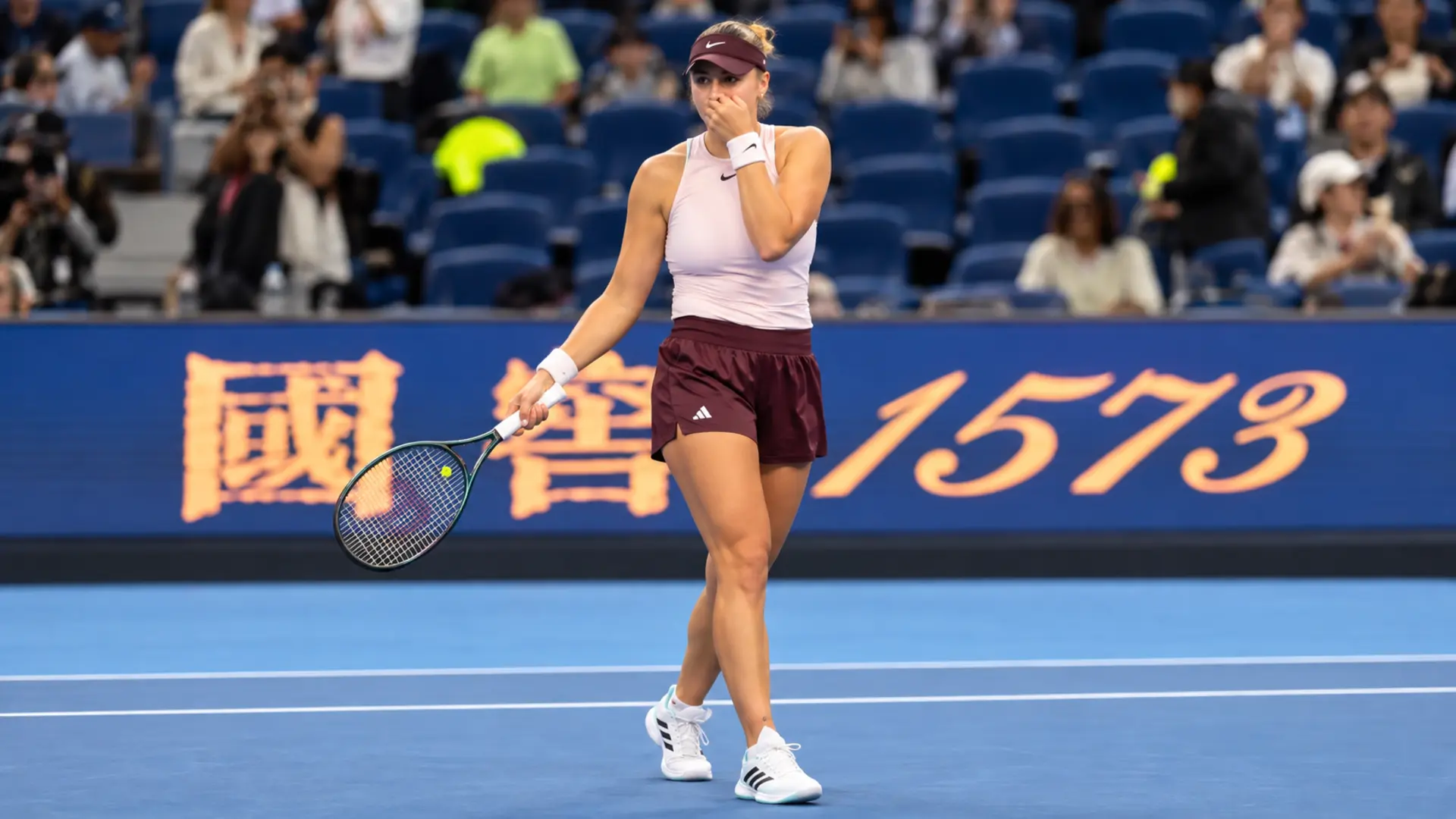
Elena Rybakina vs. Alina Charaeva — China Open 2026 Second-Round Match Report
Alina Charaeva had never faced a player ranked inside the Top 30.
Her first one happened to be world No. 1 Elena Rybakina.
The 24-year-old Armenian did not merely make the occasion respectable. She beat the US Open champion 3-6, 6-4, 6-3, turning what had initially looked like a routine opening match for Rybakina into the biggest upset of the China Open this year.
There had already been concern among fans that Rybakina looked tired, even slightly exhausted, following the rush of events and appearances that came with winning the US Open and becoming world No. 1.
For one set, none of it seemed particularly relevant. Rybakina had the match under control.
Then Charaeva took the first meaningful opening she was given.
By the deciding set, the world No. 1 was unraveling.
Rybakina Recovers From an Early Break to Take Control
The match did not begin perfectly for Rybakina.
Charaeva broke immediately for 1-0, only for the Kazakh to respond at once and level at 1-1.
From there, the favorite began to impose herself.
Rybakina held for 2-1, stayed in front through 3-2 and then broke for 4-2.
Charaeva responded with another break of her own, reducing the deficit to 4-3, but Rybakina immediately restored the advantage.
A break for 5-3 left her serving for the set, and she closed it out 6-3.
At that stage, the match was following the expected script.
Charaeva had shown that she could trouble the top seed, but Rybakina had answered every challenge.
That changed completely in the second.
Charaeva Waits and Strikes at the End of the Set
The second set was much tighter.
Charaeva held for 1-0 before Rybakina leveled. The world No. 1 then broke for 2-1, but Charaeva immediately broke back.
From 2-2 onward, neither woman gave much away.
Charaeva held for 3-2.
Rybakina answered.
The pattern repeated at 4-3 and again at 5-4.
Then came the game that changed the match.
Serving at 4-5, Rybakina could not force another hold.
Charaeva created the opening with one break point and converted it, taking the set 6-4.
There was no need for an extended sequence of missed opportunities. When the chance arrived, she used it.
One set all.
And suddenly the pressure had moved entirely onto the world No. 1.
One Break Is Enough in the Decider
Charaeva began the third set with exactly the composure she had shown at the end of the second.
She held for 1-0.
Rybakina answered.
Charaeva held again for 2-1, then 3-2, keeping the scoreboard pressure firmly on the favorite.
The decisive opening came in the sixth game.
Rybakina lost serve, handing Charaeva a 4-2 lead.
This time there would be no immediate response.
Totally unfazed, Charaeva held serve to make it 5-2 with a love hold.
Rybakina kept herself barely alive with a hold for 5-3, but the Armenian showed no hesitation when serving for the biggest victory of her career.
She closed it out 6-3.
A player who had never previously stood across the net from anyone ranked inside the Top 30 had just defeated No. 1.
Rybakina’s 48 Unforced Errors Tell the Story
The statistical contrast is striking.
Rybakina produced 33 winners, almost twice Charaeva’s 17.
But she also committed 48 unforced errors.
Charaeva made only 17.
Rybakina was still capable of producing the bigger shot, but she could not sustain enough control to turn those moments into dominance.
Charaeva did not need to out-hit her.
She needed to stay present long enough for Rybakina’s error count to become decisive.
And she did exactly that.
The dominance ratio reflected the shift: 1.11 for Charaeva, 0.90 for Rybakina.
The Armenian also won 88 of the 171 points, compared with 83 for the world No. 1.
Charaeva Wins the First-Serve Battle
Perhaps the most surprising statistical difference came on first serve.
Charaeva landed 64 percent of her first serves and won an excellent 76 percent of those points.
Rybakina, usually so dangerous behind that delivery, won only 60 percent of hers.
Charaeva even finished with more aces, six to three.
Rybakina committed seven double faults.
The world No. 1 did have an advantage behind the second serve, winning 50 percent of those points against Charaeva’s 32 percent, but it was not enough to compensate for the damage elsewhere.
Full Match Stats Rybakina vs Charaeva
| Rybakina | Statistic | Charaeva |
|---|---|---|
| Full Match Duration: 2h10m | ||
| 0.90 | Dominance Ratio | 1.11 |
| 33 | Winners | 17 |
| 48 | Unforced Errors | 17 |
| 227 | Serve Rating | 245 |
| 3 | Aces | 6 |
| 7 | Double Faults | 4 |
| 57% (53/93) | 1st Serve % | 64% (50/78) |
| 60% (32/53) | 1st Serve Points Won | 76% (38/50) |
| 50% (20/40) | 2nd Serve Points Won | 32% (9/28) |
| 38% (3/8) | Break Points Saved | 33% (2/6) |
| 188 | Return Rating | 189 |
| 24% (12/50) | 1st Return Points Won | 40% (21/53) |
| 68% (19/28) | 2nd Return Points Won | 50% (20/40) |
| 4/6 | Break Points Won | 5/8 |
| 83 | Total Points Won | 88 |
The Early Danger Came From a Different Name
Rybakina’s Beijing draw had looked uncomfortable from the moment it was made.
The danger we expected to appear first was Yuliia Starodubtseva, the player who had already beaten Rybakina at Roland Garros earlier this season.
That rematch never happened.
Instead, Charaeva took over the role of early-round disruptor.
It makes the upset even more remarkable.
Rybakina did not lose to an established Top-30 opponent hiding behind a low seed. She lost to a 24-year-old ranked No. 118 who had never previously played anyone inside the Top 30.
Her first attempt came against the very top of the rankings.
She won.
Beijing Has Its Upset
The concern around Rybakina’s workload will inevitably grow after this result.
She had just won the US Open, climbed to world No. 1 and then moved through a whirlwind of obligations that came with such a breakthrough. After a New York media tour, Rybakina was received by Slovak President Peter Pellegrini in Bratislava and later by Kazakhstan President Kassym-Jomart Tokayev in Astana before heading to Beijing.
Fans who thought she looked drained and perhaps ill before the China Open will see plenty here to reinforce that impression.
But Charaeva deserves more than becoming a footnote to Rybakina’s fatigue.
She took the match away from the world No. 1.
She absorbed Rybakina’s first-set response, stayed disciplined when the second tightened, and then played the cleaner deciding set.
Her reward is not merely the biggest win of her career.
It will remain the biggest upset of this entire China Open 2026.