
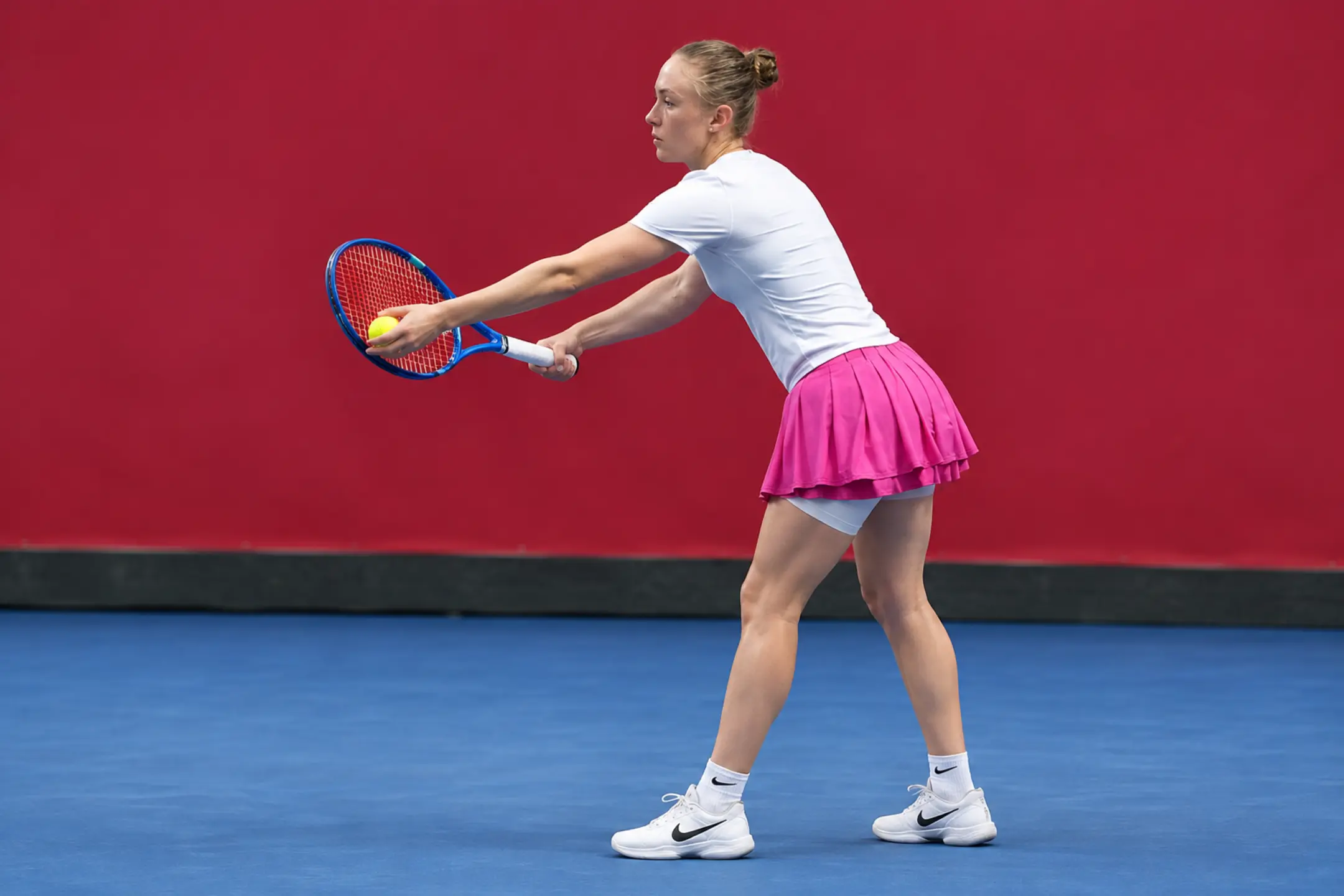
Aliaksandra Sasnovich vs. Talia Gibson — Hong Kong Open 2026 Round-of-16 Match Report.
Aliaksandra Sasnovich has played 38 qualifying matches in 2026. Even after 15 years on the professional circuit, the Belarusian is still traveling the world, fighting for places in tournaments that others enter automatically.
On Wednesday, November 4, she reminded everyone why she is still worth watching.
Sasnovich defeated fifth seed Talia Gibson 6-1, 5-7, 7-6(7) at the Hong Kong Open, surviving two match points in a final-set tiebreak to reach the quarterfinals.
The 32-year-old world No. 101 had initially dominated an opponent ranked No. 36. But Gibson recovered to take the second set and later served for the match at 5-4 in the decider.
Even after Sasnovich forced a tiebreak, the Australian came within one point of victory twice.
The Belarusian saved both match points before completing a remarkable escape.
Six Consecutive Games Give Sasnovich the Opening Set
Gibson began by holding serve, but that was as much encouragement as the Australian would find in the opening set.
Sasnovich held for 1-1 and broke immediately afterward. She consolidated for 3-1, broke again for 4-1 and continued to dominate the exchanges.
Another hold brought her within a game of the set, and a third break completed an emphatic 6-1 opening-set victory.
The Belarusian had won six consecutive games, repeatedly putting Gibson’s serve under pressure.
It was an unusually convincing start against a player ranked 65 places above her, particularly considering the number of matches Sasnovich had already played to reach this stage of the tournament.
But the second set would be a very different contest.
Gibson Recovers to Take a Tight Second Set
The opening four games went with serve before Gibson secured the first break of the set to lead 3-2.
Sasnovich responded immediately, breaking back and then holding to move ahead 4-3.
Neither player could establish another advantage until the closing stages.
Sasnovich held for 5-4, leaving Gibson serving to stay in the match. The Australian answered with a hold of her own and then produced the break she needed.
At 6-5, Gibson had the opportunity to serve out the set.
She did so, completing a 7-5 recovery and sending the match into a decider.
After losing six consecutive games in the opening set, Gibson had gradually worked her way back into contention. Sasnovich, meanwhile, had lost the opportunity to finish a match she had controlled so comfortably at the beginning.
Two Match Points Separate Sasnovich From Defeat
The deciding set brought another succession of changes in momentum.
Sasnovich held the opening game, and the players remained level until Gibson broke for a 3-2 lead.
The Belarusian broke straight back and then moved ahead 4-3, but neither player could establish a lasting advantage.
At 4-4, Gibson struck again, breaking Sasnovich to move within one game of the quarterfinals.
The Australian would serve for the match at 5-4.
But Sasnovich refused to surrender. She broke back in a lengthy game, held for 6-5 and forced Gibson to serve to stay in the contest.
The Australian held, bringing an increasingly tense encounter to a deciding tiebreak.
Sasnovich started strongly, taking a 2-0 lead. Gibson recovered, moved ahead 4-2 and eventually reached 6-4, earning two match points.
Neither was converted.
Sasnovich won three consecutive points to move ahead 7-6, earning her own first match point.
Gibson saved it.
The Belarusian then claimed another point for 8-7 and finally converted her second match point, winning the tiebreak 9-7.
Gibson had served for the match and held two match points in the tiebreak, but Sasnovich had survived both examinations.
After three fiercely contested sets, the qualifier was through to the quarterfinals.
Full Match Stats: Aliaksandra Sasnovich vs. Talia Gibson
| Gibson | Statistic | Sasnovich |
|---|---|---|
| Full Match Duration: 3h05m | ||
| 0.86 | Dominance Ratio | 1.16 |
| 40 | Winners | 49 |
| 30 | Unforced Errors | 24 |
| 236 | Serve Rating | 264 |
| 4 | Aces | 8 |
| 2 | Double Faults | 1 |
| 74% (84/114) | 1st Serve % | 72% (71/99) |
| 60% (50/84) | 1st Serve Points Won | 63% (45/71) |
| 40% (12/30) | 2nd Serve Points Won | 54% (15/28) |
| 54% (7/13) | Break Points Saved | 60% (6/10) |
| 150 | Return Rating | 184 |
| 37% (26/71) | 1st Return Points Won | 40% (34/84) |
| 46% (13/28) | 2nd Return Points Won | 60% (18/30) |
| 4/10 | Break Points Won | 6/13 |
| 101 | Total Points Won | 112 |
 Created by rallyher.com
Sasnovich’s statistical advantage reflects her dominant opening set and greater efficiency across the match.
She finished with 49 winners against 24 unforced errors, compared with Gibson’s 40 winners and 30 unforced errors.
The Belarusian also struck eight aces while committing only one double fault.
Her second serve was particularly effective, winning 54% of points compared with Gibson’s 40%. Sasnovich also converted six of 13 break points and won 11 of her 15 service games.
Gibson had opportunities throughout the final two sets, but Sasnovich proved more effective on the points classified as pressure points, winning 21 of 37.
Across 213 points, the Belarusian claimed 112 to Gibson’s 101.
The numbers suggest Sasnovich was the stronger player overall. The deciding-set scoreboard shows how close she came to losing anyway.
An Unsung WTA Veteran Who Has Never Stopped Fighting
Aliaksandra Sasnovich has spent much of the past 15 years doing what relatively few tennis fans ever see: battling through qualifying draws, often thousands of miles from home, simply to reach another main draw.
Her distinctive, unconventional service motion is familiar to longtime followers of the WTA Tour. So is her willingness to keep competing.
Earlier in her career, Sasnovich compiled an extraordinary record of 11 victories in 11 ITF singles finals.
Success in WTA finals has proved harder to secure.
She has reached several championship matches on the main tour without winning a singles title.
Her most recent final came at the Melbourne Summer Set 2 in January 2022, where she lost to Amanda Anisimova.
Later that year, Sasnovich reached the fourth round of Roland-Garros, defeating Emma Raducanu and former world No. 1 Angelique Kerber before losing to Martina Trevisan.
Those performances demonstrated her ability to compete against the world’s best, even if her achievements rarely attracted the attention given to more decorated players.
Four years later, she is still doing much of the same work.
Thirty-eight qualifying matches in 2026 alone illustrate how demanding her professional life remains.
Two of those matches came in Hong Kong, where she progressed through qualifying before defeating Katie Volynets in the opening round of the main draw.
Her victory over Gibson means she has now won four consecutive matches at the tournament.
It is an achievement that deserves more recognition than her current ranking might suggest.
Maria Sakkari Awaits a Sasnovich Hungry for More
Fourth seed Maria Sakkari will be Sasnovich’s quarterfinal opponent.
The Greek is another experienced competitor, and the Belarusian will need to produce a strong performance to keep her Hong Kong run alive.
But perhaps that is the point of Sasnovich’s career.
She has repeatedly found ways to keep going, whether through qualifying rounds, long matches or difficult periods outside the world’s elite.
Against Gibson, she controlled the first set, lost a tight second and then came within a single point of elimination twice.
After 38 qualifying matches this season, Sasnovich has earned herself something more rewarding in Hong Kong: a place among the final eight, with finally another opportunity to reach a WTA semifinal.