
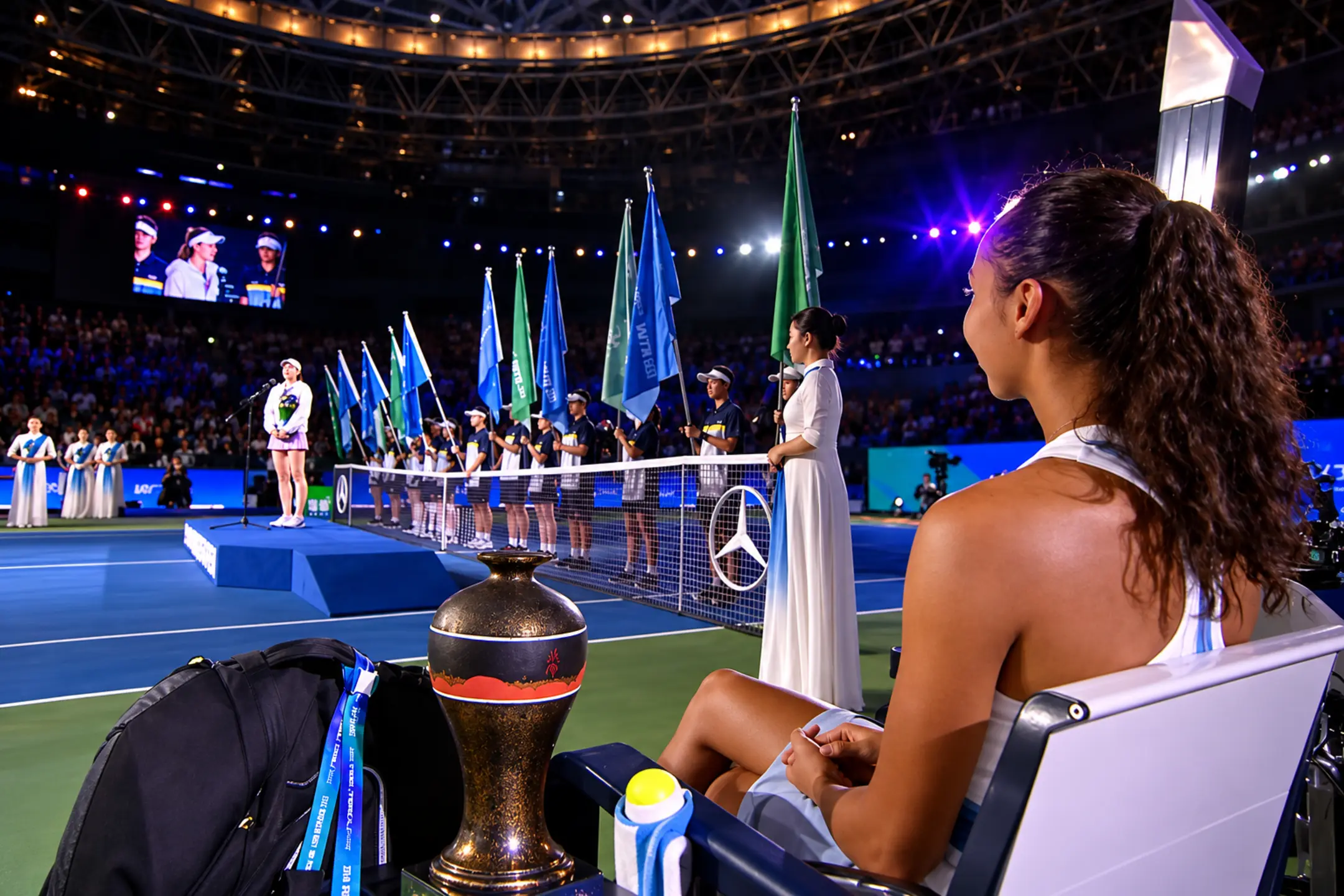
Elena Rybakina vs. Leylah Fernandez — Ningbo Open 2026 Final Match Report.
Elena Rybakina needed a few games to find her rhythm in the Ningbo final. Her backhand, however, seemed to have arrived fully prepared.
The world No. 1 defeated Leylah Fernandez 6-2, 6-2 on Sunday, October 25, claiming her fourth title of the 2026 season and ending the Canadian’s impressive run at the WTA 500 tournament.
Fernandez had made a habit of recovering from difficult positions throughout the week. She wasn’t even supposed to be in the draw, having entered as a replacement for Jessica Pegula. Everything she achieved was a bonus. But against the Kazakh, there would be no comeback.
The scoreline was rather harsh on the Canadian, who remained competitive in several lengthy rallies. Yet whenever an opportunity presented itself, Rybakina was invariably the player who made it count.
And much of the damage came from one side of her racket.
Fernandez Stays Close Until Rybakina Finds Her Range
Rybakina was not quite at the races during the opening exchanges.
Fernandez held her first service game and immediately put pressure on the Kazakh’s serve, earning break points in the second game.
But Rybakina survived to level at 1-1.
The Canadian held again for 2-1, and another Rybakina service game brought the score to 2-2.
Then the match began to change.
The world No. 1 increasingly found her range from the backhand wing. The shot was almost impenetrable, producing return winners and finishing off rallies whenever Fernandez left an opening.
Rybakina broke for 3-2 and consolidated the advantage with a comfortable hold.
Fernandez was suddenly struggling to protect her serve.
Another break followed, putting the Kazakh ahead 5-2 and leaving her to serve for the set.
She made no mistake.
6-2.
From 2-2, Rybakina had won four consecutive games. Her overall game was still not firing on every cylinder, but the backhand was doing more than enough.
Set 1 at a Glance
- Rybakina won 5 of the 6 pressure points. She saved both break points she faced and converted both she earned, which gave her a clean 2-for-2 swing in the big moments.
- Behind her first serve she was close to untouchable, winning 81% of those points (13/16) and holding all four service games.
- Fernandez struggled to make inroads on return, winning just 3 of 16 points against the Rybakina first serve. Three double faults in four service games added to the pressure on her own serve.
Full Set 1 Stats
| Rybakina | Statistic | Fernandez |
|---|---|---|
| Set 1 Duration: 0h38m | ||
| 1.65 | Dominance Ratio | 0.61 |
| 8 | Winners | 4 |
| 12 | Unforced Errors | 11 |
| 298 | Serve Rating | 204 |
| 1 | Aces | 1 |
| 1 | Double Faults | 3 |
| 67% (16/24) | 1st Serve % | 52% (13/25) |
| 81% (13/16) | 1st Serve Points Won | 62% (8/13) |
| 50% (4/8) | 2nd Serve Points Won | 42% (5/12) |
| 100% (2/2) | Break Points Saved | 0% (0/2) |
| 246 | Return Rating | 69 |
| 38% (5/13) | 1st Return Points Won | 19% (3/16) |
| 58% (7/12) | 2nd Return Points Won | 50% (4/8) |
| 2/2 | Break Points Won | 0/2 |
| 29 | Total Points Won | 20 |
Fernandez Keeps Fighting but Cannot Find a Breakthrough
The second set followed a similar pattern.
Fernandez held her opening service game, but Rybakina responded to level at 1-1.
The Kazakh then struck again, breaking the Canadian to move ahead 2-1.
The following game was anything but straightforward.
Fernandez fought her way into several promising positions and earned opportunities to recover the break. Rybakina, however, refused to surrender her serve.
After an extended battle, the world No. 1 held for 3-1.
Fernandez reduced the deficit to 3-2, but that was as close as she would get.
Rybakina moved ahead 4-2 before breaking again to lead 5-2.
The Canadian had produced some excellent tennis, particularly when she was already trailing 0-30 or 15-30 in individual games. Unfortunately, those points often came too late to change the outcome.
Rybakina was far less generous when the decisive moments arrived.
Serving for the championship, the Kazakh closed out the match 6-2, 6-2, securing another title without dropping a set in the final.
Fernandez had fought hard enough to make the contest interesting. But she had never managed to break Rybakina’s serve.
Set 2 at a Glance
- Rybakina hit 17 winners to Fernandez’s 6, while both made 13 unforced errors, so the difference was all on the attacking side.
- Fernandez had two chances to get back on serve and took neither. Rybakina saved both break points and again held all four of her service games.
- Fernandez’s second serve gave her nothing to work with: she won only 2 of 6 points behind it, and Rybakina won half of all her return points in the set.
Full Set 2 Stats
| Rybakina | Statistic | Fernandez |
|---|---|---|
| Set 2 Duration: 0h39m | ||
| 1.41 | Dominance Ratio | 0.71 |
| 17 | Winners | 6 |
| 13 | Unforced Errors | 13 |
| 296 | Serve Rating | 211 |
| 2 | Aces | 1 |
| 1 | Double Faults | 0 |
| 68% (21/31) | 1st Serve % | 70% (14/20) |
| 67% (14/21) | 1st Serve Points Won | 57% (8/14) |
| 60% (6/10) | 2nd Serve Points Won | 33% (2/6) |
| 100% (2/2) | Break Points Saved | 33% (1/3) |
| 227 | Return Rating | 73 |
| 43% (6/14) | 1st Return Points Won | 33% (7/21) |
| 67% (4/6) | 2nd Return Points Won | 40% (4/10) |
| 2/3 | Break Points Won | 0/2 |
| 30 | Total Points Won | 21 |
Rybakina’s Backhand and Serve Prove Decisive
The statistics underline how much more effective Rybakina was when opportunities appeared.
The Kazakh finished with 25 winners against Fernandez’s 10, while their unforced-error counts were almost identical at 25 and 24 respectively.
That difference in attacking effectiveness was reflected in the dominance ratio: 1.49 for Rybakina against 0.67 for Fernandez.
The world No. 1 won 73% of points behind her first serve and 56% behind her second delivery. Fernandez managed 59% and 39%, respectively.
But the most revealing figures came on break points.
Fernandez created four opportunities without converting any of them. Rybakina saved all four, holding serve throughout the match.
At the other end, she converted four of her five break points.
That efficiency made the difference in a contest containing several games that were considerably closer than the final score suggests.
Rybakina’s backhand was particularly impressive. She used it to produce outright return winners, control exchanges and finish points that Fernandez had worked hard to keep alive.
The Kazakh also showed a willingness to move forward, winning five of seven points at the net.
Her serve rating reached 297, compared with Fernandez’s 207, while her return rating of 232 was comfortably ahead of the Canadian’s 71.
Overall, Rybakina won 59 of the 100 points played, including 11 of the 15 pressure points.
Fernandez managed to trouble the world No. 1 at times, but her vulnerable serve repeatedly left her chasing the score.
And when she did create openings, Rybakina offered very few presents.
Full Match Stats Rybakina vs Fernandez
| Rybakina | Statistic | Fernandez |
|---|---|---|
| Full Match Duration: 1h16m | ||
| 1.49 | Dominance Ratio | 0.67 |
| 25 | Winners | 10 |
| 25 | Unforced Errors | 24 |
| 297 | Serve Rating | 207 |
| 3 | Aces | 2 |
| 2 | Double Faults | 3 |
| 67% (37/55) | 1st Serve % | 60% (27/45) |
| 73% (27/37) | 1st Serve Points Won | 59% (16/27) |
| 56% (10/18) | 2nd Serve Points Won | 39% (7/18) |
| 100% (4/4) | Break Points Saved | 20% (1/5) |
| 232 | Return Rating | 71 |
| 41% (11/27) | 1st Return Points Won | 27% (10/37) |
| 61% (11/18) | 2nd Return Points Won | 44% (8/18) |
| 4/5 | Break Points Won | 0/4 |
| 59 | Total Points Won | 41 |
Four Titles and Counting for the World No. 1
Rybakina’s victory in Ningbo completes another outstanding week in a remarkable season.
The Kazakh has now won four tournaments in 2026. Her haul includes two Grand Slam titles and two WTA 500 trophies. No other player has managed more than three tournament victories this season.
And she has achieved that distinction without necessarily producing her finest tennis throughout Ningbo.
Katarzyna Kawa took a set off her in the quarterfinals. Diana Shnaider pushed her hard in the semifinals, particularly with her left-handed serve.
Fernandez arrived in the final having repeatedly fought back against difficult opponents.
But the Canadian found herself facing a Rybakina who was becoming increasingly comfortable with each passing round.
The world No. 1 may not have been at her sharpest throughout Sunday’s final, but she had enough weapons to keep Fernandez at a distance.
In fact, one weapon was particularly difficult to overcome.
Tokyo is next.
And judging by what happened in Ningbo, anyone looking for a weakness in Rybakina’s game would be wise to start somewhere other than her backhand.