
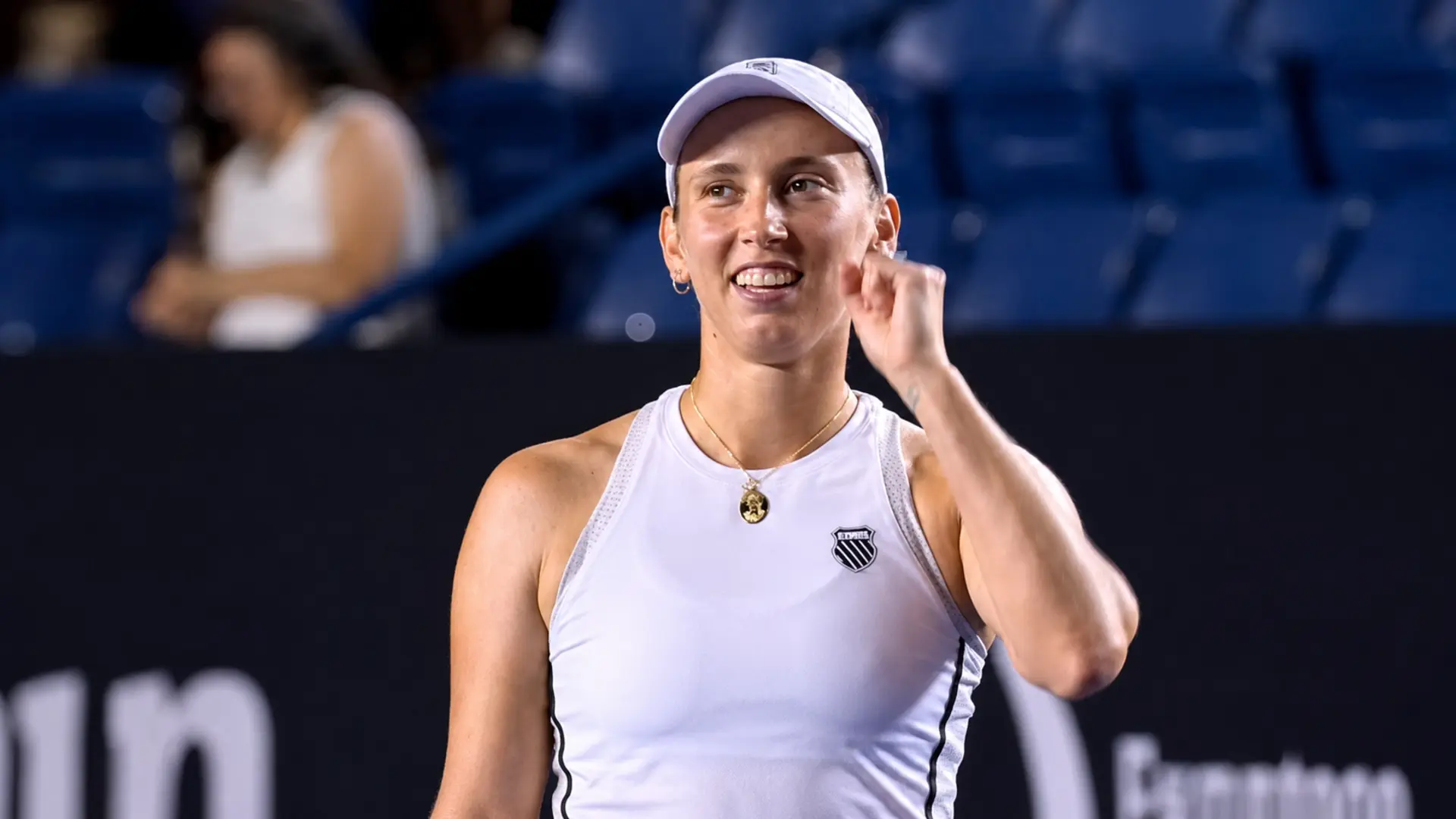
Elise Mertens’ remarkable China Open run did more than add another deep WTA 1000 result to what is becoming one of the finest seasons of her career.
It also pushed the 30-year-old Belgian past Justine Henin in career prize money.
Mertens has now earned $21,155,310 across her career, moving above Henin’s $20,863,335 and into 27th place on the all-time WTA prize-money list.
That is a striking sentence when placed next to the careers involved.
Henin won seven Grand Slam singles titles, spent 117 weeks as world No. 1 and collected 43 singles trophies. Her four Roland Garros titles alone form one of the great clay-court records of the modern era.
Mertens has built a very different career.
And yet, after Beijing, the numbers now put her ahead of one of Belgian tennis’ biggest icons in career earnings.
Mertens Passes Henin but Clijsters Is Still Ahead
Belgium is roughly the size of Maryland and only a little larger than South West England. From that small patch of Europe came Justine Henin, Kim Clijsters and now Elise Mertens, all three inside the WTA’s all-time top 30 for career prize money.
Kim Clijsters remains the Belgian leader at $24,545,194, good enough for 22nd overall on the figures supplied here.
Mertens sits 27th at $21,155,310.
Henin follows directly behind at 28th with $20,863,335.
That leaves Mertens $3,389,884 behind Clijsters.
And Clijsters is another name that shows why prize money cannot simply be read as a ranking of career greatness.
The daughter of a famous Belgian footballer won four Grand Slam singles titles, including three US Opens and the 2011 Australian Open, while also reaching world No. 1. Henin, meanwhile, won seven majors.
Mertens has not built her career around Grand Slam singles trophies at all.
Yet financially, she has now moved beyond Henin.
That tells us something about Elise Mertens.
It also tells us something about how much the tour has changed.
Why Career Prize Money Needs Some Context
Mertens overtaking Henin is absolutely an achievement, but it is not an apples-to-apples comparison between eras.
Prize money on the women’s tour has risen substantially.
The WTA announced a record $249 million in prize money for 2025, up 13 percent from $221 million in 2024 alone. WTA 1000 tournaments ranged from roughly $3.6 million to $9.5 million in total prize money that season.
The tour structure has also created more opportunities at the highest regular level.
The WTA expanded the top tier to 10 WTA 1000 tournaments, and the 2026 calendar contains all 10, with seven using an extended 12-day format.
That is a very different financial environment from the one Justine Henin competed in.
So Mertens moving ahead should not be interpreted as meaning she has somehow surpassed Henin’s career achievements.
She has not.
But earning more than $21 million across a long career still requires years of consistency at the highest level.
And that is where Mertens’ achievement becomes particularly impressive.
Mertens Has Quietly Built an Enormous Career
There has rarely been much drama around Elise Mertens.
That almost works against her when discussing how significant her career has become.
She first picked up a racket at four after being introduced to tennis by her older sister Lauren.
Her first memory of the sport was watching Kim Clijsters play live, which makes it rather fitting that Clijsters is now the Belgian woman immediately ahead of her on this particular list.
Mertens grew up in a multilingual household. Her mother, Liliane Barbe, teaches languages and history, while her father, Guido Mertens, makes furniture for churches. Mertens herself speaks English, Dutch/Flemish and French and was home-schooled during part of her development.
None of that screams superstar machinery.
Her career has instead been built on durability, adaptability and an ability to keep turning up deep into tournaments year after year, in both singles and doubles.
6 Grand Slam doubles titles
- Australian Open: 2021, 2024, 2026
- Wimbledon: 2021, 2025
- US Open: 2019
That same reliability is now being joined by some of the best tennis of her life.
Beijing Changed the Equation
Mertens’ run at the China Open was not a routine accumulation of prize money.
She was playing exceptional tennis.
At 30, she looked sharper in almost every department. Her serve carried more authority. Her returning was aggressive. The forehand down the line hurt opponents. Her defensive backhand repeatedly kept points alive that looked finished.
Coco Gauff went out.
Iga Swiatek followed.
Only Qinwen Zheng finally stopped her in the semifinal.
That Beijing run helped lift Mertens beyond Henin’s career prize-money total and reinforced something that has become increasingly difficult to ignore in 2026:
Mertens is not winding down. She may actually be playing her best tennis now.
No. 11 in 2026 Prize Money
Her year-to-date position underlines it.
Mertens currently sits 11th in 2026 prize money at about $2.66 million before her Wuhan earnings are fully added, ahead of Naomi Osaka, Belinda Bencic and Iva Jovic.
That is remarkable company for a player who often receives less attention than those immediately around her.
And Wuhan gives her another opportunity.
Mertens begins against Daria Snigur.
Win that, and Janice Tjen awaits.
After that, the draw becomes considerably less friendly.
Aryna Sabalenka, the tournament’s No. 1 seed, is waiting in that section.
Still, after what Mertens did in Beijing, dismissing another deep run would be unwise.
One Belgian Legend Passed, Another Still Ahead
Mertens is now less than $3.4 million behind Clijsters.
Whether she ever closes that gap is secondary to what the milestone already says about her longevity.
Henin’s seven majors make her one of the greatest players Belgium has ever produced. Clijsters’ four make her another.
Mertens’ career has taken another route entirely.
She has accumulated, persisted and remained relevant for years, and now, at 30, she is producing some of her most convincing tennis.
Passing Henin in prize money does not rewrite Belgian tennis history.
It adds a fascinating new line to it.
First, Belgium had Justine Henin from the French-speaking part of the country, then Kim Clijsters from the Dutch-speaking part, and now Elise Mertens, a bilingual woman born in the heart of Belgium.