
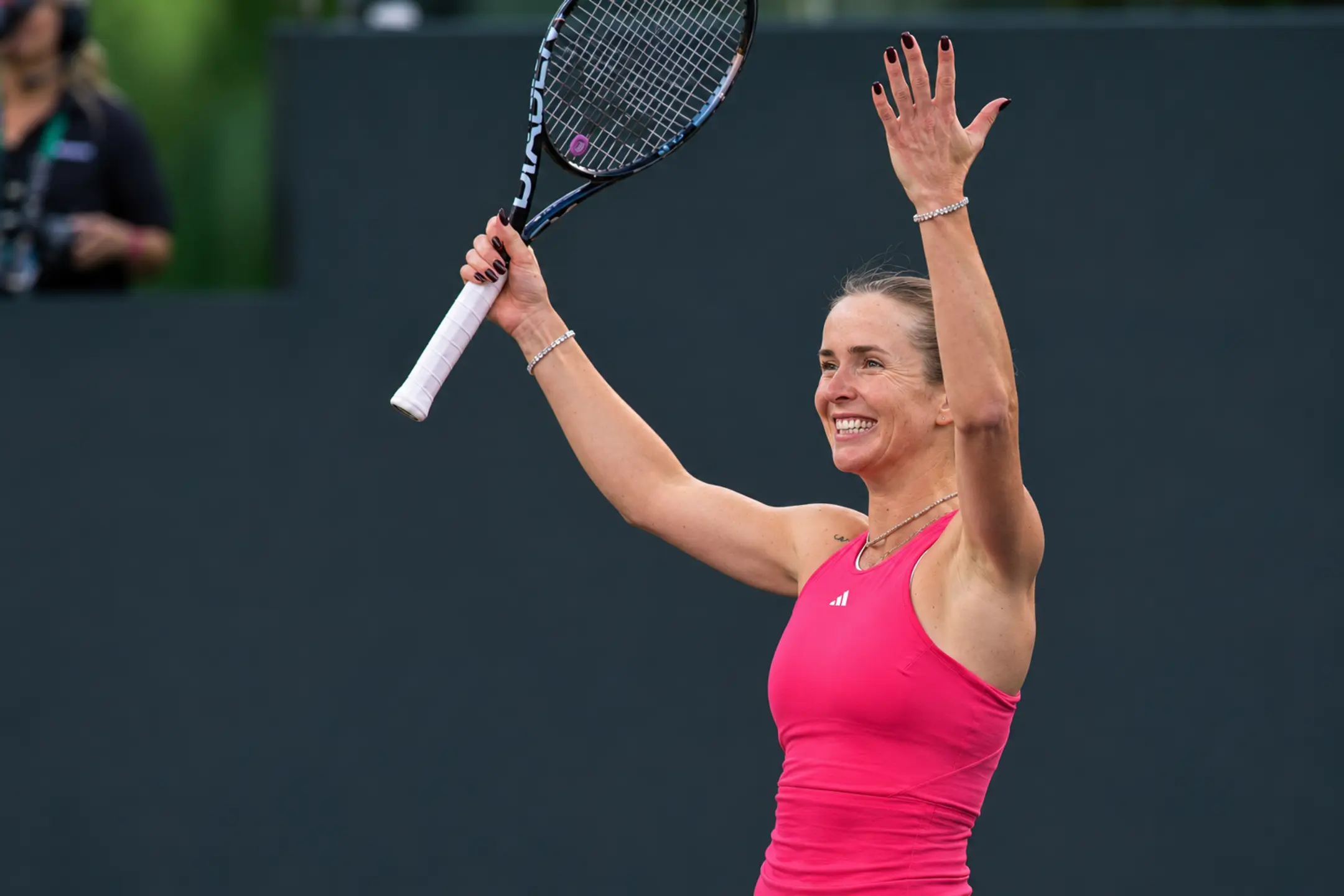
Aryna Sabalenka vs. Elina Svitolina — Indian Wells WTA Finals 2026 Group 2 Round-Robin Match Report.
Thirty-five unforced errors, just 52% of first-serve points won and six consecutive games lost in the deciding set. Aryna Sabalenka’s defeat to Elina Svitolina exposed weaknesses that one impressive second set could only temporarily disguise.
The warning signs had been visible since last year’s WTA Finals.
Yet much of the corporate WTA media and the familiar chorus of tennis commentators appeared more interested in celebrating Sabalenka’s occasional dominant spells than examining the recurring problems beneath them.
What had too often been brushed under the carpet is now impossible to ignore.
Elina Svitolina defeated the Belarusian 6-3, 3-6, 6-1 on Friday, November 13, completing a remarkable turnaround at the WTA Finals in Indian Wells and securing her place in the semifinals.
For Sabalenka, the defeat brought a miserable conclusion to a tournament that once again has exposed serious weaknesses in her game. Her movement looked hesitant, her serve worked only intermittently, and the overwhelming power that once intimidated opponents was nowhere near as effective.
Svitolina, meanwhile, had every reason to celebrate. After suffering a crushing 6-4, 6-0 defeat against Mirra Andreeva in her opening match, the Ukrainian has now fought her way into the last four.
And she did it by exposing the growing vulnerability of one of women’s tennis’s most formidable champions.
Svitolina Turns the Opening Set Around After an Early Sabalenka Blitz
Sabalenka began as though determined to erase the memory of her heavy defeat against Andreeva.
She broke Svitolina immediately and consolidated for 2-0, producing the kind of aggressive tennis that has brought her so much success.
For a brief period, her groundstrokes were finding their targets, and the Ukrainian struggled to establish herself in the rallies.
But the advantage disappeared almost as quickly as it had arrived.
Svitolina held for 2-1 before breaking Sabalenka to level at 2-2.
The Ukrainian was beginning to find her defensive rhythm, extending rallies and making Sabalenka play additional shots rather than allowing her to dictate exchanges with one or two powerful strikes.
Svitolina moved ahead 3-2, although Sabalenka responded with a hold for 3-3.
That was the Belarusian’s last game of the set.
The Ukrainian held for 4-3, survived a demanding service game and then broke Sabalenka again to move ahead 5-3.
Serving for the set, Svitolina maintained her composure and closed it out 6-3.
Sabalenka had started brightly, but her early dominance had given way to increasingly uncomfortable exchanges.
Sabalenka Finds Her Forehand as Svitolina’s Serve Falters
The second set initially suggested that Sabalenka’s difficulties might finally be coming to an end.
She held her opening service game, and after Svitolina leveled, the Belarusian moved ahead 2-1.
The decisive shift came when the Ukrainian’s serve began to misfire.
Svitolina had struggled with her delivery at times, but now the problems became considerably more pronounced.
Sabalenka took full advantage, breaking for 3-1 and consolidating for 4-1.
For the first time since the opening stages, the Belarusian began stringing together convincing sequences of points.
Her forehand was particularly effective.
She was stepping into the court with greater authority, driving through the ball and finding the angles that had been missing during much of the opening set.
Another break extended her advantage to 5-1.
Svitolina refused to surrender, breaking back for 5-2 and holding to reduce the deficit to 5-3.
But Sabalenka steadied herself and served out the set 6-3, forcing a decider.
The question was whether this represented a genuine recovery or merely a temporary improvement helped by Svitolina’s unreliable serving.
The third set provided an emphatic answer.
One Early Break and Then Sabalenka’s Game Completely Unravels
Sabalenka made the ideal start to the deciding set, breaking immediately for 1-0 and seemingly carrying her second-set momentum into the final stages.
But Svitolina responded at once, breaking back for 1-1 before holding to move ahead 2-1.
From that moment, Sabalenka’s game deteriorated rapidly.
It all felt eerily reminiscent of the closing stages of the first set.
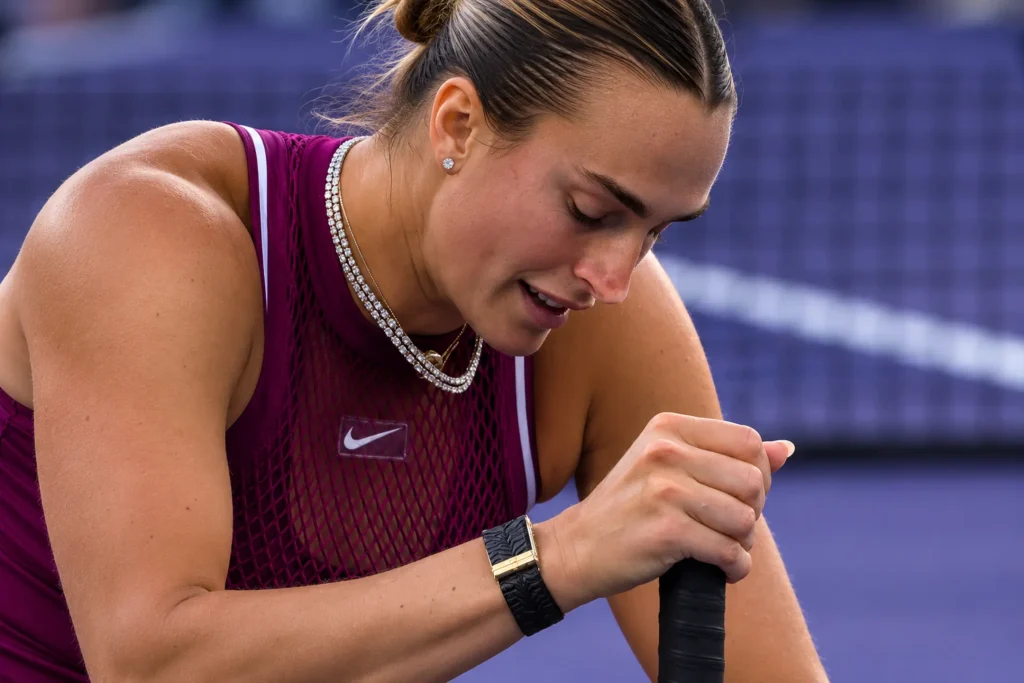
The frustration, the increasingly subdued screams, the irregular breathing, the prolonged pauses between points and the anxious glances toward her box. She looked like a player battling her own demons.
Her footwork became increasingly uncertain, leaving her poorly positioned for the powerful groundstrokes that normally underpin her game.
Svitolina recognized the opportunity.
The Ukrainian took control of the baseline exchanges, overpowering Sabalenka with aggressive groundstrokes and repeatedly forcing the Belarusian onto the defensive.
Sabalenka struggled to withstand the assault, and her errors mounted.
Too often, Sabalenka could not deliver.
The Ukrainian broke for 3-1, consolidated for 4-1 and struck again for 5-1.
By then, the contest had become painfully one-sided.
Sabalenka’s earlier forehand dominance had vanished, replaced by hurried errors and an inability to sustain pressure.
But serving for the match proved anything but straightforward. Svitolina was dragged through several deuces and saw three match points slip away, twice when Sabalenka’s shots landed right on the line.
Yet the Ukrainian refused to abandon her aggressive approach. She stuck to her guns, kept taking the initiative and finally converted her fourth match point to seal a 6-1 deciding set.
The Ukrainian had won six consecutive games after losing her opening service game, rediscovering the level needed to defeat one of the world’s leading players.
Svitolina’s Defense Exposes Sabalenka’s Growing Weaknesses
The match statistics make uncomfortable reading for Sabalenka.
| Sabalenka | Statistic | Svitolina |
|---|---|---|
| Full Match Duration: 1h53m | ||
| 0.84 | Dominance Ratio | 1.19 |
| 21 | Winners | 21 |
| 35 | Unforced Errors | 24 |
| 195 | Serve Rating | 236 |
| 1 | Aces | 6 |
| 3 | Double Faults | 9 |
| 49% (33/68) | 1st Serve % | 58% (52/90) |
| 52% (17/33) | 1st Serve Points Won | 65% (34/52) |
| 46% (16/35) | 2nd Serve Points Won | 45% (17/38) |
| 25% (2/8) | Break Points Saved | 60% (6/10) |
| 161 | Return Rating | 228 |
| 35% (18/52) | 1st Return Points Won | 48% (16/33) |
| 55% (21/38) | 2nd Return Points Won | 54% (19/35) |
| 4/10 | Break Points Won | 6/8 |
| 72 | Total Points Won | 86 |
 Created by rallyher.com
Both players finished with 21 winners, but Sabalenka committed 35 unforced errors to Svitolina’s 24.
The difference behind their first serves was even more revealing. Sabalenka won just 52% of first-serve points, compared with Svitolina’s 65%. For a player whose success relies heavily on powerful serving and aggressive first-strike tennis, that was troubling.
Svitolina converted six of eight break points (75%), while Sabalenka managed just four of ten.
The Ukrainian’s superior defensive positioning was particularly evident in longer rallies. She repeatedly retrieved shots Sabalenka expected to finish points, forcing the Belarusian to hit again under mounting pressure.
Svitolina also dominated at the net, winning 11 of 14 points, compared with Sabalenka’s three of eleven.
The pressure statistics reinforced the picture: Svitolina won 19 of 29 pressure points, while Sabalenka claimed just ten.
This was not simply a match decided by poor serving or costly errors.
Svitolina raised her level after a difficult second set, exposing weaknesses Sabalenka could no longer conceal.
Svitolina’s Remarkable Revival Earns Her a Semifinal Against Noskova
Few players at this year’s WTA Finals have experienced such a dramatic change in fortunes.
Svitolina began her campaign with a comprehensive defeat against Andreeva, winning just four games.
She then recovered from a set down to defeat Karolina Muchova before producing Friday’s impressive victory over Sabalenka.
Two wins from three matches have secured her semifinal place.
Her next opponent is Linda Noskova, the Czech who topped Group 1 despite losing her final round-robin match against Jessica Pegula.
Noskova has been among the tournament’s most convincing performers, combining formidable serving with aggressive, accurate groundstrokes.
But Noskova should be under no illusion about the challenge ahead. When Elina Svitolina gets on a roll, she becomes one of the most dangerous opponents in women’s tennis. Her movement sharpens, her defense becomes relentless, and every extra ball she sends back across the net makes life increasingly uncomfortable for even the most powerful hitters.
Sabalenka discovered that the hard way. Noskova may well be next. The Czech has the weapons to defeat anyone, but Svitolina now has the confidence and momentum to turn even the most difficult semifinal into a match she can win.
In essence, the Ukrainian who looked so comprehensively beaten earlier in the week is now just one victory away from the WTA Finals championship match.
Sabalenka Faces a Difficult Winter Before the Australian Open
For Sabalenka, the implications extend well beyond one disappointing tournament.
Only a month ago, the Belarusian was still associated with a remarkable reign of 99 weeks at world No. 1.
Now her position near the top of the rankings is under threat, and the authority with which she once controlled matches has diminished.
The problems are becoming difficult to dismiss as an isolated loss of form.
Her movement appears less assured, her serve unreliable for long stretches, and opponents are finding greater success by extending rallies rather than attempting to match her power.
There has been speculation about possible changes to her coaching team, although no such decision has been confirmed.
Whatever happens behind the scenes, considerable work awaits before the Australian Open.
Sabalenka has the weapons to recover. Few players possess her combination of power and attacking ability.
But those weapons lose much of their effectiveness when her positioning and consistency are compromised.
Friday’s deciding set offered the clearest illustration.
Svitolina did not need to hit spectacular winners to dismantle the former world No. 1. She simply kept returning the ball, defending intelligently and waiting for Sabalenka’s next mistake.
That is the most worrying development for a champion whose greatest strength was once making opponents feel they had no answer. At these WTA Finals, Elina Svitolina found one—and Aryna Sabalenka had nothing left to counter it.