
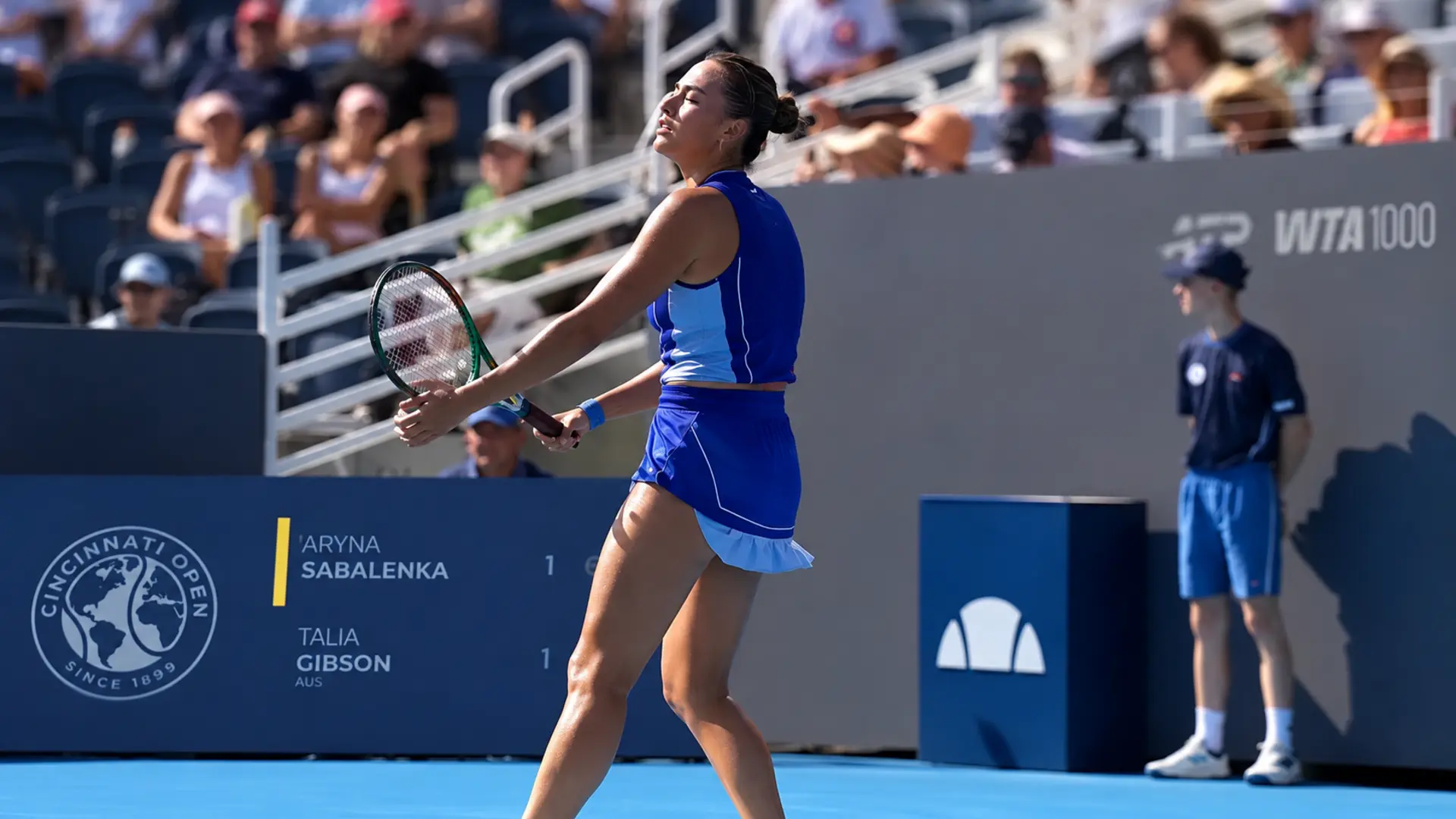
Aryna Sabalenka vs. Talia Gibson — Cincinnati 2026 R64 Match Report
Aryna Sabalenka has spent the year swatting away lower-ranked opponents without much fuss, and for a set in Cincinnati it looked like more of the same. Talia Gibson, the 65th-ranked Australian and 60 spots her junior in the rankings, had other plans. She dug in, forced a second-set tiebreak, and made the world No. 1 work far harder than a straightforward 2-0 finish would suggest.
Sabalenka won 6-2, 7-6(2) in the round of 64, a result that flatters the scoreline more than the match itself did. Gibson broke serve five times across the contest and had the top seed serving to stay in the second set at one stage. It took a dominant tiebreak to finally shut the door.
A few numbers set the tone: 13 aces for Sabalenka against two for Gibson, a wide gap in winners, and a second set that swung on a single game neither player could hold.
Four Early Breaks Set the Tone Before Sabalenka Pulls Clear
Nothing about the opening set suggested control from either player. Sabalenka broke to open, was broken straight back, then broke again for 2-1, three service breaks inside the first three games.
Both players settled briefly, trading holds to 3-2 and 4-2, before Sabalenka broke a fourth time to move to 5-2 and served out the set 6-2.
Four breaks in eight games is a chaotic way to open a match between the world No. 1 and a player ranked outside the top 60. Gibson had chances of her own in that opening exchange, breaking Sabalenka’s serve in just the second game. She simply couldn’t sustain it, losing her own serve three times to the top seed’s once.
Sabalenka vs Gibson – Key Set 1 Stats
- Sabalenka won 70% of pressure points (7/10) compared with Gibson’s 30% (3/10).
- Sabalenka won her return games 75% of the time (3/4), while Gibson managed just 25% (1/4).
- Gibson committed 5 double faults to Sabalenka’s 1, and Sabalenka won 60% of total points (33/55).
Full Set 1 Stats
| Sabalenka | Statistic | Gibson |
|---|---|---|
| Set 1 Duration: 0h40m | ||
| 1.49 | Dominance Ratio | 0.67 |
| 9 | Winners | 4 |
| 8 | Unforced Errors | 6 |
| 245 | Serve Rating | 152 |
| 3 | Aces | 1 |
| 1 | Double Faults | 5 |
| 59% (19/32) | 1st Serve % | 52% (12/23) |
| 63% (12/19) | 1st Serve Points Won | 58% (7/12) |
| 46% (6/13) | 2nd Serve Points Won | 21% (3/14) |
| 0% (0/1) | Break Points Saved | 25% (1/4) |
| 271 | Return Rating | 216 |
| 42% (5/12) | 1st Return Points Won | 37% (7/19) |
| 79% (11/14) | 2nd Return Points Won | 54% (7/13) |
| 3/4 | Break Points Won | 1/1 |
| 33 | Total Points Won | 22 |
Sabalenka Breaks for 6-5, Then Fails to Serve It Out
The second set settled into a much tighter pattern than the first. Both players held serve through the first ten games, Gibson doing it from 1-0, 2-1, 3-2, 4-3 and 5-4 up at various points without ever finding the extra break she needed to pull clear. Sabalenka couldn’t find one either. Neither could separate herself, and the set ran to 5-5.
Sabalenka finally broke through in the eleventh game. She raced to 40-15 on Gibson’s serve and converted her first break point to move ahead 6-5, a clean, comfortable break with no deuce required.
What followed was the defining sequence of the match. Serving for it at 6-5, Sabalenka reached 40-30 for a first match point. Gibson saved it. The game went to deuce, and Sabalenka earned advantage for a second match point. Gibson saved that one too.
It kept happening. Deuce, advantage, match point, saved. Four more times, Gibson found the point she needed exactly when she needed it, fighting off five match points in total without so much as a let-up in the pressure. On her second chance of the game, this one for herself, Gibson finally converted a break point of her own to level the set at 6-6.
It was as dramatic a hold as tennis produces, a run of survival that turned a set Sabalenka had all but closed out into a tiebreak that would now decide the match.
A One-Sided Tiebreak Ends the Resistance
Whatever composure Gibson had shown to force that decisive swing evaporated in the breaker. Sabalenka took an early mini-break for 3-1, extended it to 5-2, and closed out the tiebreak 7-2 to win the set 7-6(2) and the match.
It was a stark contrast to everything that had preceded it. A set that had been decided by a single break in either direction for eleven straight games ended with Sabalenka winning six of the tiebreak’s final seven points.
The world No. 1 found another gear exactly when she needed it, and Gibson had nothing left to answer with.
Sabalenka vs Gibson – Key Set 2 Stats
- Sabalenka hit 10 aces to Gibson’s 1, and 23 winners to Gibson’s 10.
- Sabalenka won 73% of her first serve points (22/30) compared with Gibson’s 56% (14/25).
- Sabalenka won 53% of total points (49/92) despite committing more unforced errors, 14 to Gibson’s 9.
Sabalenka vs Gibson – Full Set 2 Stats
| Sabalenka | Statistic | Gibson |
|---|---|---|
| Set 2 Duration: 1h14m | ||
| 1.14 | Dominance Ratio | 0.88 |
| 23 | Winners | 10 |
| 14 | Unforced Errors | 9 |
| 276 | Serve Rating | 256 |
| 10 | Aces | 1 |
| 1 | Double Faults | 2 |
| 61% (30/49) | 1st Serve % | 58% (25/43) |
| 73% (22/30) | 1st Serve Points Won | 56% (14/25) |
| 50% (10/20) | 2nd Serve Points Won | 60% (12/20) |
| 50% (1/2) | Break Points Saved | 67% (2/3) |
| 134 | Return Rating | 144 |
| 44% (11/25) | 1st Return Points Won | 27% (8/30) |
| 40% (8/20) | 2nd Return Points Won | 50% (10/20) |
| 1/3 | Break Points Won | 1/2 |
| 49 | Total Points Won | 43 |
Sabalenka’s Serve Made the Difference
The scoreline suggests total control. The set-two numbers tell a different story. Gibson actually won more break points than she lost across the match, converting 2 of 3, and her return rating of 168 was closer to Sabalenka’s 194 than a 6-2, 7-6 loss usually implies.
On pressure points specifically, the two were dead level, five apiece out of ten.
Where Sabalenka pulled away was on the reliability of her own serve. She struck 13 aces to Gibson’s two and won 71 percent of her first-serve points to Gibson’s 59.
Her double-fault count stayed low at just two, while Gibson leaked seven, a difference that shows up starkly in the double-fault rate: 10.6 percent for the Australian against 2.5 for the top seed.
Sabalenka’s total-points tally, 82 of 147, reflected a players’ gap that the set scores somewhat exaggerated but didn’t invent.
An Australian on the Rise
Gibson is only 21 and still building her résumé at this level.
Born in Perth, she broke into the top 100 for the first time in March, a goal she’d set herself at the start of the year, and reached her first WTA Masters-level second week at Indian Wells by beating players ranked 11th and 16th in the world in back-to-back matches.
A run like that against the top seed in Cincinnati, even in defeat, fits the pattern of a player whose ceiling keeps climbing faster than her ranking suggests.
Wang Xinyu Awaits in the Next Round
Sabalenka needed a tiebreak to see off an opponent 60 places below her, evidence that her form, while good enough to win, isn’t yet frictionless.
She moves on to face Wang Xinyu, China’s No. 1 and the 42nd-ranked player in the world, in the next round, a rematch of the level of test Gibson just gave her, only against a far more experienced opponent.