
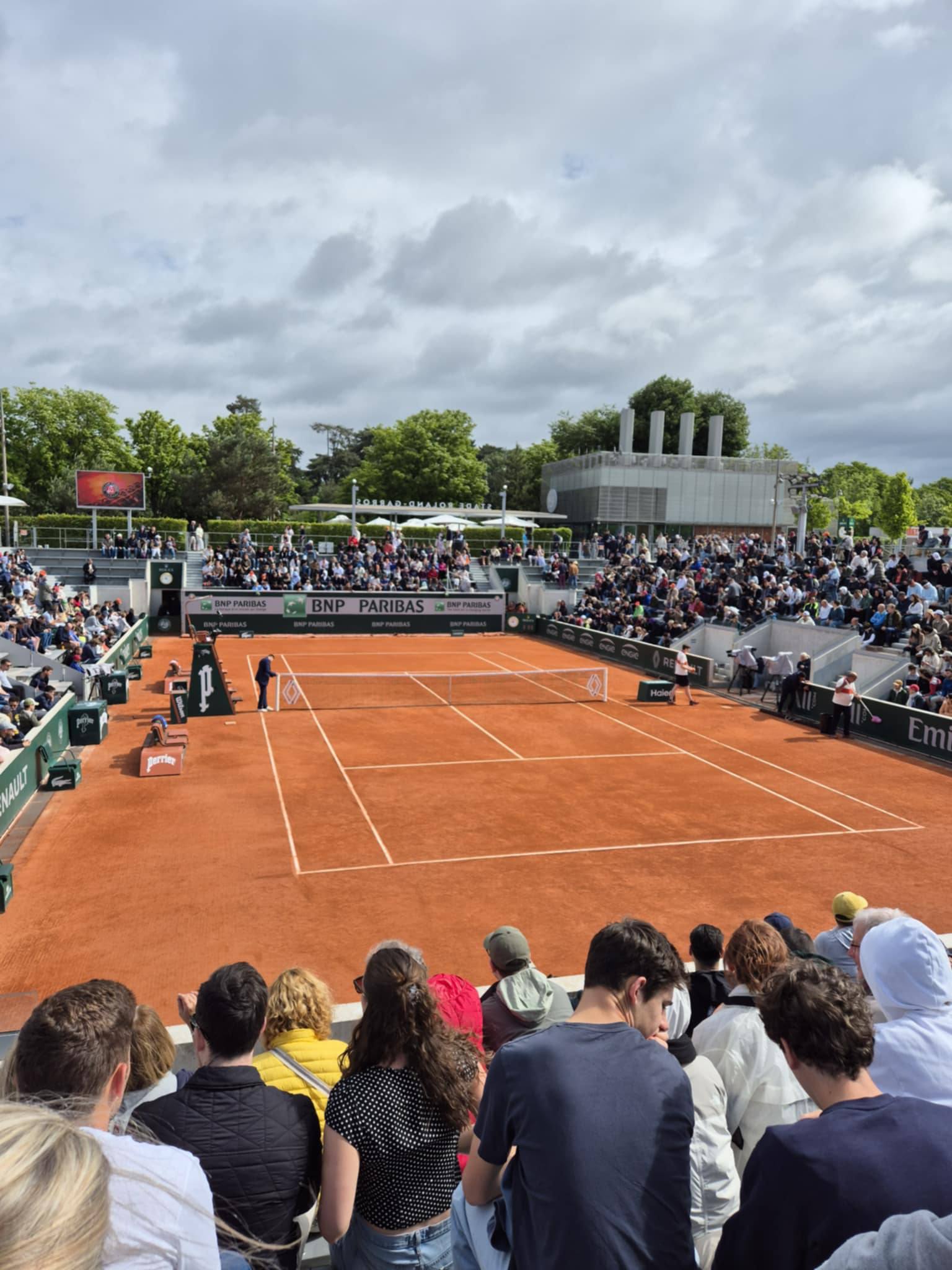
Roland Garros has a very modern problem wrapped inside its oldest surface.
Clay leaves marks. Tennis now loves technology. Players want certainty. Fans want instant proof. And somewhere in the middle stands Amélie Mauresmo, trying to explain why the French Open is not yet ready to hand the whole thing over to machines.
The Roland Garros tournament director addressed one of the most sensitive debates of this year’s tournament: why the event still relies on human line judges and chair umpires on clay while electronic line-calling becomes increasingly common elsewhere.
Her answer was simple enough.
The technology is not ready.
“The thing is that as of today and from what we’ve seen in the previous clay court tournaments in the last few months is that it appears that the technology on clay is not 100% reliable,” Mauresmo said.
That sentence may not satisfy everyone, especially after another clay swing full of disputed marks, angry players and television replays that seem to invite their own verdict. But it does explain Roland Garros’ current position. On clay, where the ball leaves a visible trace and surface conditions can change the reading, the tournament still believes the human eye has not yet been fully replaced.
Mauresmo Keeps the Human Call for Now
Mauresmo did not present Roland Garros as anti-technology. That would be impossible in a sport moving rapidly toward electronic systems.
Instead, she framed the issue as one of reliability.
On hard courts and grass, electronic line-calling has become part of the sport’s direction. On clay, the argument is messier. Ball marks are visible, but not always as simple as they look. The surface shifts. Marks overlap. Players point to one spot, umpires inspect another, and the camera angle at home can make everyone feel certain in different directions.
That is the contradiction Roland Garros is trying to manage.
Mauresmo said the tournament reviews these systems every year, particularly with electronic line-calling becoming more common across the ATP and WTA tours. But for now, Roland Garros is not prepared to pretend that the technology has solved clay.
That position will not end the debate.
It may even intensify it.
Because the moment a player loses a key point on a disputed mark, the question returns: is human judgement still the best answer, or simply the answer Roland Garros trusts most?
Scheduling Questions Still Stay Behind Closed Doors
The press conference did not stop with line-calling.
Mauresmo was also asked about scheduling, night sessions and whether player or television requests influence where and when matches are placed. That topic has become a recurring pressure point at Grand Slams, especially when marquee names receive preferred slots and others are left to deal with difficult conditions or late finishes.
Mauresmo did not open that door very far.
“I will never comment TV request, player request, or never really comment that,” she said.
It was a firm answer, and probably the only one she was willing to give. But it also shows the problem for tournaments in 2026: fans and players increasingly expect transparency, while tournament directors still operate inside a maze of broadcasters, ticket-holders, player preferences, weather, court availability and commercial pressure.
Night sessions remain part of that puzzle.
Mauresmo said match length is one factor, but not necessarily the most important one. In other words, the tournament is not simply asking which match will last longest or produce the cleanest entertainment block. It is balancing several interests at once.
That may be operationally true.
It is also exactly the sort of answer that leaves space for argument.
Roland Garros Has a Space Problem Too
The French Open is beautiful partly because it is compact.
It is also complicated for the same reason.
Mauresmo acknowledged that Roland Garros does not have the space it would ideally like. That affects fan movement, boutique queues, player areas and general logistics. The tournament has tried to improve access and simplify parts of the experience, but the site itself imposes limits.
That is the hidden tension of Roland Garros. The venue’s intimacy is part of its charm. The lack of space is part of its daily stress.
Mauresmo also addressed player safety around practice courts, saying small adjustments had already been made during the tournament, including moving blocks back to give players more room. Further discussions are expected after the event.
That detail matters because Grand Slams are not only judged by centre-court glamour. They are judged by what happens around the edges too: warm-up courts, player movement, crowd control, recovery spaces and whether the athletes feel the tournament is built around their needs as well as the show.
The French Open Model Is Under Pressure
Mauresmo also pointed toward a broader issue: the French Open’s economic model.
Roland Garros operates under a federation-based, non-profit structure, which separates it from the way many fans may imagine elite sport. Mauresmo said the tournament needs to explain that better, especially in discussions with players and tours.
That is an important point, but not a magic shield.
Players do not only care about profit models. They care about conditions, communication, scheduling, recovery, prize money, travel and whether decisions are explained clearly. If the tournament feels distant or opaque, saying the model is different will not automatically remove frustration.
Mauresmo appeared to understand that. She said discussions with players continue and that more substantial progress may come after the tournament season.
That sounds sensible.
It also means the biggest answers are still waiting.
Clay Wants Tradition, Tennis Wants Certainty
The most interesting part of Mauresmo’s comments is that they show Roland Garros caught between two identities.
It is the Grand Slam of red clay, long rallies, visible marks and human inspection. It is also a modern global event that must answer to players, broadcasters, fans, data, replays and social media outrage within seconds.
Those two worlds do not always sit comfortably together.
On line-calling, Mauresmo is saying the tournament will not rush into technology just because the rest of the sport is moving that way. On scheduling, she is saying some decisions will remain internal. On infrastructure, she is admitting there are limits. On player relations, she is promising more conversation.
That is not a clean revolution.
It is a tournament trying to modernise without losing control of its own clay.
And that is why this debate will not disappear when the fortnight ends. Roland Garros can defend human calls. It can defend its scheduling process. It can explain its model and its site limitations.
But tennis is moving toward more proof, more transparency and fewer grey areas.
Clay may still leave a mark.
The question is whether, in the years ahead, that will be enough.