Roland Garros predictions are rarely just about who looks strongest on paper. They are also about who the market believes in, who the data likes, and where the numbers may be missing something.
So let us be clear from the start: this is not a betting article. RallyHer does not carry ads, does not carry betting ads, and does not promote gambling. Full stop.
The bookmakers matter here only because their business runs on data. Form, surfaces, injuries, matchups, money flow and probability are all converted into prices for one purpose — protecting the margin. That does not make the bookies wise. It does make their odds a hard-edged market signal before Paris.
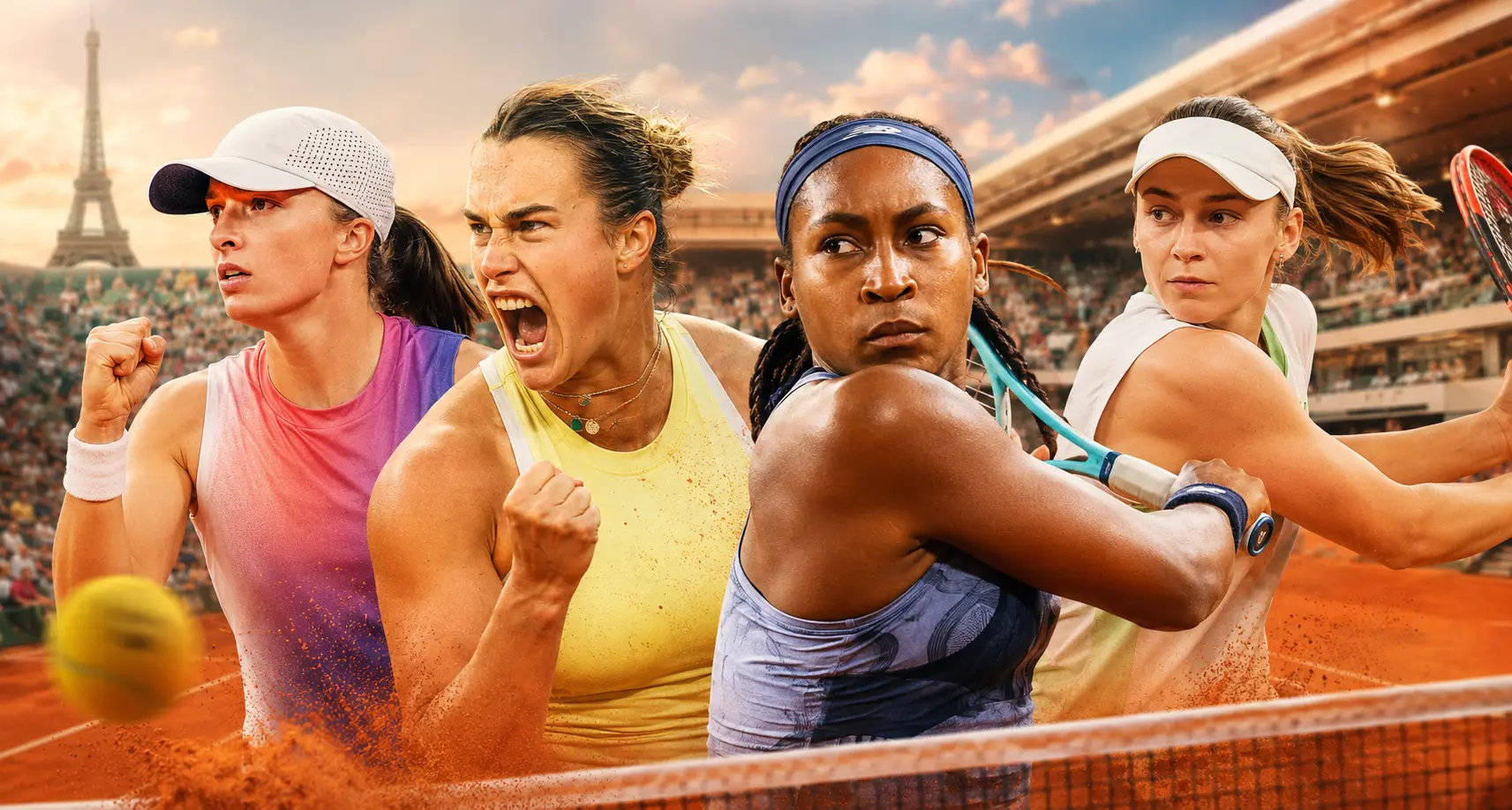
That signal is unusually structured this year. Iga Swiatek and Aryna Sabalenka sit together at the top, Coco Gauff and Elena Rybakina form the next serious bracket, and a dangerous group of dark horses wait for the draw to open.
We disagree — not with the structure entirely, but with the order.
Swiatek and Sabalenka Stand Apart in the Predictions
Iga Swiatek and Aryna Sabalenka are clearly being put forward as the two leading names in the Roland Garros women’s predictions.
Swiatek sits mostly around 3.25 to 4.00, which is roughly 9/4 to 3/1, or about +225 to +300. That range still gives her the respect of a player whose name and Paris clay remain heavily linked, but it also suggests the market no longer views the tournament as a foregone conclusion.
Sabalenka is right beside her, generally priced around 3.50 to 4.04, approximately 5/2 to 3/1, or about +250 to +304.
That matters. The bookies are not treating Sabalenka as a distant challenger or a hard-court threat merely visiting the clay season. They are placing her in the same championship conversation as Swiatek.
It is the clearest tier on the board: two elite players, almost shoulder to shoulder, with the rest of the field asked to chase.
Gauff and Rybakina Form the Second Prediction Bracket
The second chapter belongs to Coco Gauff and Elena Rybakina.
Rybakina is mostly priced around 7.50 to 8.64, roughly 13/2 to 15/2, or about +650 to +764. That makes her a clear second-tier contender rather than a speculative outsider. If her serve fires and her first-strike tennis lands cleanly, she has the weapons to make even the best clay-court defenders feel rushed.
Gauff sits in a similar range, mostly around 8.00 to 10.00, roughly 7/1 to 9/1, or about +700 to +900. The market appears to see her as a serious Roland Garros threat, but one still separated from the Swiatek-Sabalenka tier.
That feels like a fair prediction. Gauff’s movement, court coverage and competitive discipline fit Paris naturally. The question is whether her attacking patterns hold together across seven matches, especially if she has to beat one or two of the very biggest names late in the tournament.
Together, Gauff and Rybakina form the second bracket: dangerous enough to win it, but not quite priced as the players the field must go through first.
Why Our Prediction Flips the Bookies’ Order
There is, however, a strong case for disagreeing with the bookies’ order.
While the market has Swiatek and Sabalenka grouped together at the top, our Roland Garros women’s prediction would push Elena Rybakina and Coco Gauff higher. In fact, they look like the two most compelling title picks from this vantage point.
Rybakina’s case rests heavily on 2026 form. She has looked like the player most capable of taking matches out of an opponent’s hands, and on clay that matters more than the old clichés sometimes suggest. When her serve, return position and first strike are aligned, she does not need long decorative rallies to make a point. She can simply take control of the court.
There is also the Rome argument.
Elina Svitolina went on to win the title emphatically, but Rybakina was the one player who truly outplayed her for large stretches of their match. She was a break up in the final set, only to squander it. That matters.
Results tell us who survived the week. Match dynamics often tell us who may be closer to something bigger.
Gauff’s case is different but just as persuasive. Her clay season has been building rather than exploding, with each run adding a little more evidence that her game is settling into the surface. Add the fact that she won Roland Garros last year, and it becomes hard to treat her as merely part of the second tier.
The bookies may still have her behind Swiatek and Sabalenka, but a defending Paris champion improving through the clay swing is not a side note. It is a warning.
The bookies have Swiatek and Sabalenka at the top; our reading of form, clay rhythm and recent evidence says Rybakina and Gauff deserve to be treated as the real danger pair.
Dark Horse predictions: Andreeva, Svitolina and a deep chasing pack
The dark-horse tier starts with Mirra Andreeva, whose odds sit roughly around 8.50 to 13.30, approximately 15/2 to 12/1, or about +750 to +1230. It is a fascinating number because it reflects both belief and hesitation. The ceiling is obvious. The Grand Slam title experience is not there yet.
Elina Svitolina also commands respect, with many prices around 14.00 to 19.00 — roughly 13/1 to 18/1, or +1300 to +1800. She is not being priced like a favorite, but she is not being dismissed either. On clay, with her intelligence, resilience and ability to turn matches physical, she remains a player few would want to see early.
Behind them comes the wider outsider field. Marta Kostyuk, Victoria Mboko, Naomi Osaka, Jessica Pegula, Karolina Muchova, Qinwen Zheng, Amanda Anisimova, Sorana Cirstea, Belinda Bencic and others all appear at longer prices, with the numbers varying sharply from book to book.
That spread tells its own story. The bookies’ Roland Garros women’s predictions see Swiatek and Sabalenka as the headline act, Gauff and Rybakina as the credible second wave, and then a deep group of players who could become dangerous if form, fitness and the draw align.
Our prediction does not simply follow that order. The market may have Swiatek and Sabalenka in the obvious top tier, but the tennis itself points to a more complicated picture.
On form, clay rhythm and recent evidence, Rybakina and Gauff look far closer to the front of the race than those odds suggest.
And if the bookies are searching for a dark horse, they may have underpriced the most obvious one: Marta Kostyuk. She has won all her clay-court matches this season, which makes her more than a loose outsider. It makes her arguably the biggest dark horse in the field, if fit.
The real tension, then, may sit between the market and the clay-court evidence.
The odds say one thing. Roland Garros will soon begin to say another — and the draw may get the first word.