
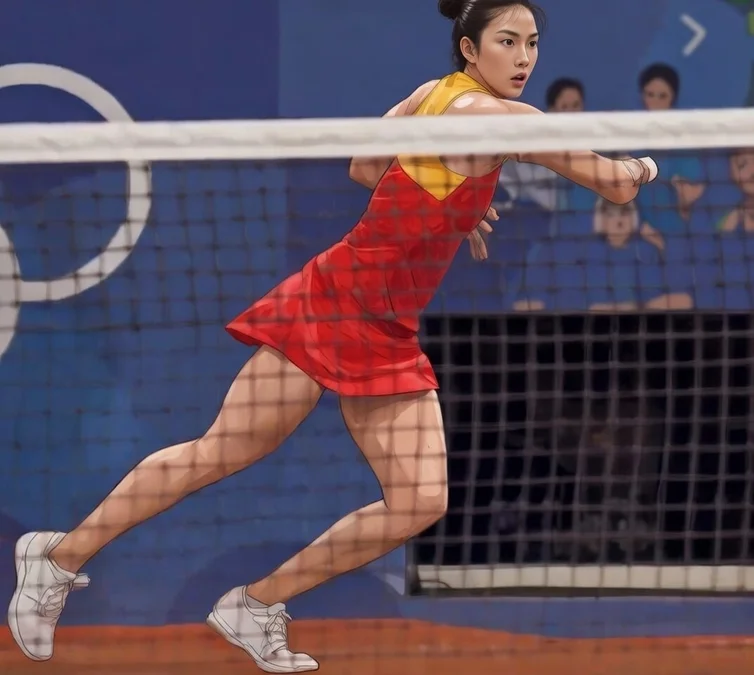

In elite tennis, coaching changes rarely arrive with press conferences. They arrive in fragments — a social media move here, a new face in the practice box there. And when the athlete happens to be Chinese, that sense of fragmentation is often intensified.
Zheng Qinwen’s preparations for Indian Wells 2026 have unfolded exactly that way.
The Olympic gold medalist has unfollowed long-time coach Pere Riba on social media, igniting fresh speculation that their partnership could once again be in jeopardy. Days later, reports surfaced that she had trained at the Barcelona Pro Tennis Academy with Jordi Arrese, the former Olympic silver medalist who once coached Riba himself. And now, in Indian Wells, Marcos Baghdatis has appeared in her team — reportedly on a trial basis.
From Stability to Transition — Again
Riba played a central role in Zheng’s rise. When they first teamed up, she was 18 and ranked outside the Top 150. Between 2021 and 2023, she matured from prospect to Top 20 mainstay under his guidance.
Their first split came during the 2023 clay season after a run of early losses. Zheng then hired Wim Fissette, captured her first WTA title in Palermo, and reached her maiden Grand Slam quarterfinal at the US Open. That collaboration ended quickly when Fissette joined Naomi Osaka.
Riba returned late in 2023 — and the reunion delivered immediate rewards.
In 2024, Zheng reached the Australian Open final, won Olympic gold in Paris and finished runner-up at the WTA Finals, climbing to a career-high No. 4.
It looked like structural stability had been restored.
But by late 2024, Riba underwent hip surgery and stepped away temporarily. Zheng worked with Dante Bottini and Albert Costa before reuniting with Riba again in February 2025.
Now, uncertainty resurfaces.
Injuries and Interrupted Momentum
The turning point came in mid-2025.
Zheng underwent right elbow surgery in July, sidelining her during a pivotal stretch of the season. She attempted a comeback at the China Open in September but retired in the third round and later admitted she had rushed the return.
In January 2026, she withdrew from the Australian Open, citing insufficient match readiness.
Her results since have shown flashes, but not continuity. At the Qatar Open in Doha, she defeated Sofia Kenin and Alycia Parks before falling in three sets to world No. 3 Elena Rybakina.
The ranking reflects the turbulence. After peaking at No. 4, Zheng now sits at No. 23.
For a 23-year-old who has already reached a Slam final and won Olympic gold, the conversation has shifted from potential to sustainability.
Baghdatis Enters the Frame
The presence of Marcos Baghdatis in Indian Wells adds another variable.
The former world No. 8 and Australian Open finalist is reportedly working with Zheng on a trial basis. Baghdatis previously gained WTA coaching experience when he joined Elina Svitolina’s team in 2019 as an advisory coach.
Whether this signals a permanent change or simply an evaluation phase remains unclear.
Training sessions with Jordi Arrese in Barcelona further complicate the picture. Arrese, a respected figure in Spanish tennis, coached Riba during his playing career. The overlap suggests either continuity behind the scenes — or quiet recalibration.
At this stage, no official split has been announced.
But the optics suggest transition.
Indian Wells as Structural Test
Indian Wells is more than a tournament for Zheng this year. It is a diagnostic.
She reached the quarterfinals in 2025 before losing to Iga Swiatek. This time, it is only her second event of the season, and she needs ranking points to prevent further slide.
Just as importantly, the California desert will test both her physical durability and the cohesion of her team structure.
Since early 2023, Zheng’s career has moved rapidly — outside the Top 100 to the Top 5 and back toward the mid-20s in a compressed window. Coaching shifts, injury interruptions and ranking swings have defined the journey.
The question now is not whether she can reach the elite again.
It is whether she can build something that lasts.
Indian Wells may not answer every structural question. But it will offer the first visible clues about where Zheng Qinwen — and her coaching direction — are heading next.