
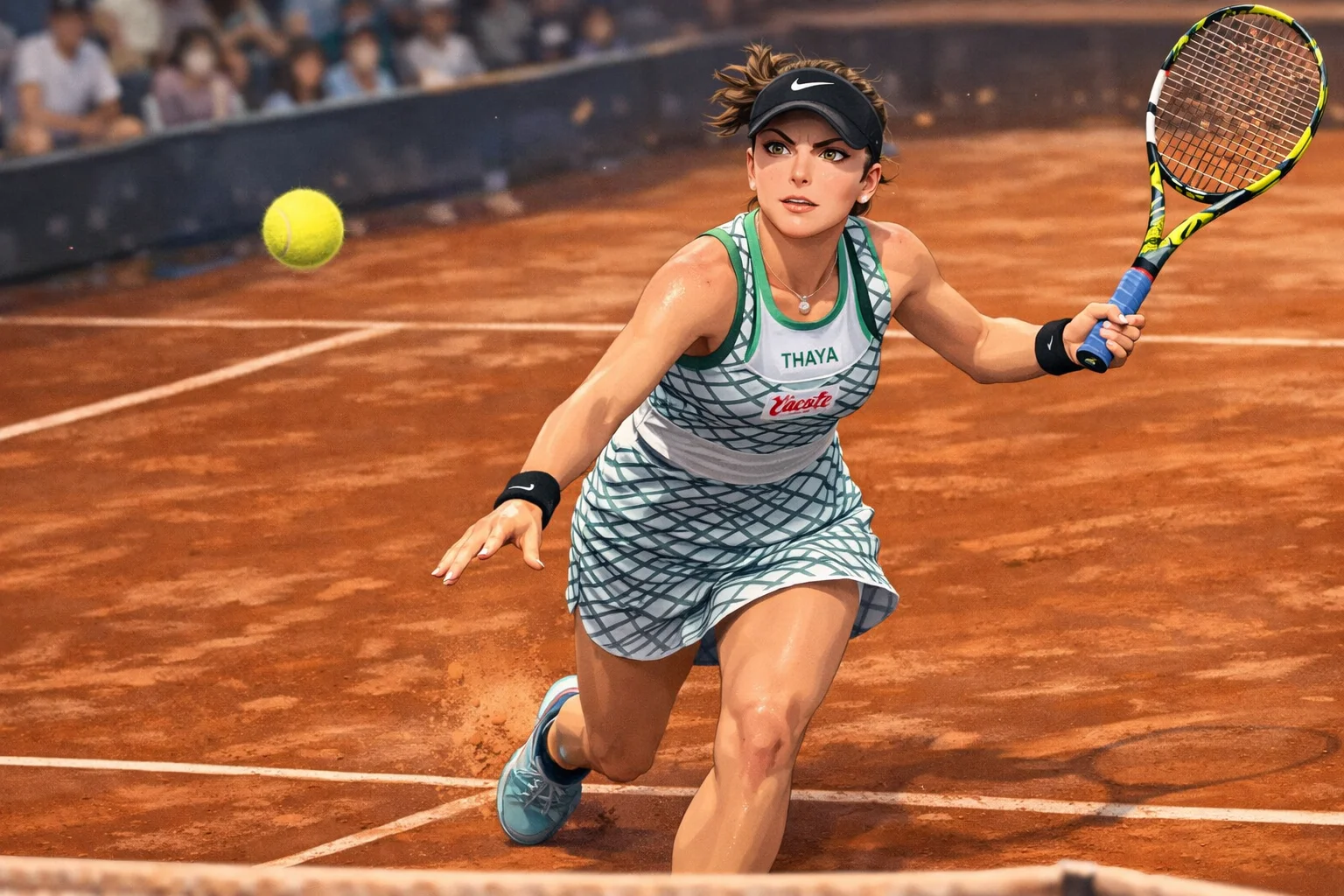

Sára Bejlek’s week in Abu Dhabi in early February 2026 didn’t feel like a qualifier’s lucky streak. It felt like a player arriving at her next level, then staying there long enough for everyone to notice.
Ranked No. 101, Bejlek came through qualifying and then began trimming the main draw with brisk authority. She beat Ekaterina Ovcharenko 6-3, 6-0 and Chloe Paquet 6-2, 6-2 to qualify, then carried that clarity into the tournament proper: 6-3, 6-0 over Ashlyn Krueger (ranked 55), 6-4, 6-3 over Jelena Ostapenko (ranked 24), and 6-0, 6-2 over Sonay Kartal (ranked 61) to reach the semi-finals, where Clara Tauson (ranked 16) stood between her and a final.
The wins themselves were eye-catching. The manner of them was louder. Bejlek didn’t survive on a hot hand and hope. She controlled matches, removed doubt early, and made even a chaos merchant like Ostapenko look as though she’d been forced to play someone else’s script.
Who Is Sara Bejlek Right Now?
Bejlek is 20 years old (born 31 January 2006), left-handed, and already hovering around the top 100 with the sort of underlying strength that often climbs faster than the ranking can keep up.
Her current profile is neatly split between what she already is and what she’s becoming:
- Current WTA ranking: 101
- Career-high ranking: 75 (3 November 2025)
- Elo rank: 82 (rating 1753)
- Career record: 162–73 (69%)
- Last 52 matches: 39–13 (75%)
- Last 52 on clay: 31–9 (78%)
- Last 52 on hard: 8–4 (67%)
Those last two lines are the reason she’s an evergreen story rather than a one-week curiosity. For a while, Bejlek could be filed—fairly, if unimaginatively—as a clay-forward prospect. Abu Dhabi dragged her out of that tidy box. Her baseline identity is travelling, and that is how careers turn serious.
Why Abu Dhabi Wasn’t Just a “Nice run”
Qualifiers reach quarters and semi-finals all the time in women’s tennis. Sometimes it’s match-ups. Sometimes it’s an opponent having a grim day at the office. Sometimes it’s just the freedom of playing with nothing to lose.
Bejlek’s Abu Dhabi run suggested something more durable: repeatable patterns executed with calm. Her scorelines weren’t the by-product of constant risk. They were a product of a high-percentage style that makes opponents hit the same uncomfortable shot again and again, until they either overreach or get worn down.
The Ostapenko match is the cleanest proof. Beating Ostapenko isn’t usually about matching her power. It’s about refusing to panic when the ball arrives with interest. Bejlek did not look spooked. She served, started points, made returns, and turned the match into a workmanlike problem rather than a crisis.
That is a mature trait for a 20-year-old still building her tour footprint.
The Foundation of Her Game: Not Cheap Points, but Constant Pressure
Bejlek does not win by raining aces. Her ace rate sits around 0.6% across her career. She isn’t built for endless free points, and she doesn’t pretend otherwise.
Instead, she wins by making the sport feel longer for her opponents.
She lands a high percentage of first serves—71.7% across her career, 72.7% across her last 52 matches. That means she begins points. A lot of them. It also means she avoids gifting opponents the immediate look at her second serve, which is where many developing players get mugged at tour level.
Her first-serve points won has stayed steady at about 59% (career 59.0%, last 52 at 59.2%), and her second-serve points won has been workable (last 52 at 48.5%). Put simply, she doesn’t donate games. You have to take them.
The Return: Where Her Rise Starts To Look Inevitable
The most telling improvement in her profile is on return. Her return points won rises from 48.8% across her career to 51.0% across her last 52 matches.
That jump matters because return points won is one of the best indicators of whether a player can step up a level without needing constant “good days”. Crossing 50% suggests you’re doing more than hanging around. It suggests you are taking points off opponents regularly, and that you can turn their service games into conversations rather than monologues.
Abu Dhabi, with its steady run of break-heavy scorelines, fits that picture neatly. A 6-0 set is often a return story disguised as a serving one.
Clay Is Her Base, But the Story Is No Longer Only Clay
Bejlek’s clay record across her last 52 matches—31–9 (78%)—confirms what her results have implied for some time: she’s already an authority on the surface, not merely a player who likes it.
Slow courts reward patience, footwork, and the ability to build points without needing constant winners. Bejlek’s tennis is made for that. Her lefty shapes, her ability to redirect, and her comfort living in rallies allow her to grind opponents into low-percentage decision-making.
But the more interesting shift is that she’s beginning to bring that identity onto hard courts. Her last-52 hard record of 8–4 (67%) is not a complete body of evidence, but it is strong enough to undermine the old “we’ll see on hard courts” shrug. Abu Dhabi gave that shrug a shove.
This is how the ranking climbs quickly: clay season becomes a springboard rather than the entire house.
The Left-Handed Factor: Advantage, But Only If You Know What To Do With It
Left-handers in tennis are often treated like mythological creatures. In reality, they simply offer patterns opponents see less often, and that creates an adjustment period.
Bejlek is good because she uses that adjustment window sensibly. She doesn’t go hunting for magic. She repeats reliable patterns, nudges opponents out of position, and lets the geometry do the work.
Her last-52 record against right-handers is 31–13 (70%). She is also 6–0 against left-handers in the same period, which hints at something important: she isn’t merely living off the lefty advantage. She is solving match-ups.
That matters as she rises, because the best players don’t lose because they “couldn’t handle a lefty”. They lose because the lefty had a plan, executed it, and then adjusted when the opponent adjusted back.
The Growth Zone: What Still Needs To Improve For Top-50 Life
If Bejlek’s strengths are clear, her next steps are fairly clear too.
Her deciding-set record across her last 52 matches is 8–8. That’s normal for a developing player, but it’s also the next frontier. The top of the sport is full of players who win ugly third sets because they manage momentum, accept discomfort, and make smarter decisions at 30-all. That’s less about a new shot and more about a stronger default under stress.
Her tiebreak record is solid (29–22 across her career), but she doesn’t want to live there. Tiebreak tennis is where margins shrink and luck gets louder. Her best long-term path is the one she showed in Abu Dhabi: win matches by being the more consistent pressure, not by gambling on a late sprint.
The serve will always be a conversation too. With a low ace rate, she must keep building serving patterns rather than hoping for free points that won’t arrive. The good news is that her high first-serve percentage already gives her stability. The next step is improving the “first ball after serve” clarity—where the point goes, and why.
Why Her Ranking Still Understates Her Level
Rankings are calendar arithmetic. They don’t always reflect current strength in the short term, especially when points drop off at inconvenient times.
Bejlek’s last-52 form (75% wins) and Elo rank (82) suggest her level is already hovering above her current ranking. Abu Dhabi looked like the sport’s public acknowledgement of that gap. When the ranking finally catches up, it tends to do so quickly.
| Year | Year-End Singles WTA Ranking |
|---|---|
| 2021 | 380 |
| 2022 | 189 |
| 2023 | 190 |
| 2024 | 142 |
| 2025 | 76 |
The Czech Context: a Production Line, But Not a Guarantee
Czechia has produced elite women’s tennis for so long it feels less like a golden generation and more like a habit. That background can help a player: higher training standards, a culture of competitiveness, and an early understanding that professionalism isn’t optional.
But it can also clutter the narrative. The “next Czech star” label is a heavy coat to wear at 18 or 20, and careers rarely follow tidy scripts.
Bejlek’s rise so far looks more earned than marketed. She has built through match volume, steady improvements, and repeatable winning. That tends to translate better than hype when the tour stops being forgiving.
What The Next 12 Months Should Look Like if This Is Real
The next stage is not glamour. It’s consolidation.
Bejlek needs to spend more weeks in main draws and fewer in qualifying. That’s where points and rhythm live. She needs to turn her hard-court progress into habit, not a headline. She needs to win a few more matches like the Ostapenko one—wins that change how opponents prepare for her.
If those boxes get ticked, the top 50 becomes less a dream and more an address.
The Verdict: an Evergreen Contender, Not a Fashionable Name
Sára Bejlek is a standout story because her rise is supported by evidence rather than wishful thinking.
She wins a lot. She’s winning more lately. Her return numbers are rising into top-player territory. Her clay excellence is already proven, and her hard-court bite is beginning to show. Abu Dhabi was the week where all of that stopped being background noise and became the main plot.
If you like tennis that feels like thinking—patterns, pressure, and patience with teeth—Bejlek isn’t just one to watch. She’s one to take seriously.
Quick FAQ
How old is Sara Bejlek?
She was born on 31 January 2006 and is 20 years old in 2026.
How tall is Sara Bejlek?
Sara Bejlek’s official height on the WTA website is 5’3″ (1.59 m).
What is Sara Bejlek’s ranking?
She is ranked No. 101, with a career-high of No. 75 (3 November 2025).
What is Sara Bejlek known for?
Left-handed patterns, a high first-serve percentage, and a return game that’s improving into a real weapon—especially on clay, and increasingly on hard courts.
Why did Abu Dhabi matter?
She came through qualifying and beat higher-ranked opponents including Jelena Ostapenko in straight sets, reaching the semi-finals and showing tour-level hard-court credibility.