
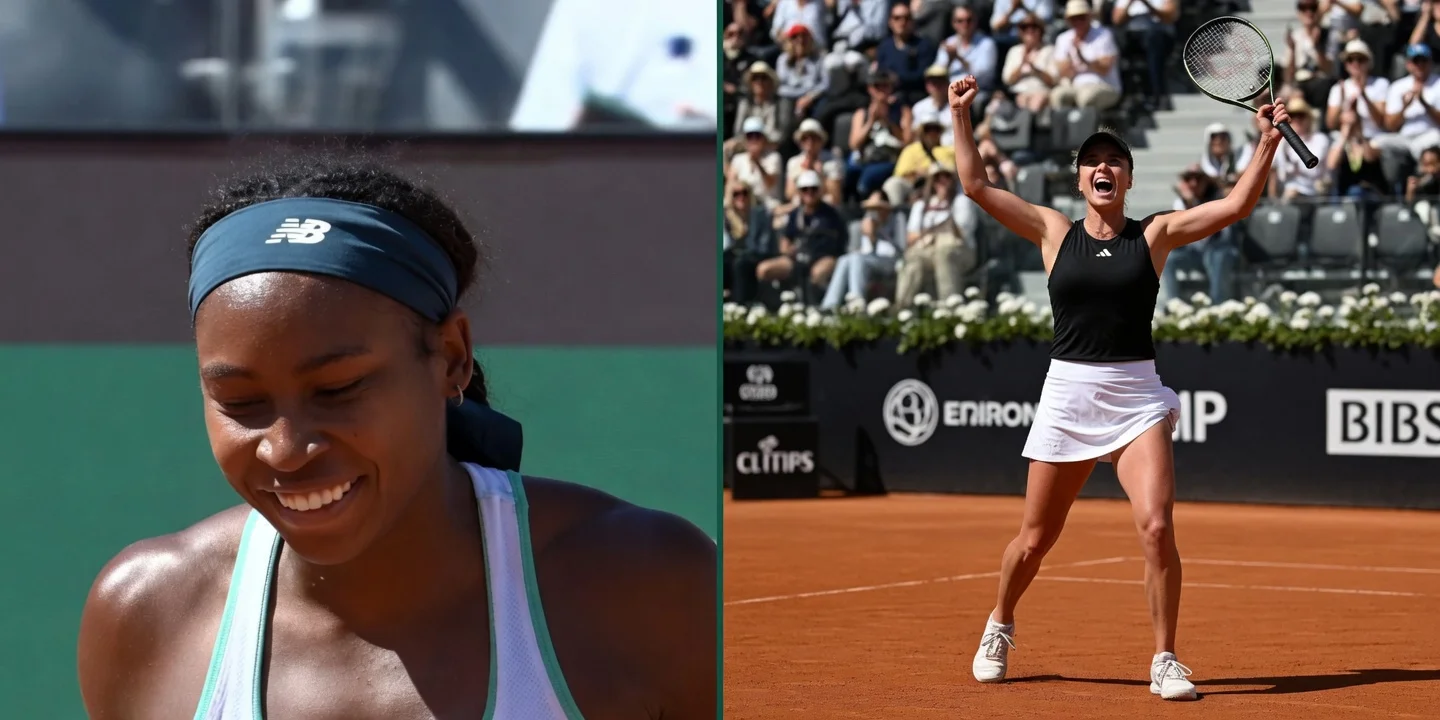
Clay-court tennis has a habit of revealing the truth slowly. Rome, perhaps more than any other stop before Roland Garros, strips away short-term noise and exposes who is physically ready, mentally stable and tactically complete enough to survive two brutal weeks in Paris.
By that measure, Coco Gauff and Elina Svitolina have already won something significant before even stepping onto court for the Rome final.
Both leave Foro Italico with their French Open credentials strengthened considerably. Whatever happens in the championship match now belongs in the category of bonus territory. The deeper message has already been delivered.
And when Strasbourg begins next week, another name may yet join the expanding list of genuine Roland Garros threats.
Because the women’s draw suddenly looks far wider — and far more dangerous — than it did a month ago.
Gauff’s chaos has become strangely reliable
There are cleaner routes to a WTA 1000 final than the one Coco Gauff has taken in Rome.
She survived repeated collapses in momentum, recovered from a match point down against Iva Jovic, escaped a near-impossible comeback against Mirra Andreeva and spent large portions of the fortnight looking simultaneously vulnerable and unstoppable.
And yet here she is again.
That matters.
In the last four major clay events stretching back to 2025, Gauff has now reached three WTA 1000 finals. Rome has underlined something increasingly difficult to ignore: even when her forehand fluctuates and the second serve becomes unstable, her movement, defence and competitive instincts remain among the very best in the sport.
Her win over Andreeva especially felt important beyond the scoreline. That final 20-point game, loaded with net cords, baseline grazers and missed chances, demanded emotional endurance as much as tennis quality. Gauff survived it.
The American has always been a dangerous clay-court player. She is becoming one of the constants of the surface.
The next day, she backed it up against the in-form Sorana Cirstea.
Coco Gauff is ready to win this Italian Open final.
Svitolina’s hunger may be the most dangerous thing in Paris
Elina Svitolina’s Rome run has carried a different energy entirely.
There is less noise around her game now. Less expectation. Fewer declarations. Yet somehow she keeps dismantling elite opponents with ruthless efficiency once matches become physical and uncomfortable.
Elena Rybakina discovered that in the quarter-finals after dominating the opening set before being slowly dragged into Svitolina’s pace, depth and relentless court coverage. Iga Swiatek experienced it next.
Against both Elena Rybakina and Iga Swiatek, Svitolina saved an enormous number of break points. Time and again, she escaped from 0-30 and 15-40 situations that looked certain to swing the match. Those holds became one of the biggest reasons she made such a deep run in Rome.
That combination instantly makes her dangerous in Paris.
The Ukrainian has already reached a Roland Garros quarter-final before. On current form, another deep run feels entirely realistic. Once the draw comes out, she will be one of the players every top-four seed hopes to avoid.
Winning Rome would be an enormous bonus for Svitolina considering the task still ahead. She leads Coco Gauff 3-2 in their head-to-head.
Four names were already there — now the list is growing
Before Rome began, most realistic Roland Garros conversations revolved around four players.
Aryna Sabalenka remains the dominant force of the season despite her shock defeat to Sorana Cirstea. Iga Swiatek, after months without a final, suddenly looks reborn on clay again after bulldozing Jessica Pegula in one of her sharpest performances in nearly a year. Elena Rybakina still possesses the cleanest first-strike tennis in the draw when healthy and confident. And Marta Kostyuk should be everyone’s dark horse for winning Paris.
Now Gauff and Svitolina clearly belong in that conversation too.
Neither arrives in Paris with perfect tennis. But perfect tennis rarely wins The French Open anymore. Survival, adaptability and emotional resilience matter just as much.
Rome exposed exactly those qualities.
Strasbourg may still produce another contender
The timing of Strasbourg, always awkwardly placed between Rome and Roland Garros, often makes it difficult to interpret.
Most players skip it. Others use it to rebuild confidence. Surely, though, the tournament produces something more revealing: a player discovering late belief at exactly the right moment.
This year feels especially open.
Rome may have clarified more than it decided
The Rome title still matters enormously. So do the 1000 ranking points waiting on Saturday.
Even if the broader significance of this fortnight may lie elsewhere.
Coco Gauff has once again proved she can survive chaos on clay. Elina Svitolina has reminded everyone what elite court craft and competitive discipline still look like when fully operational.
The trophy in Rome 2026 may ultimately come down to one question: can Svitolina continue saving break points at the extraordinary rate she managed in the quarter-finals and semi-finals — 27 out of 36 — before Coco Gauff slowly drags the match into her own exhausting territory? That would require exceptional serving under pressure once again.
She managed it this week against the world No. 2 and world No. 3.
Coco Gauff also knows exactly where this final can be won.