
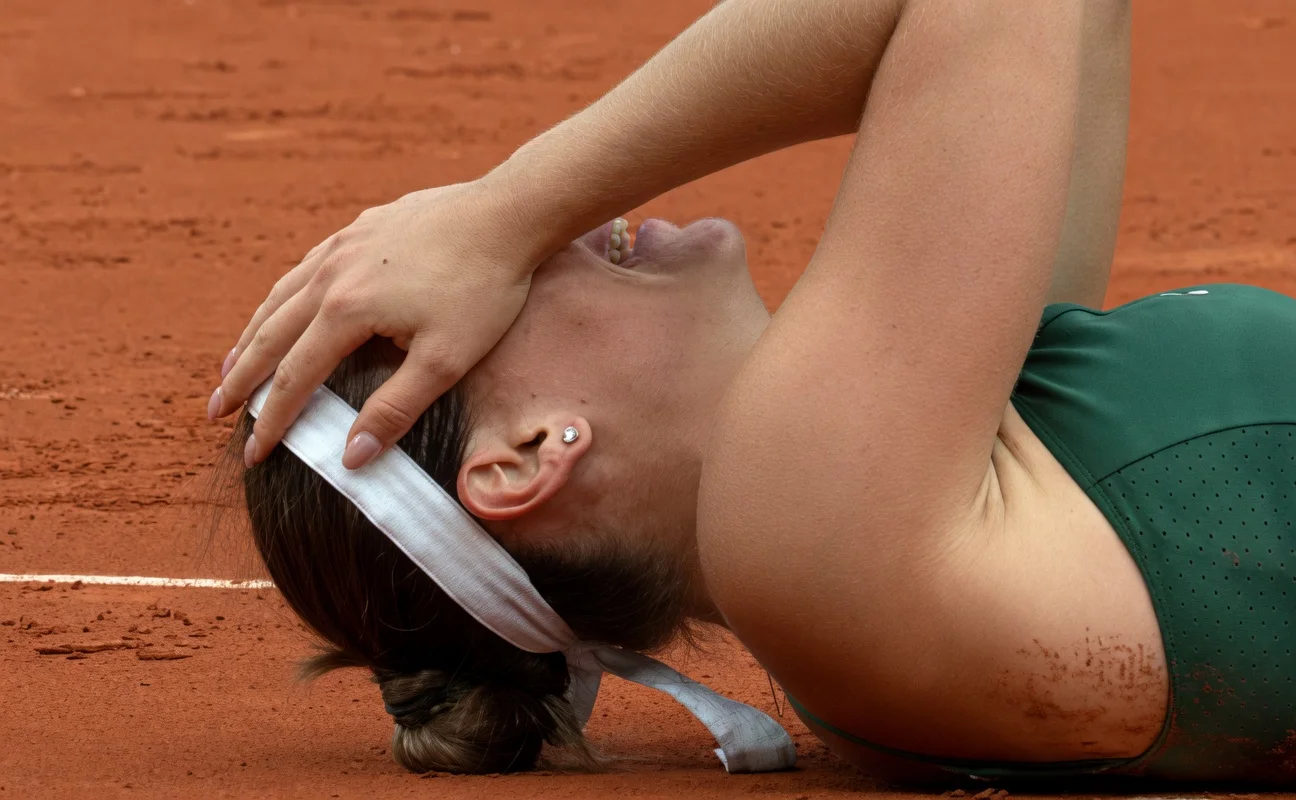
As social media lit up in the immediate aftermath of the Madrid final between Marta Kostyuk and Mirra Andreeva, the essence of the match had already unfolded in plain sight.
Marta Kostyuk, of Ukraine, defeated Russia’s teenage star Mirra Andreeva in straight sets, 6-3, 7-5, once again reinforcing a familiar truth in tennis: the player in the better form often prevails. And yet, her victory still carried an element of surprise. This was, after all, a WTA 1000 event — a stage Andreeva had already conquered at just 17, fully aware of what it takes to win at that level.
Losing, however, told a different story. Andreeva buried her emotions deep in a towel at her chair, unaware that behind her, Kostyuk was marking the biggest win of her career with a backflip.
What unfolded was tennis in its purest form — a contest between two players shaped by very different paths, meeting in a sport that remains among the most unforgiving. It demands precision of movement, clarity of thought and, ultimately, emotional exposure. When those emotions spill over — in triumph or in defeat — they do not detract from the spectacle; they define it.
Kostyuk Sets the Tone Early
Kostyuk wasted little time asserting control. She was also the first to strike when the set settled. With both players holding firmly through the early games, the breakthrough only came at 3-2. From 15-40, she constructed the point patiently, not going for the overhead smash, before finishing with a forehand winner to move 4-2 ahead.
That shift proved decisive.
She consolidated with authority, extending the lead to 5-2 as her depth and pace began to push Andreeva further behind the baseline. The Russian responded well to force Kostyuk to serve it out, but the Ukrainian remained composed, closing the set 6-3 on her second opportunity.
For Andreeva, the set slipped away not through any dramatic dip, but through the steady accumulation of pressure — a reminder of how little margin exists at this level when an opponent is dictating from the first strike.
Elena Rybakina vs Elina Svitolina – Set One Stats
| Statistic | Elena Rybakina | Elina Svitolina |
|---|---|---|
| Dominance Ratio | 1.20 | 0.84 |
| Serve Rating | 263 | 220 |
| Aces | 6 | 6 |
| Double Faults | 1 | 8 |
| 1st Serve % | 61% (46/75) | 59% (50/85) |
| 1st Serve Points Won | 78% (36/46) | 64% (32/50) |
| 2nd Serve Points Won | 38% (11/29) | 43% (15/35) |
| Break Points Saved | 78% (7/9) | 64% (7/11) |
| Service Games | 82% (9/11) | 64% (7/11) |
| Ace % | 8% | 7.1% |
| Double Fault % | 1.3% | 9.4% |
| Return Rating | 165 | 124 |
| 1st Return Points Won | 36% (18/50) | 22% (10/46) |
| 2nd Return Points Won | 57% (20/35) | 62% (18/29) |
| Break Points Won | 36% (4/11) | 22% (2/9) |
| Return Games | 36% (4/11) | 18% (2/11) |
| Pressure Points | 55% (11/20) | 45% (9/20) |
| Service Points | 63% (47/75) | 55% (47/85) |
| Return Points | 45% (38/85) | 37% (28/75) |
| Total Points | 53% (85/160) | 47% (75/160) |
| Set 1 Duration | 0h35m | |
Andreeva Responds, the Match Tightens
The second set refused to settle.
Kostyuk struck first again, breaking early to move 1-0 ahead, but Andreeva responded immediately. The Russian broke back, then surged into a 3-1 lead with six consecutive points, briefly taking control of the final.
That phase did not last.
Kostyuk reset sharply, producing one of the defining passages of the match—eight points in a row to break to love and level at 3-3. From there, the set became a series of narrow holds and missed chances, with both players pushing for a decisive opening.
At 5-4, Andreeva had it.
The moment that would shape the final had come.
Andreeva earned two set points on the Kostyuk serve. But both slipped. One erased by a clean response, the other shut down by a powerful ace. The chance was gone.
The final turn
Kostyuk sensed it immediately.
In the next game, Andreeva faltered—a double fault at a crucial moment handing over the break. Suddenly, the match was on Kostyuk’s racket.
Serving for the title at 6-5, Ukraine’s No.2 did not rush it. Two match points came and went. On the third, she finished it.
The release was immediate.
Mirra Andreeva vs Marta Kostyuk – Set Two Stats
| Statistic | Mirra Andreeva | Marta Kostyuk |
|---|---|---|
| Dominance Ratio | 0.86 | 1.17 |
| Winners | 12 | 16 |
| Unforced Errors | 17 | 16 |
| Serve Rating | 209 | 241 |
| Aces | 1 | 2 |
| Double Faults | 2 | 2 |
| 1st Serve % | 63% (20/32) | 59% (20/34) |
| 1st Serve Points Won | 55% (11/20) | 55% (11/20) |
| 2nd Serve Points Won | 42% (5/12) | 64% (9/14) |
| Break Points Saved | 0% (0/3) | 50% (2/4) |
| Service Games | 50% (3/6) | 67% (4/6) |
| Ace % | 3.1% | 5.7% |
| Double Fault % | 6.3% | 5.7% |
| Return Rating | 181 | 253 |
| 1st Return Points Won | 45% (9/20) | 45% (9/20) |
| 2nd Return Points Won | 36% (5/14) | 58% (7/12) |
| Break Points Won | 50% (2/4) | 100% (3/3) |
| Return Games | 50% (3/6) | 50% (3/6) |
| Pressure Points | 33% (3/9) | 67% (6/9) |
| Service Points | 50% (16/32) | 59% (20/34) |
| Return Points | 44% (15/34) | 50% (16/32) |
| Total Points | 47% (31/66) | 55% (36/66) |
| Set 2 Duration | 0h48m | |
Full match stats: small edges, big moments
The match itself was played on narrow margins, but the key numbers underline where it tilted.
Kostyuk’s ability to win second-serve points proved decisive, consistently keeping her out of prolonged pressure on serve. She also held firm under strain, saving key break points at critical stages—particularly in the closing phase of the second set.
Andreeva, by contrast, created the more significant openings late in the match but could not convert them. Two set points at 5-4 represented her clearest route back into the contest. Both went.
Across the match, the balance of points remained close, but the difference lay in execution under pressure. Kostyuk was more efficient in break-point situations and more composed when the match tightened.
That was enough.
Andreeva’s composure, then emotion
For Andreeva, the level was there again.
This was her third WTA 1000 final, and for long stretches she matched Kostyuk in both weight of shot and composure. When the match slipped, it did so in moments rather than phases.
Afterwards, the composure gave way.
During the trophy ceremony, the 19-year-old struggled to contain her emotions, breaking down mid-speech. “I’m sorry… I promised myself I wasn’t going to cry,” she said, turning away briefly as the crowd responded with support.
It was not defeat that defined her Madrid run—but the reminder of how close she had come.
Mirra Andreeva spoke afterwards: “I can think of some parts where I played well, but to win you have to play like that the whole match and be consistent. So I cannot say I’m happy right now. She played well—she hit a lot of winners and was very aggressive. At times I tried to pressure her and be aggressive too. Sometimes I felt I was winning more points when I just put the ball back in play and built the point slowly, trying to get her tired. But none of that worked well enough, because I didn’t win in the end. So I think it was a combination of all those things.”
A champion built through the week
Kostyuk’s title run reflects the authority she has carried throughout the two weeks in Madrid.
She did not drop a match. She did not let control slip for long. Even in a final that tightened at the edges, she found the moments that mattered and took them.
And that is what this Madrid demanded.
A tournament that began with withdrawals, drifted through illness, and dismantled its own hierarchy ends with a player who imposed order on it. While the draw unravelled around her, Kostyuk stayed intact.
Madrid had everything—chaos, disruption, surprise.
In the end, it had a champion who cut through all of it.