
Madrid did not build quietly this year. It surged, stumbled, twisted—and somehow kept raising the stakes.
What began with concern over withdrawals quickly turned into something far more compelling.
Big names disappeared, new ones stepped forward, and the draw reshaped itself almost daily. Illness swept through the locker room. Late withdrawals from Madison Keys and Clara Tauson added to the sense that this tournament was slipping out of structure.
And then the matches took over.
Upsets came early and never really stopped. Seeds fell, favourites faded, and by the time the second week settled, the entire Top 7 had gone. Some were beaten. Some were forced out. None made it through.
What remained was not a weakened field. It was a different one—alive, unpredictable, and increasingly difficult to control.
The run that redefined the draw
No story captured that better than Anastasia Potapova’s.
A lucky loser entry, brought in after Keys’ withdrawal, she turned a second chance into something far more significant. Round after round, she dismantled expectations, beating top names and pushing deep into the semi-finals.
For a moment, history felt within reach. No lucky loser had ever gone this far at this level in quite this way.
Her run ended against Marta Kostyuk—but not before it reshaped the entire tournament.
Andreeva’s control through the chaos
While the draw fractured around her, Mirra Andreeva held steady.
She has been the closest thing Madrid has had to a constant. Matches have not always been straightforward, but her response has been consistent—calm under pressure, precise when it matters, and increasingly comfortable deep in big tournaments.
Her semi-final against tournament sensation Hailey Baptiste summed it up. Even when drawn into a rare, heated exchange over electronic line calling, she reset quickly. Even when Baptiste pushed her to the edge in a tight second-set tiebreak, she still found a way through, and Sabalenka’s conqueror was out.
This is now her third WTA 1000 final. At just 19—a birthday she celebrated in.. Madrid.
Kostyuk’s command of the moment
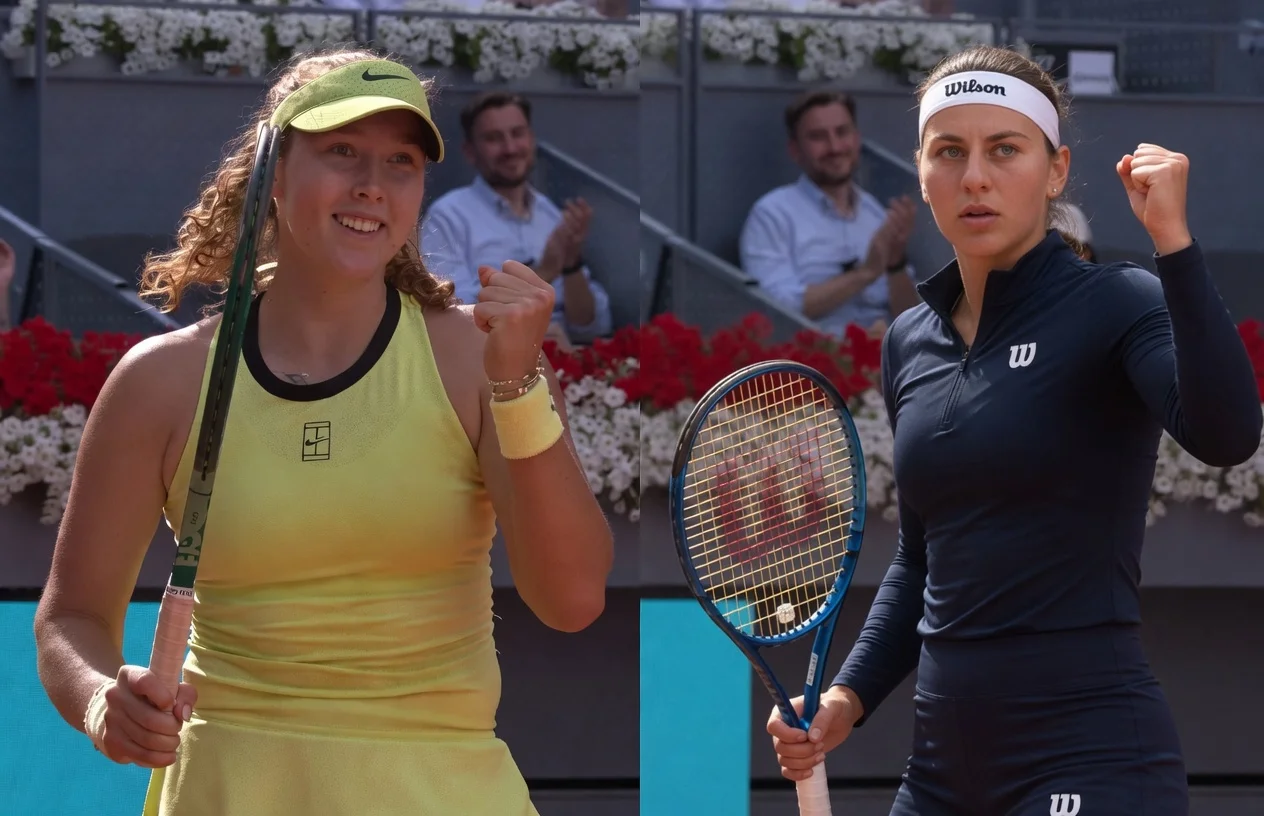
If Andreeva has controlled Madrid, Kostyuk has conquered it.
Her path has not been smooth, but it has been resilient. Matches have shifted, sometimes sharply, yet she has repeatedly found a way back into control.
Against Potapova in the semi-final, she lost an entire set of momentum—1-6—and still finished the match with authority. That ability to reset, to refuse to drift, has defined her run.
And it is not just Madrid.
She arrived in form, unbeaten on clay this season, fresh from her title in Rouen. Ten matches, ten wins on the surface now. The level is not a spike. It is sustained.
This final is her first at WTA 1000 level.
It has not come by chance.
A final shaped by everything that came before
There is no need to force meaning into this match. It carries its own.
Russia’s highest-ranked player against one of Ukraine’s finest. Two players shaped by very different paths through the same chaotic tournament. One built on control, the other on recovery.
And both, crucially, still standing when the rest fell away.
The one note that missed the mark
For all the drama, one detail did not match the stage.
Late evening sessions, even deep into the tournament, played out in front of sparse crowds. For an event that delivered this much unpredictability and quality, it felt oddly disconnected.
Madrid gave the spectacle.
It just did not always fill the seats.
The final that fits the tournament
And so it ends where it should.
Not with the expected names, but with the players who handled the conditions, the pressure, and the shifting landscape better than anyone else.
Andreeva brings clarity. Kostyuk brings force.
Madrid 2026 brought everything else.
Now it has its final.