
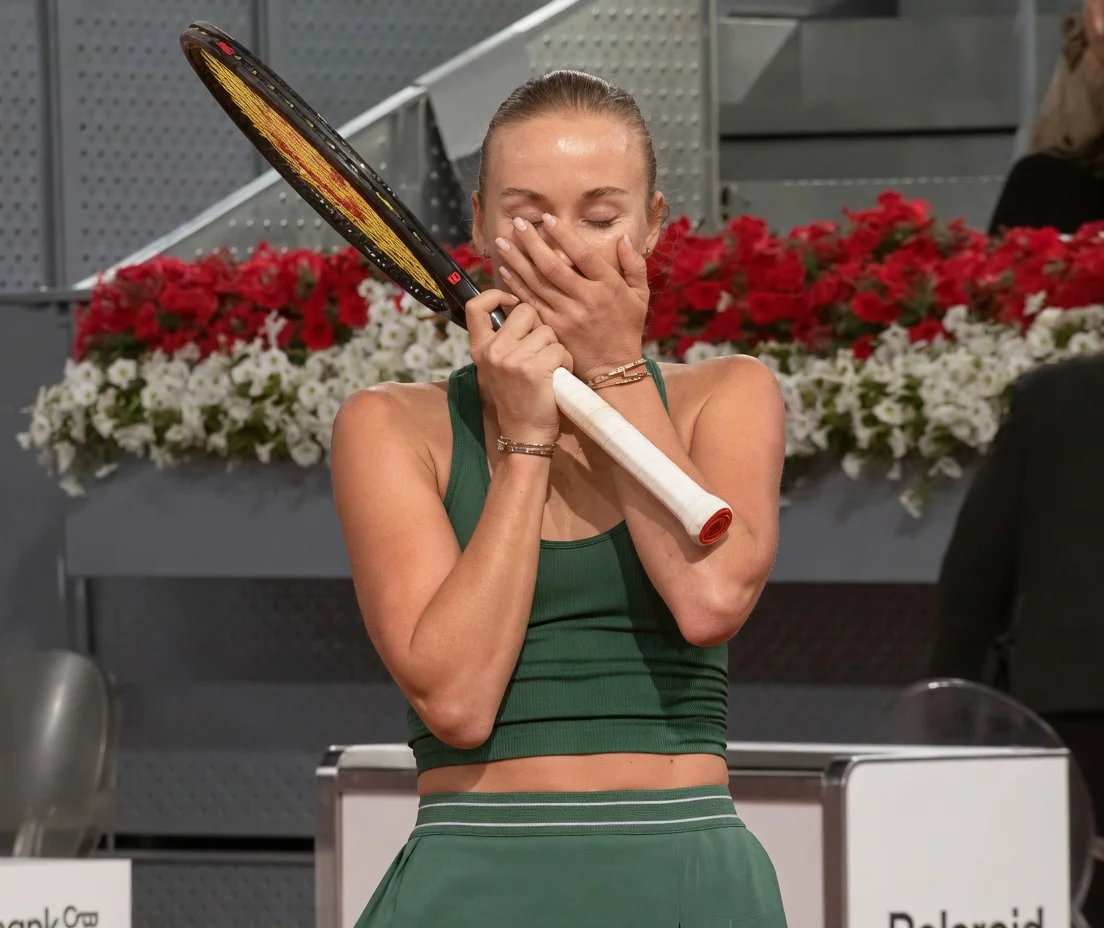
Anastasia Potapova did not so much win this match as wrestle it back under control.
From a position of dominance to the edge of collapse and back again, the Austrian navigated one of the most volatile contests of the Madrid Open 2026, eventually overcoming Karolina Pliskova 6-1, 6-7, 6-3 to reach the semi-finals.
What followed her early control was not clean. What defined her finish, however, was.
Early authority, clean execution
For a set and a half, Potapova dictated.
She moved Pliskova immediately onto the defensive, striking through the court with authority and backing it up with consistent first-strike tennis. The opening set, secured 6-1, reflected that balance—measured aggression, controlled serving, and sustained pressure on return.
Karolina Pliskova vs Anastasia Potapova – Set One Stats
| Statistic | Karolina Pliskova | Anastasia Potapova |
|---|---|---|
| Dominance Ratio | 0.52 | 1.93 |
| Winners | 5 | 11 |
| Unforced Errors | 8 | 6 |
| Serve Rating | 199 | 307 |
| Aces | 0 | 3 |
| Double Faults | 1 | 1 |
| 1st Serve % | 84% (16/19) | 68% (15/22) |
| 1st Serve Points Won | 50% (8/16) | 87% (13/15) |
| 2nd Serve Points Won | 33% (1/3) | 50% (3/6) |
| Break Points Saved | 0% (0/2) | – (0/0) |
| Service Games | 33% (1/3) | 100% (4/4) |
| Ace % | 0% | 13.6% |
| Double Fault % | 5.3% | 4.5% |
| Return Rating | 63 | 284 |
| 1st Return Points Won | 13% (2/15) | 50% (8/16) |
| 2nd Return Points Won | 50% (3/6) | 67% (2/3) |
| Break Points Won | – (0/0) | 100% (2/2) |
| Return Games | 0% (0/4) | 67% (2/3) |
| Pressure Points | 0% (0/3) | 100% (3/3) |
| Service Points | 47% (9/19) | 73% (16/22) |
| Return Points | 27% (6/22) | 53% (10/19) |
| Total Points | 37% (15/41) | 63% (26/41) |
| Set 1 Duration | 0h24m | |
The numbers underline the extent of that early control. Potapova struck 43 winners across the match, more than doubling Pliskova’s output in key phases, while winning 77% of points behind her first serve. Her return position also paid dividends, particularly against Pliskova’s second delivery, where she won 80% of those points.
At 6-1, 5-3, the match appeared settled.
The match slips
Then it shifted.
Serving for the match, Potapova faltered. Double faults crept in—two in succession at a critical moment—and the clarity that had defined her play gave way to hesitation. Pliskova, who had struggled to impose herself for much of the contest, sensed the opening.
The second set slipped away.
Momentum, briefly, belonged elsewhere.
Karolina Pliskova vs Anastasia Potapova – Set Two Stats
| Statistic | Karolina Pliskova | Anastasia Potapova |
|---|---|---|
| Dominance Ratio | 1.03 | 0.97 |
| Winners | 10 | 20 |
| Unforced Errors | 22 | 21 |
| Serve Rating | 227 | 230 |
| Aces | 3 | 5 |
| Double Faults | 4 | 4 |
| 1st Serve % | 73% (27/37) | 55% (24/44) |
| 1st Serve Points Won | 70% (19/27) | 71% (17/24) |
| 2nd Serve Points Won | 18% (2/11) | 40% (8/20) |
| Break Points Saved | 0% (0/2) | 0% (0/2) |
| Service Games | 67% (4/6) | 67% (4/6) |
| Ace % | 8.1% | 11.1% |
| Double Fault % | 10.8% | 8.9% |
| Return Rating | 222 | 245 |
| 1st Return Points Won | 29% (7/24) | 30% (8/27) |
| 2nd Return Points Won | 60% (12/20) | 82% (9/11) |
| Break Points Won | 100% (2/2) | 100% (2/2) |
| Return Games | 33% (2/6) | 33% (2/6) |
| Pressure Points | 57% (4/7) | 43% (3/7) |
| Service Points | 57% (21/37) | 57% (25/44) |
| Return Points | 45% (20/44) | 43% (16/37) |
| Total Points | 51% (41/81) | 51% (41/81) |
| Set 2 Duration | 0h55m | |
A third set without certainty
At 3-1 down in the deciding set, the match had fully turned.
Potapova’s level dipped, her movement slowed, and the structure of her game began to fragment. Pliskova stepped forward, using her experience to extend rallies and force errors, turning defence into control.
“I didn’t believe in myself at that moment,” Potapova admitted afterwards.
It was, by her own account, the lowest point of the match.
Reset and response
The turnaround did not come from a technical adjustment.
It came from a reset.
Urged on from her box—most notably by her partner Tallon Griekspoor—Potapova simplified her approach. Fewer reactions, more intent. Less conversation, more movement.
“Shut up and start to work,” she recalled being told.
She did exactly that.
From 3-1 down, the match shifted once more. Potapova began to step forward again, reclaiming control of the baseline exchanges and reasserting pressure on return.
The finish was abrupt.
She won 16 of the final 18 points.
Karolina Pliskova vs Anastasia Potapova – Set Three Stats
| Statistic | Karolina Pliskova | Anastasia Potapova |
|---|---|---|
| Dominance Ratio | 0.69 | 1.46 |
| Winners | 8 | 12 |
| Unforced Errors | 14 | 13 |
| Serve Rating | 161 | 230 |
| Aces | 1 | 2 |
| Double Faults | 3 | 5 |
| 1st Serve % | 74% (17/23) | 65% (22/34) |
| 1st Serve Points Won | 47% (8/17) | 77% (17/22) |
| 2nd Serve Points Won | 17% (1/6) | 33% (4/12) |
| Break Points Saved | 0% (0/3) | 67% (4/6) |
| Service Games | 25% (1/4) | 60% (3/5) |
| Ace % | 4.2% | 5.7% |
| Double Fault % | 12.5% | 14.3% |
| Return Rating | 163 | 311 |
| 1st Return Points Won | 23% (5/22) | 53% (9/17) |
| 2nd Return Points Won | 67% (8/12) | 83% (5/6) |
| Break Points Won | 33% (2/6) | 100% (3/3) |
| Return Games | 40% (2/5) | 75% (3/4) |
| Pressure Points | 36% (5/14) | 64% (9/14) |
| Service Points | 39% (9/23) | 59% (20/34) |
| Return Points | 44% (15/34) | 65% (15/23) |
| Total Points | 42% (24/57) | 61% (35/57) |
| Set 3 Duration | 0h38m | |
The numbers behind the swing
The broader statistics reflect a match shaped by extremes, but ultimately decided by execution in key moments.
Potapova posted a dominance ratio of 1.32 to Pliskova’s 0.76, converting all seven of her break-point opportunities and winning 73% of pressure points. Her serve, though not without fluctuation—nine double faults—remained effective enough, particularly behind the first delivery.
Pliskova, by contrast, struggled to sustain any consistency on second serve, winning just 20% of those points. Even her 75% first-serve percentage could not offset that vulnerability, particularly under scoreboard pressure.
The difference lay not in stability, but in recovery.
A match reclaimed
Potapova arrives in the Madrid semi-finals not on momentum alone, but on the back of a match that demanded adaptation at every stage.
And, ultimately, delivered it.
There is, too, the broader context that sharpens the achievement. Potapova was not meant to be here. She entered the main draw as a lucky loser following Madison Keys’ withdrawal, a late reprieve that has since turned into the most significant run of her season.
From that unexpected entry point, she has navigated shifting match dynamics, pressure moments, and her own doubts to reshape her week in Madrid.
Meanwhile, Karolina Pliskova’s run to the quarter-finals offered a reminder of something equally familiar on the WTA Tour: resilience rarely follows a straight line. Whether through returns from injury or the evolving balance around motherhood and competition, these trajectories continue to define the tour’s depth.
It is that unpredictability—and the persistence behind it—that gives WTA fans plenty to cheer about.