
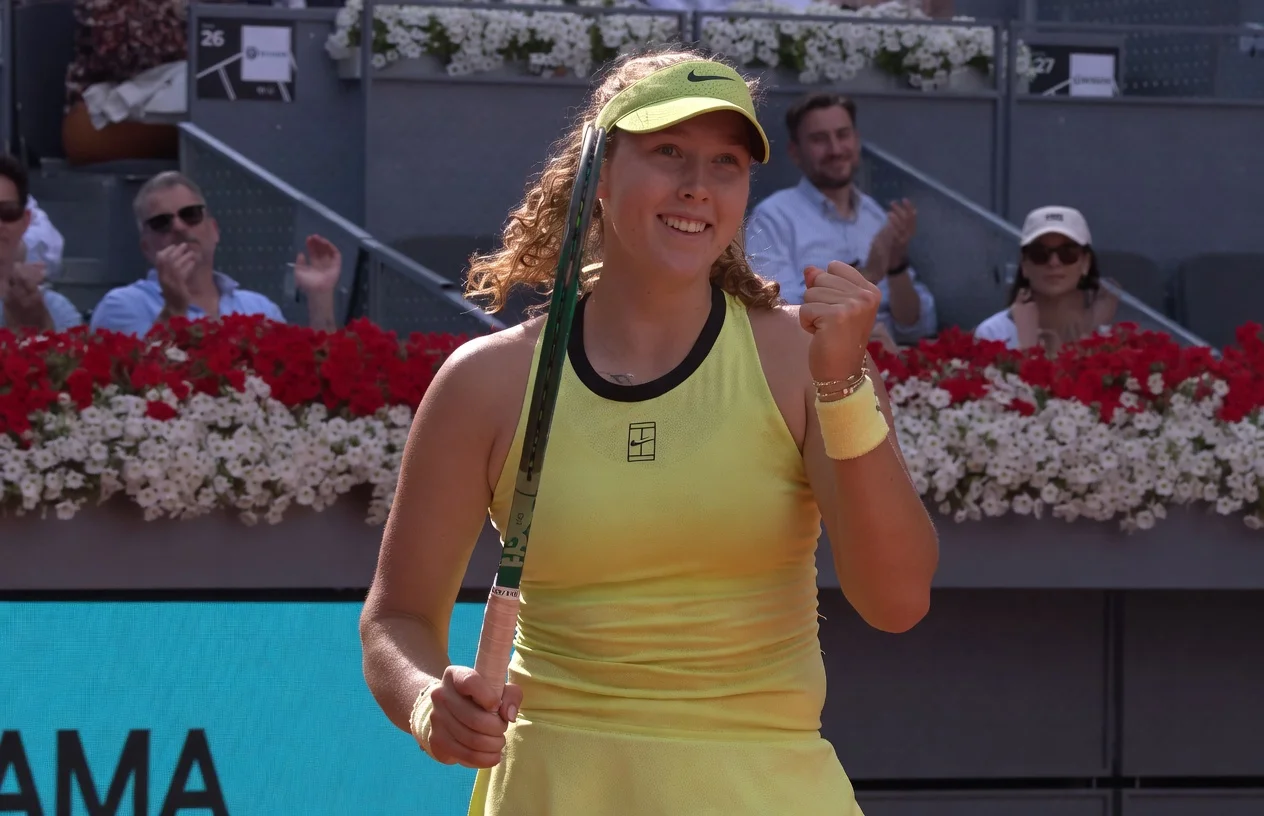
Mirra Andreeva’s visit to Madrid has been built on control. Even when that control was briefly tested—by scoreboard pressure, by an in-form opponent, and by a moment of visible frustration with the officiating system—she returned to it quickly enough to close out Hailey Baptiste 6-4, 7-6(8) and move into her third WTA 1000 final.
This was not her cleanest performance of the tournament. It did not need to be. What mattered was her ability to steady the match whenever it drifted.
A match played on Andreeva’s terms
From the outset, Andreeva set the tone, even if the scoreboard did not immediately reflect it.
Both players opened with comfortable holds, settling quickly into the semi-final. Baptiste showed early resistance, saving a break point in emphatic fashion to edge 2-1 ahead, but the underlying pattern was already forming—Andreeva probing, extending rallies, and testing the American’s consistency from the baseline.
At 3-2, the match found its first real shift. A hold to love for Baptiste briefly masked the pressure building underneath, but Andreeva continued to press, stepping closer to the baseline and forcing tighter margins.
The breakthrough arrived soon after.
With the set finely balanced, Andreeva edged ahead 4-3 by securing the first break of the match, helped in part by a forehand that clipped the baseline at a crucial moment. It was a marginal gain in score, but a significant one in control.
From there, she managed the set with assurance. Baptiste held to force Andreeva to serve it out at 5-4, but there was no hesitation this time. A composed service game—closed with authority—sealed the opening set 6-4.
Small margins had defined it. Andreeva had handled them better.
Hailey Baptiste vs Mirra Andreeva – Set One Stats
| Statistic | Hailey Baptiste | Mirra Andreeva |
|---|---|---|
| Dominance Ratio | 0.26 | 3.88 |
| Winners | 11 | 9 |
| Unforced Errors | 16 | 7 |
| Serve Rating | 266 | 339 |
| Aces | 3 | 2 |
| Double Faults | 0 | 0 |
| 1st Serve % | 53% (18/34) | 77% (17/22) |
| 1st Serve Points Won | 61% (11/18) | 100% (17/17) |
| 2nd Serve Points Won | 69% (11/16) | 60% (3/5) |
| Break Points Saved | 50% (1/2) | – (0/0) |
| Service Games | 80% (4/5) | 100% (5/5) |
| Ace % | 8.8% | 9.1% |
| Double Fault % | 0% | 0% |
| Return Rating | 40 | 140 |
| 1st Return Points Won | 0% (0/17) | 39% (7/18) |
| 2nd Return Points Won | 40% (2/5) | 31% (5/16) |
| Break Points Won | – (0/0) | 50% (1/2) |
| Return Games | 0% (0/5) | 20% (1/5) |
| Pressure Points | 67% (4/6) | 33% (2/6) |
| Service Points | 65% (22/34) | 91% (20/22) |
| Return Points | 9% (2/22) | 35% (12/34) |
| Total Points | 43% (24/56) | 57% (32/56) |
| Set 1 Duration | 0h40m | |
A moment of friction in Madrid’s ongoing debate
Yet the match will also be remembered for a moment that briefly disrupted that rhythm.
At 2-2 in the first set, Baptiste struck a forehand that landed deep and was called in by the electronic system. Andreeva immediately questioned the call, pointing to what she believed was a visible mark on the clay.
“So even if you see that it’s out, you cannot overrule?” she asked umpire Kader Nouni.
“You know how it works,” came the reply. “I have the green light… nothing I can do.”
What followed was a rare, extended exchange. Andreeva insisted the ball was clearly long—“this is like five centimetres”—while Nouni maintained the limits of the system.
“I understand that you cannot do anything,” she said, “but as players, this can mean a lot.”
The discussion reflected a broader tension in Madrid this week, where electronic line calling on clay has repeatedly clashed with visible ball marks.
In this case, the decision stood.
Andreeva moved on.
Baptiste pushes, Andreeva responds
If the first set was controlled, the second demanded more.
Baptiste, coming off an emotionally charged run through the draw, resisted strongly. She held early, absorbed pressure, and stayed within reach even as Andreeva continued to dominate on serve.
At 4-3, the Russian struck again, breaking to move within one game of the final. The match appeared to be closing.
It did not.
Serving at 5-4, Andreeva faltered. Suddenly the dynamic shifted. The American, who had survived multiple tight matches earlier in the week, sensed another opening.
She saved a match point. Then another.
At that point, it almost felt like a Sabalenka scenario was unfolding for Hailey Baptiste. The acceleration in the forehand was back.
The set moved into a tiebreak.
Closing without panic
In the tiebreak, the pressure flipped.
An impeccable Baptiste surged to a 3-0 and 4-1 lead, creating three set points and threatening to push the match into a decider. Each time, Andreeva responded—not with risk, but with clarity. She served precisely, controlled the exchanges, and even produced a lob of the highest quality.
By her third match point, the pattern held.
The young Russian athlete closed it.
A release followed—brief, loud, but contained. Another final secured, without the need for theatrics.
Hailey Baptiste vs Mirra Andreeva – Set Two Stats
| Statistic | Hailey Baptiste | Mirra Andreeva |
|---|---|---|
| Dominance Ratio | 0.83 | 1.21 |
| Winners | 15 | 12 |
| Unforced Errors | 23 | 18 |
| Serve Rating | 267 | 294 |
| Aces | 2 | 1 |
| Double Faults | 2 | 1 |
| 1st Serve % | 59% (26/44) | 68% (27/40) |
| 1st Serve Points Won | 69% (18/26) | 70% (19/27) |
| 2nd Serve Points Won | 56% (10/18) | 73% (11/15) |
| Break Points Saved | 50% (1/2) | 0% (0/1) |
| Service Games | 83% (5/6) | 83% (5/6) |
| Ace % | 4.5% | 2.5% |
| Double Fault % | 4.5% | 2.5% |
| Return Rating | 174 | 142 |
| 1st Return Points Won | 30% (8/27) | 31% (8/26) |
| 2nd Return Points Won | 27% (4/15) | 44% (8/18) |
| Break Points Won | 100% (1/1) | 50% (1/2) |
| Return Games | 17% (1/6) | 17% (1/6) |
| Pressure Points | 80% (4/5) | 20% (1/5) |
| Service Points | 64% (28/44) | 70% (28/40) |
| Return Points | 30% (12/40) | 36% (16/44) |
| Total Points | 48% (40/84) | 52% (44/84) |
| Set 2 Duration | 1h01m | |
Full match stats: control over time
The underlying numbers highlight the foundation of Andreeva’s performance.
Her dominance ratio stood at 1.59 to Baptiste’s 0.63, reflecting sustained control across both sets. While Baptiste struck more winners (26 to 21), the difference came in efficiency and error management, with Andreeva limiting herself to 25 unforced errors against 39 from her opponent.
On serve, the gap widened further. Andreeva landed 69% of first serves and won 81% of those points, compared to Baptiste’s 66%. She also protected her service games with greater consistency, winning 91% of them.
In rallies, she applied steady pressure rather than overwhelming force, winning 54% of total points and maintaining a clear edge in return consistency.
Even in the tighter moments—such as the tiebreak—her margin for error remained lower.
A final earned through control
Mirra Andreeva moves into her third WTA 1000 final not through momentum swings, but through something more reliable: control, applied consistently, even when the match threatens to drift.
For Hailey Baptiste, the ending will sting, but it does little to diminish the weight of her 2 Spanish weeks.
She fought again—brave, inventive, and willing to take risks under pressure. Even here, she extended the match, saved match points, and forced Andreeva into uncomfortable territory late on. But in the decisive moments, her serve did not quite hold up. A missed first delivery here, a second serve sitting up there—it was enough for the balance to tilt away.
Still, the broader picture is unmistakable.
Baptiste leaves Madrid with one of the standout runs of the tournament, having taken down Jasmine Paolini, Belinda Bencic, and world No.1 Aryna Sabalenka in succession. It was a stretch of matches that confirmed not just her level, but her ability to sustain it against the very top tier.
In the end Andreeva closed the door.
But a brave Hailey Baptiste made sure it was anything but straightforward.