
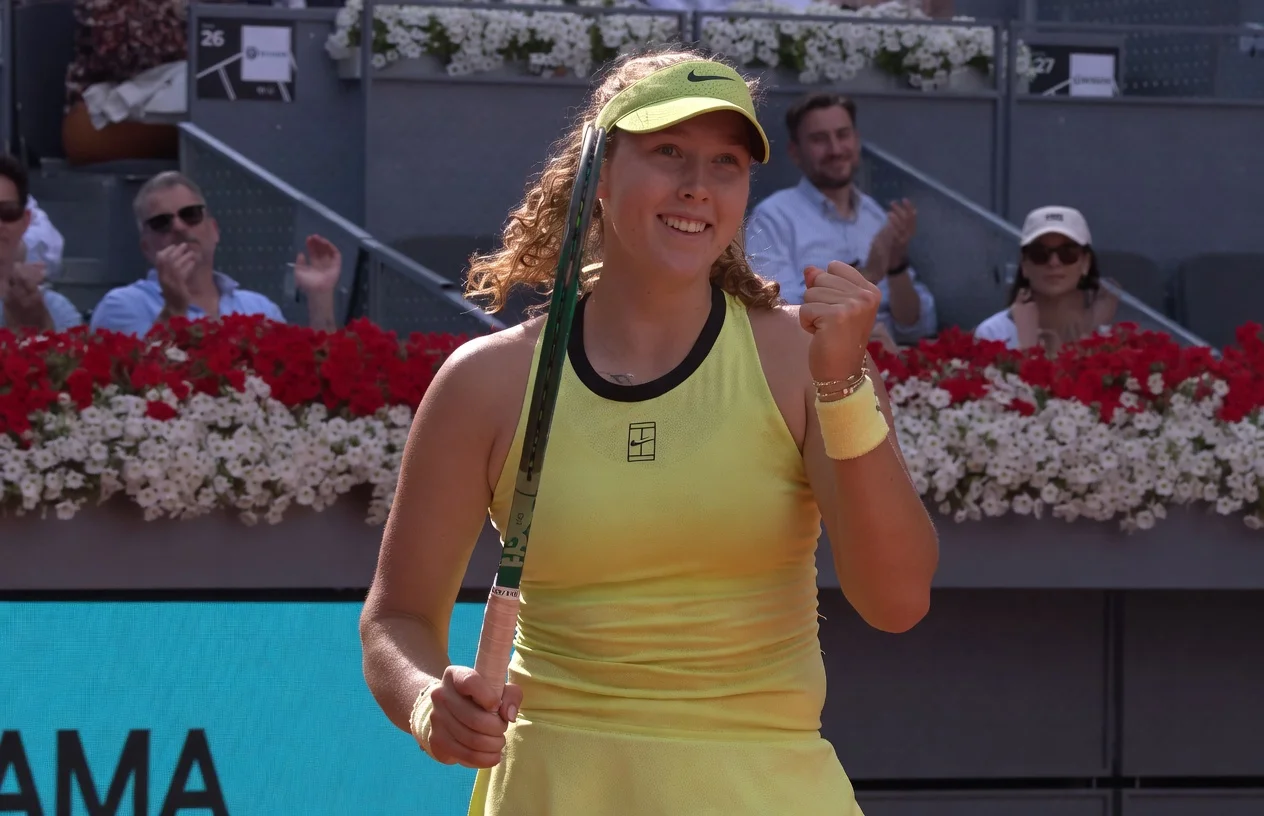
Rome was supposed to sharpen the hierarchy before Roland Garros.
Instead, it has scrambled it. Partly.
The world No. 1 is gone. The defending champion is gone. Madison Keys is gone. So is Amanda Anisimova before even striking a ball. Around them, teenagers have exploded into contention, qualifiers have distorted entire sections of the draw and one 36-year-old Romanian has quietly produced the most captivating story of the tournament.
Now the Italian Open arrives at its quarter-final stage with four wildly different matches — and perhaps the clearest clay-court snapshot yet of where the women’s game currently stands two weeks before Paris.
Sorana Cirstea vs Jelena Ostapenko — chaos meets reinvention
Nobody remaining in Rome has altered the emotional temperature of the tournament quite like Sorana Cirstea.
When the draw opened, her quarter looked top-heavy and largely closed off. Aryna Sabalenka sat there as the obvious favourite. Clara Tauson was dangerous. Amanda Anisimova was meant to anchor the lower half before withdrawing. Yet somehow it is Cirstea — in the final season of her career — who now stands three victories away from the biggest title run she has produced in years.
And she has earned it properly.
The Romanian dismantled Tatjana Maria, then produced the defining upset of the tournament by taking down Sabalenka in three emotionally violent sets, recovering after the Belarusian threatened to snatch the match back late in the decider. Against Linda Noskova in the Round of 16, she backed it up calmly, which perhaps mattered even more.
That is usually the difficult part after a career-defining win: playing normally again.
Cirstea managed it.
Now comes Jelena Ostapenko, which guarantees that “normal” disappears entirely.
The Latvian has bulldozed through this event in her own wonderfully unstable fashion. Lucrezia Stefanini barely touched the ball. Qinwen Zheng was eventually overpowered. Anna Kalinskaya simply got hit off the court in the Round of 16.
When Ostapenko sees the ball early, the sport starts resembling controlled demolition.
But this quarter-final feels less about pure hitting and more about emotional management. Cirstea has looked unusually serene throughout Rome, almost liberated by the knowledge that these are the final chapters of her career. Ostapenko, meanwhile, remains capable of producing both the cleanest tennis and the messiest ten-minute collapse in the same match.
That tension alone makes this impossible to predict cleanly.
Coco Gauff vs Mirra Andreeva — the future arrives early again
There is something fitting about this match happening in Rome.
Clay tends to expose young players emotionally faster than any other surface. It stretches points, extends pressure and removes shortcuts. Yet Gauff and Andreeva continue handling it better than most established stars.
Neither arrives in the quarter-finals completely comfortably.
Gauff has spent half the tournament surviving herself. She dropped the opening set against Solana Sierra before storming back 6-0 in the second, then nearly disappeared entirely against Iva Jovic before saving match point and escaping in three sets.
The American admitted afterwards that, at one stage against Jovic, her “head was almost in the locker room.”
And yet she is still here.
That says plenty about her resilience, even if the tennis itself has fluctuated wildly.
Mirra Andreeva’s route has looked calmer on paper, though no less impressive. She demolished Antonia Ruzic, recovered intelligently after dropping the second set against Viktorija Golubic and then clinically dismantled Elise Mertens in the Round of 16.
The Russian teenager increasingly plays like somebody who already understands how to structure big tournaments rather than simply survive individual matches.
That maturity is becoming frightening.
Stylistically, this feels fascinating. Gauff still possesses the superior athletic range and defensive elasticity, but Andreeva’s ability to redirect pace early could repeatedly force the American into uncomfortable forehand exchanges.
And emotionally, both arrive carrying very different momentum.
Gauff escaped.
Andreeva advanced.
There is a difference.
Jessica Pegula vs Iga Swiatek — the cleanest collision left in the draw
For all the volatility elsewhere, this quarter-final feels refreshingly straightforward.
Two elite players. Two proven clay-court operators. No strange circumstances needed.
Pegula’s Rome has been almost absurdly efficient. She handed Rebeka Masarova the first double bagel of her entire career in the third round, then navigated Anastasia Potapova’s heavy hitting in straighter lines than the score perhaps suggested.
Everything about Pegula right now feels measured. Compact. Economical.
Swiatek, meanwhile, may quietly be building toward something dangerous after weeks of scrutiny surrounding her form. The Pole survived Catherine McNally’s aggression in a messy second-round battle before flattening Elisabetta Cocciaretto 6-1, 6-0 in one of the cleanest performances of the tournament.
The timing looked better. The movement sharper. The emotional noise lower.
And that matters.
Historically, Swiatek remains the superior clay-court player, particularly in extended physical exchanges. But Pegula’s ability to absorb pace and redirect rallies earlier than most opponents has troubled the Pole before.
This may ultimately become the quarter-final that most closely resembles a Roland Garros latter-stage match.
Not necessarily spectacular.
But brutally high-level.
Elina Svitolina vs Elena Rybakina — pressure absorbed differently
Few players in Rome have looked as quietly convincing as Elina Svitolina.
There has been remarkably little drama around her progress. She brushed aside Hailey Baptiste, comfortably ended Nikola Bartunkova’s remarkable lucky-loser run and continues to move through clay-court rallies with the kind of balance and patience that once made her one of the sport’s most difficult players to hit through.
But Rybakina presents an entirely different problem.
The Kazakh has looked sharper with every round in Rome after a strangely incomplete Madrid campaign. Maria Sakkari barely laid a glove on her. Alexandra Eala competed bravely but spent most of the match trying to survive first-strike pressure. Karolina Pliskova lasted just fourteen games in the Round of 16.
That last performance especially felt ominous.
Because when Rybakina’s low backhands and fierce forehands start landing cleanly on clay, the surface suddenly becomes much faster than opponents want it to.
The contrast here is compelling. Svitolina absorbs pressure better than almost anyone left in the draw. Rybakina creates pressure faster than almost anyone in the sport.
Something has to give.
And perhaps that is the larger feeling surrounding Rome now.
The tournament no longer feels like preparation.
It’s money time in Rome.