
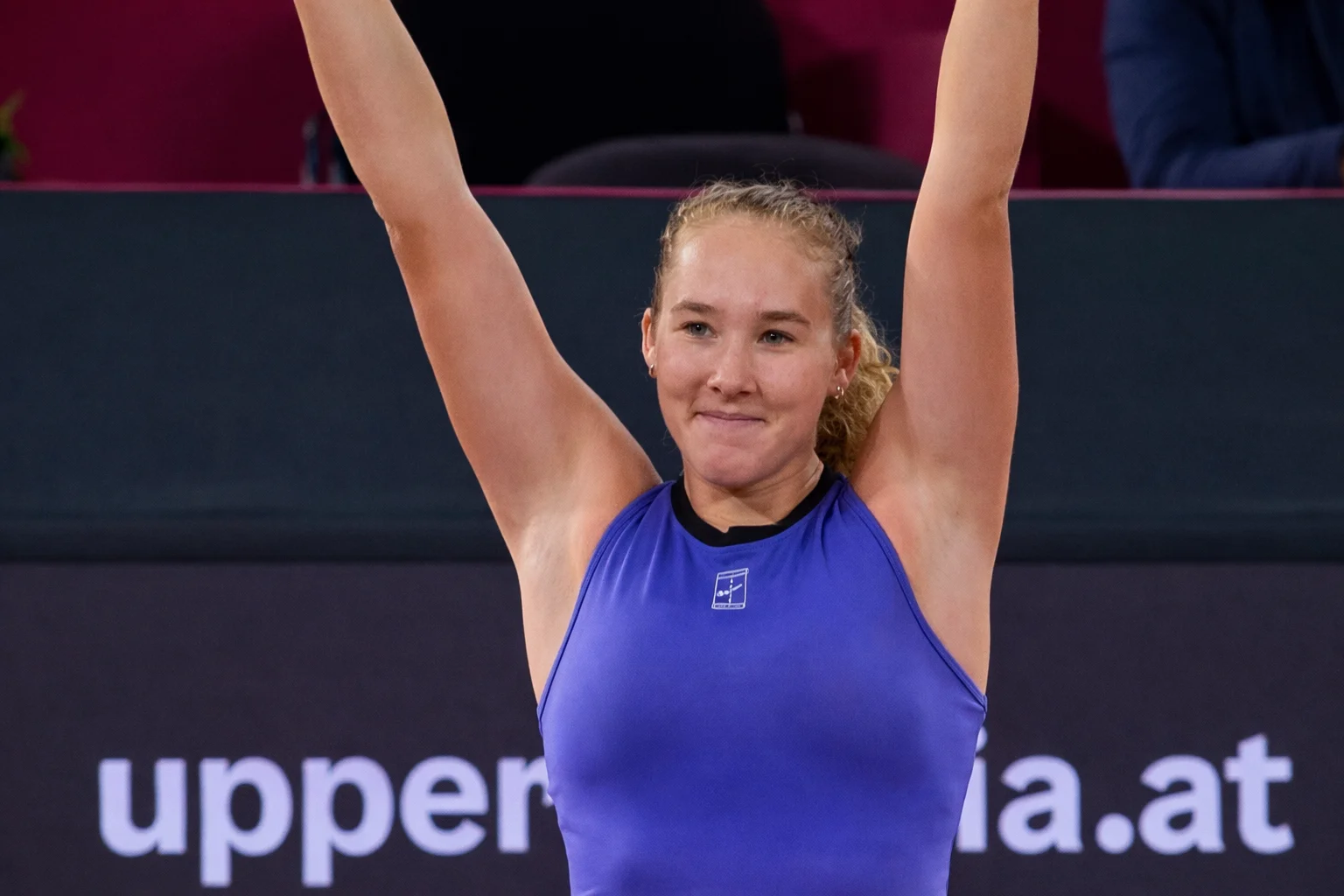
Slice at Mirra Andreeva, and she can slice back. Hit heavy, and she will try to hit heavier. Throw moonballs into the Paris sky, and she has enough topspin of her own to make the clay feel like a trampoline.
That is the frightening part of Andreeva’s Roland Garros run now. She is not winning with one clean pattern. She is adapting inside the rally, changing height, pace and shape, then waiting for the opponent to run out of answers.
Jil Teichmann tried to give her a different kind of afternoon. The Swiss left-hander had already made a serious run in Paris and had the variety to ask awkward questions. For a short while, she did.
Then Andreeva started solving them.
The 19-year-old beat Teichmann 6-3, 6-2 to reach the Roland Garros quarter-finals for the third consecutive year, improving her Paris record to 15-3. Next comes Sorana Cirstea 3.0, a veteran enjoying one of the sharpest runs of her career.
Andreeva keeps looking younger than the résumé and older than the moment.
Teichmann Asks Early Questions Before Andreeva Finds the Range
The first set had a scruffy start, which suited Teichmann more than Andreeva.
Teichmann held from danger in the opening game, saving two break points. Andreeva then had to save a break point herself before levelling at 1-1. The rhythm was not clean. Both players were testing each other’s patience, and the court had that slightly untidy feeling of two left-handed patterns rubbing against each other.
Andreeva broke first for 2-1, but Teichmann broke straight back for 2-2. That was the one moment where the match could have become awkward.
For a while, Teichmann was not just surviving on serve. She was building points beautifully from it, especially with the wide delivery that pulled Andreeva off the court and opened space for the next strike.
That pattern kept her in the set.
Then, at 3-3, it suddenly stopped holding.
Andreeva read the serve better, got enough returns back with depth, and made Teichmann play the extra ball she had previously been avoiding. The Swiss player no longer had the same clean first-shot finish after the serve, and once the game turned into repeated exchanges under pressure, Andreeva took over.
She earned a string of break chances and finally broke through, turning a set that had been awkward into one she could control.
Then came a clean hold for 5-3, followed by another break to seal the set 6-3.
The set was not pretty. It was useful. Andreeva had absorbed Teichmann’s variety, the Swiss player’s serve had started to lose its bite, and the 19-year-old walked away with the scoreline.
Andreeva vs Teichmann – Set One Stats
| Statistic | Andreeva | Teichmann |
|---|---|---|
| Dominance Ratio | 1.44 | 0.70 |
| Winners | 5 | 7 |
| Unforced Errors | 15 | 23 |
| Serve Rating | 278 | 201 |
| Aces | 1 | 1 |
| Double Faults | 1 | 0 |
| 1st Serve % | 75% (18/24) | 72% (28/39) |
| 1st Serve Points Won | 61% (11/18) | 46% (13/28) |
| 2nd Serve Points Won | 67% (4/6) | 42% (5/12) |
| Break Points Saved | 67% (2/3) | 63% (5/8) |
| Service Games | 75% (3/4) | 40% (2/5) |
| Ace % | 4.2% | 2.6% |
| Double Fault % | 4.2% | 0% |
| Return Rating | 210 | 130 |
| 1st Return Points Won | 54% (15/28) | 39% (7/18) |
| 2nd Return Points Won | 58% (7/12) | 33% (2/6) |
| Break Points Won | 38% (3/8) | 33% (1/3) |
| Return Games | 60% (3/5) | 25% (1/4) |
| Pressure Points | 53% (9/17) | 47% (8/17) |
| Service Points | 63% (15/24) | 46% (18/39) |
| Return Points | 54% (21/39) | 38% (9/24) |
| Net Points | 40% (2/5) | 50% (4/8) |
| Total Points | 57% (36/63) | 43% (27/63) |
| Set 1 Duration | 0h45m | |
The Second Set Belonged to Andreeva’s Return
The second set moved faster.
Andreeva held to open, broke for 2-0, then held to love for 3-0. Teichmann was already showing frustration, and the scoreboard started to feel heavy. Against Andreeva, once a player begins chasing, every service game becomes a negotiation.
Teichmann got on the board for 3-1, but she never found a proper route back. Andreeva held for 4-1, broke again for 5-1, and had match points on serve at 5-1.
That was the one little wobble.
Teichmann broke for 5-2, delaying the finish and making Andreeva do the closing work on return instead. The teenager accepted the invitation. She broke again to win the match 6-2, sealing it without letting the Swiss player turn the ending into a real conversation.
No fuss. No drama spiral. Just another round solved on clay.
Andreeva vs Teichmann – Set Two Stats
| Statistic | Andreeva | Teichmann |
|---|---|---|
| Dominance Ratio | 1.73 | 0.58 |
| Winners | 11 | 9 |
| Unforced Errors | 6 | 15 |
| Serve Rating | 264 | 151 |
| Aces | 0 | 0 |
| Double Faults | 1 | 2 |
| 1st Serve % | 65% (17/26) | 71% (15/21) |
| 1st Serve Points Won | 65% (11/17) | 40% (6/15) |
| 2nd Serve Points Won | 60% (6/10) | 17% (1/6) |
| Break Points Saved | 0% (0/1) | 0% (0/3) |
| Service Games | 75% (3/4) | 25% (1/4) |
| Ace % | 0% | 0% |
| Double Fault % | 3.8% | 9.5% |
| Return Rating | 318 | 200 |
| 1st Return Points Won | 60% (9/15) | 35% (6/17) |
| 2nd Return Points Won | 83% (5/6) | 40% (4/10) |
| Break Points Won | 100% (3/3) | 100% (1/1) |
| Return Games | 75% (3/4) | 25% (1/4) |
| Pressure Points | 67% (4/6) | 33% (2/6) |
| Service Points | 62% (16/26) | 33% (7/21) |
| Return Points | 67% (14/21) | 38% (10/26) |
| Net Points | 75% (3/4) | 100% (6/6) |
| Total Points | 64% (30/47) | 36% (17/47) |
| Set 2 Duration | 0h41m | |
Same Winners, Different Match
One of the strangest numbers in the match is this: both players hit 16 winners.
That should suggest a balanced contest. It was not.
The difference sat in the error column and in the serve-return exchange. Teichmann made 38 unforced errors, including 26 on the backhand side. Andreeva made 21. That gap turned the match from competitive on paper into clear on court.
Andreeva’s dominance ratio was 1.54 to Teichmann’s 0.65. She won 60 percent of the total points, 66 of 110, and took six of 11 break points.
The return numbers were especially sharp. Andreeva won 55 percent of Teichmann’s first-serve points and 67 percent behind the Swiss player’s second serve. That is how you make an opponent feel hunted even when she is landing 70 percent of first serves.
Teichmann could start points.
Andreeva kept taking them away.
The Serve Gave Andreeva a Platform Teichmann Never Had
Andreeva’s own serve did not need to be spectacular. It needed to be sturdy.
It was.
She won 62 percent of her first-serve points and 63 percent behind her second serve, which is a very healthy balance on clay. She saved two of four break points and held six of eight service games.
Teichmann held only three of nine.
That gap explains why the match never fully slipped into trouble for Andreeva. Even when the rallies got awkward, even when Teichmann changed pace, Andreeva usually had enough structure behind her own games to keep the scoreboard moving forward.
Then, when Teichmann served, the pressure came back immediately.
Conchita Martínez Keeps Pushing, Andreeva Keeps Listening
There was a revealing little moment in the first set, with Andreeva ahead 5-3 and trying to keep the match from becoming messy again. From the coaching box, Conchita Martínez kept urging her on.
“Vamos Mirra, vamos.”
It fits this stage of Andreeva’s development. The talent is obvious. The feel is obvious. The problem-solving is becoming more obvious every round. What Martínez seems to be helping sharpen is the match management: when to accept a rough game, when to push the return, when to make the opponent live through one more uncomfortable service game.
Against Teichmann, that mattered because the Swiss player had enough craft to irritate her. Andreeva did not get irritated for long.
She adjusted, pressed, and moved on.
Cirstea 3.0 Is Waiting
Andreeva’s next opponent is Sorana Cirstea, and that is not the old version of a familiar name.
This is Cirstea 3.0: older, sharper, freer, and suddenly back in a Roland Garros quarter-final conversation. She demolished Solana Sierra 6-0, 6-0 in the previous round, then beat qualifier Xiyu Wang 6-3, 7-6 to reach the last eight.
That match will ask Andreeva different questions. Cirstea can strike cleanly, rush through games when the timing is there, and punish any loose middle ball. She will not be there simply to extend rallies and wait.
But Andreeva’s run keeps gaining weight.
Ferro. Bassols Ribera. Bouzkova. Teichmann. Four wins, one quarter-final place, and a teenager who looks increasingly comfortable switching gears on the slowest surface.
Slice? She can deal with it.
Pace? She can borrow it.
Topspin? She can produce plenty of her own.
Paris keeps asking Mirra Andreeva different questions.
So far, she keeps changing the answer.