
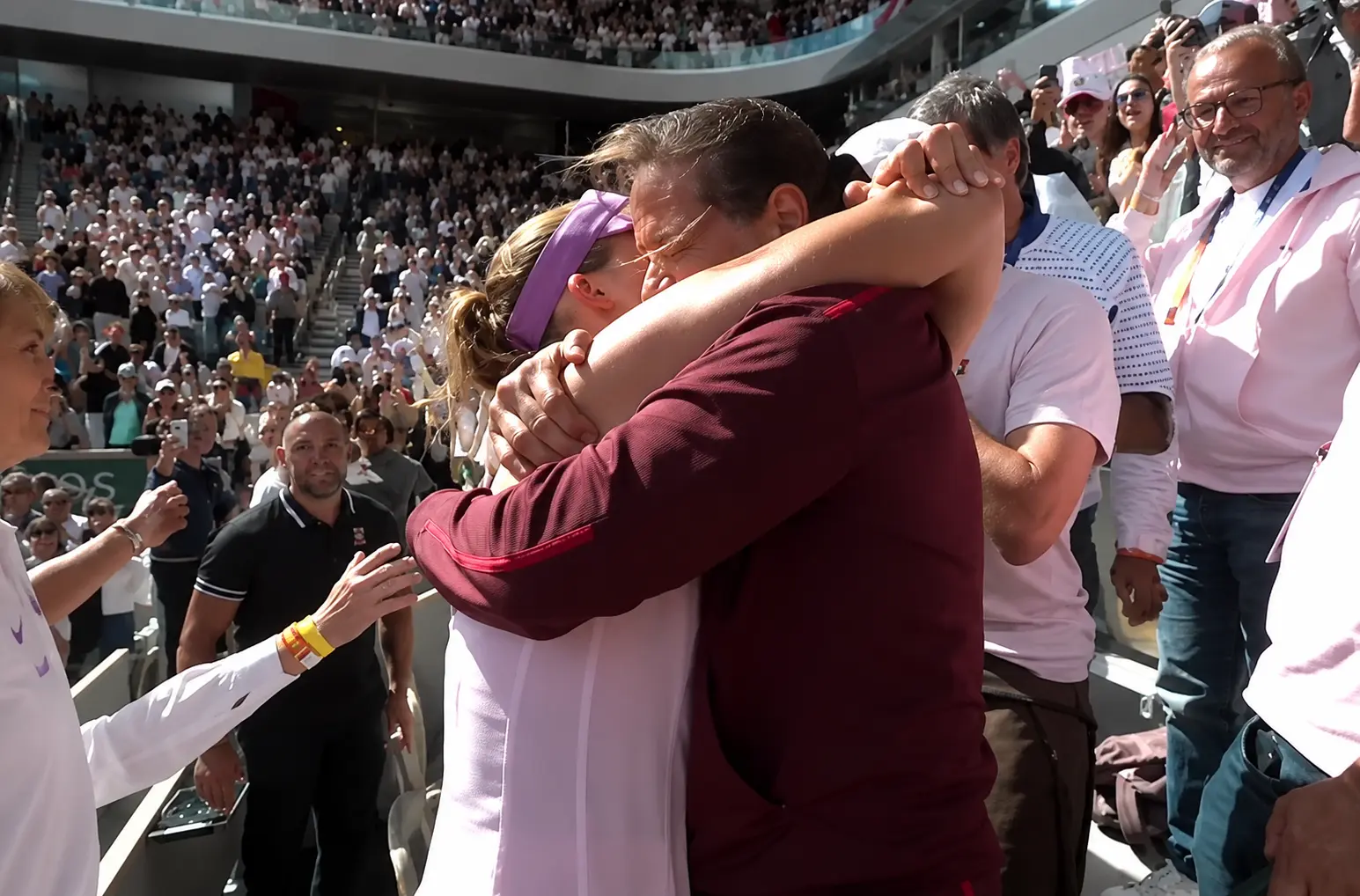
Conchita Martínez has always understood what softness can do to power.
She knew it as a player, long before coaching boxes became part of her life.
She knew it when she won Wimbledon in 1994 with patience, timing, variety and that elegant one-handed backhand, beating Martina Navratilova on grass when Spanish tennis was still mainly expected to speak in clay.
She knew it through Rome, where she won four straight titles.
She knew it through 18 years on tour, 33 singles titles, three Olympic doubles medals and a career that carried her to world No. 2.
And now she has taught it to Mirra Andreeva.
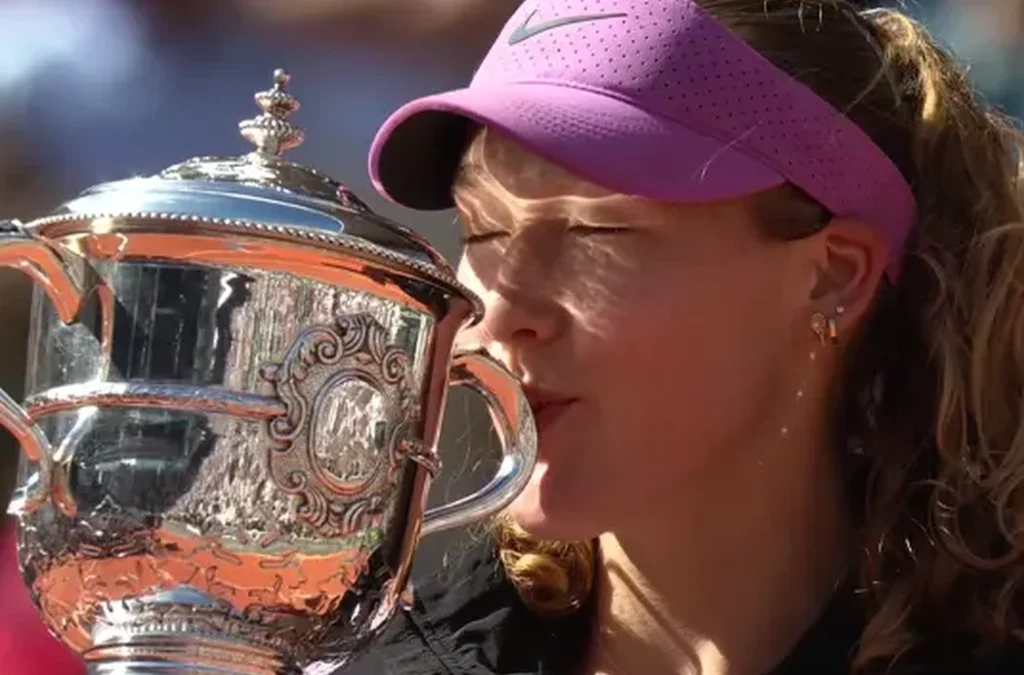
Not by draining the fire out of her. That would have been a mistake. Andreeva’s spark is part of the whole thing. What Martínez has done is more delicate. She has helped turn that spark into a controlled flame.
At Roland Garros, the reward arrived.
Andreeva beat Maja Chwalińska 6-3, 6-2 to win her first Grand Slam title, becoming the first Russian woman to lift the Roland Garros trophy since Maria Sharapova in 2014. In the box, Martínez watched a project become a champion.
It also made history for the coach herself.
After Anabel Medina Garrigues guided Jeļena Ostapenko to the 2017 Roland Garros title, Martínez is now the second female coach in the Open Era to guide a women’s singles champion to the title in Paris.
Women have shaped tennis from the baseline, from the net, from the locker room and from the commentary booth. Coaching boxes, though, have too often told another story. In Paris, Martínez and Andreeva changed the picture again.
The Coach Who Had Already Lived the Whole Match
Martínez’s presence in Andreeva’s box has never looked theatrical.
She is not there to perform for the cameras. She is not trying to become the match. Her coaching style, at least from the outside, seems built around something quieter: enough calm to let Andreeva breathe, enough authority to stop the teenager from drifting into emotional chaos.
That is why the partnership works.
Andreeva can be pretty unfiltered and moody on court if things don’t go her way. But she is also a teenage Grand Slam champion now, and that does not happen only because the talent is large. It happens because someone helps build structure around it.
Martínez has lived almost every version of the tennis problem. She was a prodigy herself. At 15, she won Mediterranean Games gold in Latakia. At 16, she became Spanish champion by beating Arantxa Sánchez Vicario. At 16, she was already making noise at Roland Garros. She knows what early expectation feels like before it becomes comfortable.
That is invaluable with Andreeva.
The Russian is not short of gifts. She has the movement, the backhand, the improvisation and the nerve. But gifts can become noise if a player is not taught how to manage them. Martínez’s job has been to make Andreeva less rushed, less combustible, less likely to treat every lost point as an offence against her talent.
From Muguruza at Wimbledon to Andreeva in Paris
Martínez had already stood inside a Grand Slam-winning coaching story before.
In 2017, she stepped in with Garbiñe Muguruza at Wimbledon after replacing Sam Sumyk as a stand-in coach for that tournament. Muguruza won the title, beating Venus Williams in the final. It was one of those coaching episodes that felt almost too neat: a Spanish Wimbledon champion helping another Spanish player win Wimbledon.
Later, Martínez and Muguruza worked together more formally, and the partnership brought another major peak when Muguruza won the 2021 WTA Finals. That run earned Martínez the WTA Coach of the Year award.
But Andreeva is different.
Muguruza was already a major champion before Martínez became central to her story. Andreeva was still being formed. The talent was obvious, but the identity was not finished. With Andreeva, Martínez has not just added calm to an established champion. She has helped shape one from the clay up.
That is a different kind of coaching satisfaction.
And surely a more intimate one.
They play Uno together.
The Players Martínez Has Coached
Martínez’s coaching path has been broader than many casual fans realise.
Her reported coaching résumé includes:
| Player | Country | Period |
|---|---|---|
| Shahar Peer | Israel | 2007 |
| Janet Husárová | Slovakia | After 2007 |
| Rennae Stubbs | Australia | After 2007 |
| Anastasia Rodionova | Russia/Australia | 2011 |
| Sally Peers | Australia | 2011 |
| Alicia Molik | Australia | 2011 |
| Karolina Pliskova | Czech Republic | 2019 season |
| Garbiñe Muguruza | Spain | 2017 Wimbledon part-time |
| Garbiñe Muguruza | Spain | 2019/2020 to 2023 |
| Marie Bouzková | Czech Republic | 2023 |
| Mirra Andreeva | Russia | 2024–present |
There have also been national-team roles. Martínez served as Spain’s Fed Cup captain from 2013 to 2017 and Davis Cup captain from 2015 to 2017, which gave her another kind of education in managing personalities, pressure and expectation.
Stubbs was an elite doubles mind. Pliskova brought huge serve-and-first-strike tennis. Muguruza carried major-winning power and volatility. Bouzkova brought movement, discipline and a more contained game. Andreeva brings teenage instinct with a champion’s ceiling.
Martínez has not been working with one type of player.
She has been collecting tennis languages.
Why Andreeva Needed This Kind of Voice
There are players who need technical correction.
Andreeva needed something more interesting.
She needed a coach who could let her be herself without letting the tennis become too much about herself. There is a difference. Some players begin to think they have a divine right to win every point. When the opponent plays better, they cannot accept it quickly enough. The match becomes a personal argument, and the arrogance of that feeling can break them mentally.
Andreeva has shown flashes of that frustration in the past. That is normal. She is young, ambitious and emotionally alive on court.
But in this Roland Garros, she looked different.
When Chwalińska made the final awkward early, Andreeva did not get offended by the problem. She solved it. She used forehand slices and backhand slices. She dealt with the wind. She adjusted to the Pole’s drop shots, changes of height and strange rhythms. She stopped waiting for clean tennis and started winning the messy points too.
That is coaching.
Not the shouting kind. Not the notebook kind. The deeper kind, where a player starts making better decisions because the right voice has been present long enough to become part of her own thinking.
Conchita the Player Still Lives in Conchita the Coach
Martínez’s playing career explains a lot about why she can coach Andreeva without flattening her.
She was never only a clay-court grinder, even if clay suited her patience and tactical mind. Her Wimbledon title proved that. Her game had shape. She could absorb, redirect, vary, wait, then strike. She knew how to make a match feel uncomfortable without needing to dominate every second of it.
That is a rare education.
The Special Relationship Is Built on Trust and Joy
The most compelling coach-player relationships are not always the loudest.
They are the ones where the player looks toward the box and does not see panic. Andreeva does not need Martínez to act amazed by her. She needs someone who can see the child, the competitor and the champion-in-progress at the same time.
That is the unusual balance here.
There is warmth in the partnership, but also steel. Martínez does not appear to be trying to make Andreeva older than she is. The kid in her is still there. But she has helped make the tennis more adult.
That is why Roland Garros felt like a natural arrival rather than a freak eruption.
Andreeva had been coming. Martínez helped her arrive in one piece.
A Paris Title With a Wider Meaning
This title belongs to Andreeva first. She hit the shots. She handled the final. She won the trophy.
But coaching is part of tennis history too, and Martínez has now written herself into another chapter.
Wimbledon champion as a player. Wimbledon-winning coach with Muguruza. WTA Finals-winning coach. Roland Garros-winning coach with Andreeva. Hall of Famer. Former national captain. One of the rare figures who has succeeded across eras, roles and surfaces.
And now, the second female coach in the Open Era to guide a women’s singles champion at Roland Garros.
It tells us something about Martínez. It tells us something about Andreeva. It also tells us something about tennis, a sport that still does not place enough women in the most visible coaching positions.
Andreeva’s title may be the beginning of a new arrangement on court.
Martínez’s role in it should be seen just as clearly.
Because behind the teenager who lifted the trophy in Paris stood a woman who had already won Wimbledon, already learned the whole sport from the inside, and then found a way to pass that knowledge on without killing the joy.
That is the relationship.
That is the work.
And in Paris, that work became a Grand Slam title.