
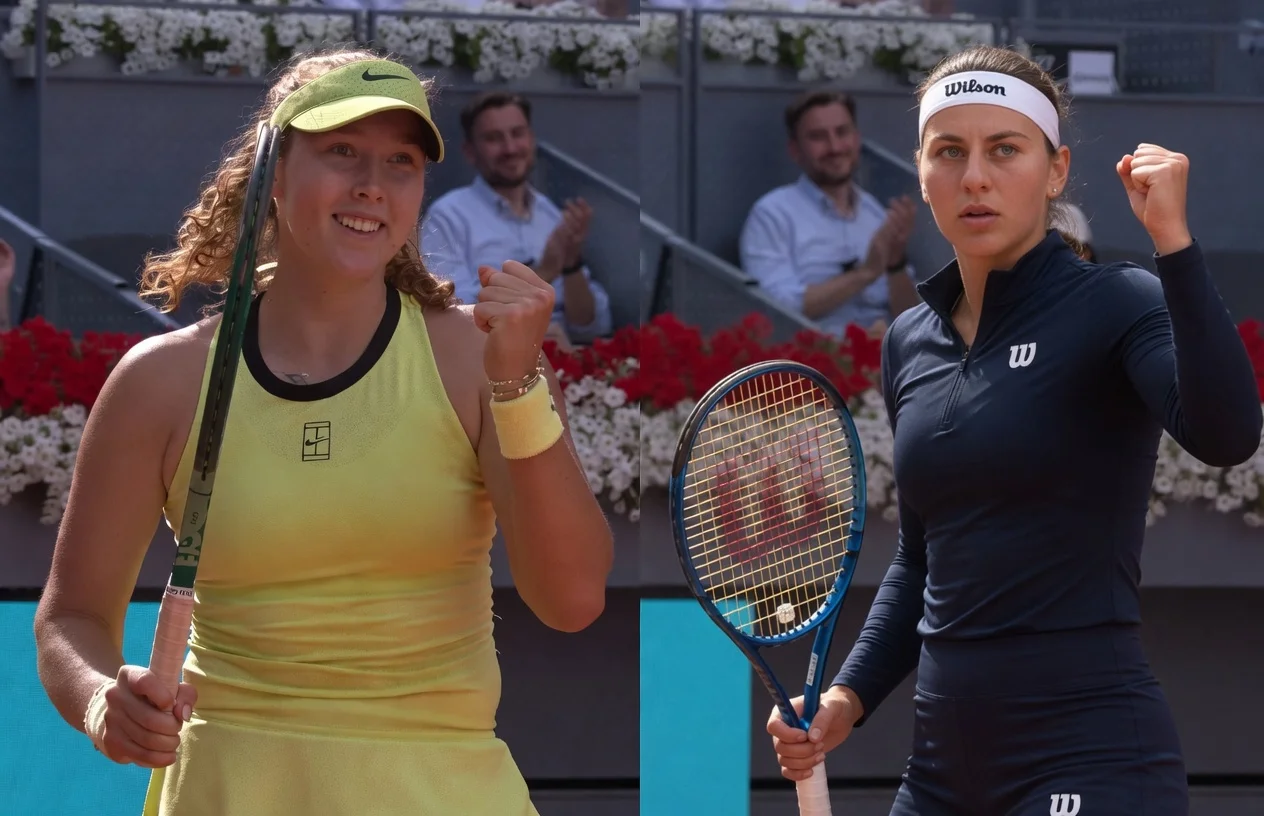
Marta Kostyuk has spent this clay season turning pressure into fuel.
Rouen started it. Madrid made it impossible to ignore. Paris has made it historic. The 23-year-old from Kyiv is still unbeaten on clay this year, still carrying that remarkable 17-0 record, and now stands one match from a first Grand Slam final.
Across the net will be Mirra Andreeva, the 19-year-old Russian who has looked frighteningly comfortable at Roland Garros, especially in the quarter-final, where she rolled over Sorana Cirstea 6-0, 6-3 under the closed roof.
This semi-final is already huge as a tennis match.
It is also impossible to detach from the world around it.
Kostyuk has just come through an all-Ukrainian quarter-final against Elina Svitolina, a match played only hours after heavy Russian attacks on Kyiv. She dedicated that win to the people of Ukraine and their resilience. Now she faces a Russian opponent for a place in the French Open final. There will be no handshake at the end. There cannot be any pretending otherwise.
That gives the match a charge far beyond tactics.
But the tactics are fascinating too.
Kostyuk Has Made the Clay Season Hers
Kostyuk’s run no longer looks like form. It looks like possession.
She has beaten Iga Swiatek and Svitolina in back-to-back rounds at Roland Garros, which is about as loud as a clay-court statement can get. Swiatek was the four-time champion and one of the tournament’s great reference points. Svitolina was the Rome champion, a fellow Ukrainian, and one of the most emotionally complicated opponents Kostyuk could have faced.
Kostyuk handled both.
Against Swiatek, she rushed the Pole into discomfort, attacked the serve and turned the second set into a run of control. Against Svitolina, she had to absorb a proper response. She won the first set, lost the second, then came through a third set that began with five straight breaks before she finally found the hold that changed everything.
Svitolina gave the clearest summary afterwards.
“In the third set she played more aggressive. That was the difference.”
That line should travel into the Andreeva match too, because aggression has become Kostyuk’s separator. Not blind hitting, but aggression with intent: early court position, pressure on second serves, and a willingness to take the shot before the rally turns into someone else’s comfort zone.
Andreeva Looks Like She Has Brought Every Answer
Andreeva’s quarter-final was almost absurdly clean.
Cirstea had arrived with momentum, experience and one of the sharpest versions of her late-career game. Andreeva gave her three games. The dominance ratio was 2.17 to 0.46. The winner count was 18 to four. Andreeva won 67 percent of the total points and converted all six of her break points.
That is not a quarter-final win. That is a warning.
What makes Andreeva so dangerous on clay is that she does not need one pattern to work. Slice at her, and she can slice back. Hit hard, and she can redirect or hit harder. Throw moonballs at her, and she has enough topspin to send the ball back with interest.
Against Jil Teichmann, she solved variety. Against Marie Bouzkova, she handled organisation. Against Cirstea, she smothered a big-hitting veteran before the match had time to develop.
That is the part Kostyuk must respect. Andreeva is not arriving as a teenager hoping to survive the occasion. She is arriving as a player who has made the Roland Garros semi-finals look like a natural stage in her development.
Two Different Kinds of Clay-Court Violence
This is not a soft semi-final.
Kostyuk brings the more obvious forward strike. She wants to take time away, punish short balls, and make the match feel rushed. When she is on, she can turn a rally into a series of collisions.
Andreeva’s violence is different. It can look less explosive, but it is just as suffocating. She changes the height, changes the spin, changes the direction, then suddenly steps in and turns the point. She can make opponents feel as if every answer only creates another question.
That contrast may decide the match.
If Kostyuk can take control early in rallies, especially on Andreeva’s second serve, she can test the Russian’s ability to defend under repeated pressure. But if Andreeva gets time to work the point, vary the pattern and drag Kostyuk into awkward contact, the Ukrainian’s error count may become the danger.
Kostyuk made 37 unforced errors against Svitolina. She could live with that because she hit 33 winners and took charge late. Against Andreeva, that balance may need to be cleaner.
Andreeva made only 17 unforced errors against Cirstea, while giving away almost nothing on serve or return.
The Serve and Return Battle Could Decide Everything
Kostyuk served well enough against Svitolina to create separation, hitting four aces and winning 70 percent of her first-serve points. But her second serve was less secure, winning only 32 percent.
That is a flashing light against Andreeva.
Andreeva destroyed Cirstea’s second serve in the quarter-final, winning 88 percent of those points. If Kostyuk gives her too many looks at second serves, the match can tilt quickly.
The same applies in reverse.
Kostyuk has attacked second serves throughout this run. Against Swiatek, that was central to the upset. Against Svitolina, her aggression in the third set helped break the match open. If she can pressure Andreeva’s second serve before the Russian settles into rallies, she can make this semi-final far less comfortable than Andreeva’s last match.
Both players are excellent returners.
The player who protects the second serve better may protect the match.
When Will this Roland Garros Semi-Final Be Played? Global Start Times Revealed
Thursday June 4 on Court Philippe-Chatrier
- Los Angeles, San Francisco, Vancouver — 6:00
- Miami, New York, Toronto — 9:00
- Buenos Aires, São Paulo — 10:00
- Dublin, London — 14:00
- Paris (France) — 15:00 (local time)
- Amsterdam, Berlin, Brussels, Madrid, Prague, Rome, Stockholm — 15:00
- Athens, Bucharest, Helsinki, Kyiv, Moscow — 16:00
- New Delhi — 18:30
- Beijing, Manila, Singapore — 21:00
- Melbourne, Sydney — 0:00 (Saturday midnight)
What the Moment Means
For Andreeva, this is another chance to turn enormous promise into a first Grand Slam final. She has looked ready for this kind of stage for a while, but readiness still has to be proven when the final is one match away.
For Kostyuk, the match carries more layers.
She is unbeaten on clay. She has just beaten Swiatek and Svitolina. She has dedicated her quarter-final victory to Ukraine. She now faces a Russian opponent in a semi-final where the usual sporting rituals will not apply.
There will be no neutral atmosphere around that fact, even if the tennis itself has to be played point by point.
That is why this semi-final feels so loaded. Two players chasing a first major final. Two modern clay games built around pressure, movement and attack. One Ukrainian player carrying a season that has become bigger every round. One Russian teenager trying to keep proving that Roland Garros already belongs in her future.
Kostyuk has made the clay season hers.
Andreeva has made Paris look easy.
Only one of those things can still be true by the end of the semi-final.