
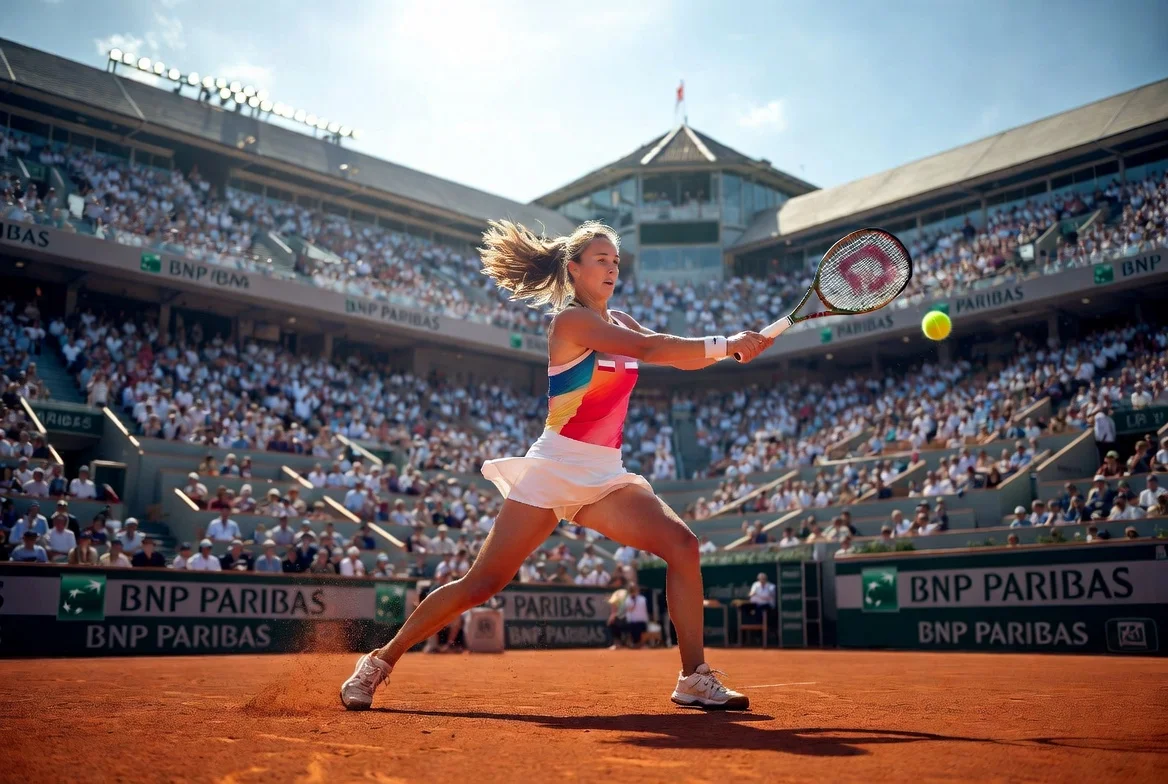
Maja Chwalinska wondered a week ago whether she could even afford to book another week in a Paris hotel.
Now Paris may have to keep booking space for her.
The Polish qualifier, ranked world No. 114 when this French Open began, beat Anna Kalinskaya 7-6(3), 6-3 to reach the semi-finals of Roland Garros in one of the most improbable stories this tournament has produced. She came through qualifying. She had never played a main-draw match at Roland Garros before this fortnight. She arrived as the sort of player big outlets often treat as a name to be cleared from the bracket before the serious business begins.
That bracket has been shredded.
Zheng Qinwen. Elise Mertens. Maria Sakkari. Diane Parry. Anna Kalinskaya.
All gone.
Chwalinska has now won eight matches in Paris: three in qualifying and five in the main draw. That is more than the seven matches required to win the title from the first round. She has gone from trying to stretch a tournament budget to playing for a place in a Grand Slam final.
Afterwards, she looked as stunned as everyone else.
“I honestly don’t know what’s going on,” she said. “Every single match here is crazy.”
That is one way of putting it.
Another is this: the French Open has found its impossible story, and she is left-handed, Polish, crafty, and refusing to leave.
Kalinskaya Starts Fast, Then Chwalinska Changes the Match
Kalinskaya began like the player with the bigger ranking and the heavier expectation.
She broke in the opening game and had chances to make the start even more comfortable. But Chwalinska did what she has done throughout this run: she refused to let the match settle into someone else’s rhythm.
From 1-0 down, she broke back. Then she broke again. Then she held. Then she broke once more. Suddenly the qualifier had won five straight games and led 5-1.
It was not power tennis. It was disruption.
Chwalinska kept changing the shape of points. Different heights. Different speeds. Slices that stayed low. Loops that bought time. Angles that made Kalinskaya hit one more ball from a position she did not like.
Kalinskaya’s errors began to stack up, and the scoreboard looked almost unreal.
Then came the wobble.
Chwalinska had set point at 5-1 and could not take it. Kalinskaya broke. She had another chance to serve it out at 5-3, and again the set escaped her. Kalinskaya levelled at 5-5, and for a moment it looked as if the whole comeback had been handed back to the seeded player.
But the tie-break told the truth.
Chwalinska steadied herself, took control of the mini-battle, and won it 7-3. After all the tension, after the missed set points, after Kalinskaya’s recovery, the qualifier still walked away with the set.
That was huge.
Kalinskaya vs Chwalinska – Set One Stats
| Statistic | Kalinskaya | Chwalinska |
|---|---|---|
| Dominance Ratio | 0.88 | 1.14 |
| Winners | 25 | 16 |
| Unforced Errors | 29 | 10 |
| Serve Rating | 186 | 228 |
| Aces | 0 | 0 |
| Double Faults | 4 | 1 |
| 1st Serve % | 67% (29/43) | 83% (44/53) |
| 1st Serve Points Won | 59% (17/29) | 52% (23/44) |
| 2nd Serve Points Won | 14% (2/14) | 44% (4/9) |
| Break Points Saved | 25% (1/4) | 63% (5/8) |
| Service Games | 50% (3/6) | 50% (3/6) |
| Ace % | 0% | 0% |
| Double Fault % | 9.3% | 1.9% |
| Return Rating | 192 | 252 |
| 1st Return Points Won | 48% (21/44) | 41% (12/29) |
| 2nd Return Points Won | 56% (5/9) | 86% (12/14) |
| Break Points Won | 38% (3/8) | 75% (3/4) |
| Return Games | 50% (3/6) | 50% (3/6) |
| Pressure Points | 48% (10/21) | 52% (11/21) |
| Service Points | 44% (19/43) | 51% (27/53) |
| Return Points | 49% (26/53) | 56% (24/43) |
| Net Points | 69% (11/16) | 64% (7/11) |
| Total Points | 47% (45/96) | 53% (51/96) |
| Set 1 Duration | 1h10m | |
The Second Set Became a Break-Fest, but Chwalinska Had the Cooler Head
The second set began quietly enough. Kalinskaya held. Chwalinska held to love.
Then the service games of the Russian started falling apart.
Chwalinska broke for 2-1, backed it up for 3-1, then broke again for 4-1. That should have been enough daylight. But Kalinskaya was not gone. She broke back for 2-4, only for Chwalinska to answer even better and move to 5-2.
Again, Kalinskaya delayed the ending.
She broke for 3-5. One more twist, one more nervous service game, one more invitation for the match to get messy.
Chwalinska did not accept it.
She broke again to finish it 6-3, converting match point on Kalinskaya’s serve and completing another result that would have sounded absurd two weeks ago.
Kalinskaya vs Chwalinska – Set Two Stats
| Statistic | Kalinskaya | Chwalinska |
|---|---|---|
| Dominance Ratio | 0.81 | 1.24 |
| Winners | 11 | 8 |
| Unforced Errors | 18 | 5 |
| Serve Rating | 169 | 238 |
| Aces | 1 | 0 |
| Double Faults | 2 | 0 |
| 1st Serve % | 69% (22/32) | 74% (17/23) |
| 1st Serve Points Won | 41% (9/22) | 47% (8/17) |
| 2nd Serve Points Won | 40% (4/10) | 67% (4/6) |
| Break Points Saved | 0% (0/4) | 33% (1/3) |
| Service Games | 20% (1/5) | 50% (2/4) |
| Ace % | 3.1% | 0% |
| Double Fault % | 6.3% | 0% |
| Return Rating | 203 | 299 |
| 1st Return Points Won | 53% (9/17) | 59% (13/22) |
| 2nd Return Points Won | 33% (2/6) | 60% (6/10) |
| Break Points Won | 67% (2/3) | 100% (4/4) |
| Return Games | 50% (2/4) | 80% (4/5) |
| Pressure Points | 33% (3/9) | 67% (6/9) |
| Service Points | 41% (13/32) | 52% (12/23) |
| Return Points | 48% (11/23) | 59% (19/32) |
| Net Points | 64% (9/14) | 50% (1/2) |
| Total Points | 44% (24/55) | 56% (31/55) |
| Set 2 Duration | 0h45m | |
Qualifier into the French Open semi-finals.
World No. 114 into the last four.
Paris still trying to understand what just happened. There would be even more to take in later on.
Same Match, Two Different Error Columns
Kalinskaya hit more winners, 36 to Chwalinska’s 24. That number alone could make the match look like a missed chance for the Russian.
The rest of the statistics tell the real story.
Kalinskaya made 47 unforced errors. Chwalinska made 15.
That was the difference between having the bigger racket and having the better match.
Chwalinska’s dominance ratio was 1.18 to Kalinskaya’s 0.85. She won 82 of the 151 points, taking 54 percent overall. She also won 13 of 19 pressure points, which matters because this was exactly the kind of match where nerves could have swallowed her.
The return numbers were even sharper. Chwalinska won 75 percent of points on Kalinskaya’s second serve and broke seven times from eight chances. Kalinskaya won only 25 percent of her own second-serve points, and that left her constantly exposed.
Every time the Russian missed a first serve, the next few seconds felt dangerous.
Chwalinska did not overpower her.
She picked her apart.
The Style Is Now Part of the Story
There is a reason opponents keep looking uncomfortable against Chwalinska.
She does not offer the same ball twice for long. She can take pace off. She can roll the forehand higher. She can pull the ball low with the slice. She can make a rally feel slow, awkward and irritating, then suddenly change direction.
She explained it well herself, saying she tries to vary the rhythm because it is difficult to face someone constantly changing speeds and spins. That has become the defining feature of her French Open.
Kalinskaya never found a clean reference point.
That is the trick. Against big hitters, Chwalinska does not always need to hit bigger. She needs to make them hit from places where their power becomes less simple. Kalinskaya had the weapons, but the match kept dragging her into half-answers.
One more slice.
One more change of height.
One more point that did not behave.
By the end, Kalinskaya had lost not only the scoreboard, but the comfort of knowing what kind of ball was coming next.
From Hotel Doubts to a Life-Changing Prize
This is where the story becomes almost ridiculous.
Chwalinska’s career had not been built on Grand Slam riches. She had won WTA 125 titles, made progress the hard way, and carried a game that serious tennis people respected long before the wider audience noticed. But this was not a player arriving in Paris with the financial cushion of a permanent top-20 career.
She has spoken during this run about the difficulty of covering the cost of staying in Paris. Now, by reaching the semi-finals, she has secured a life-changing payday and a ranking rise that will change her calendar, her access, her leverage and perhaps her whole sense of what is possible.
That is not a side note. It is central to why this run feels different.
For some players, a semi-final is a sporting breakthrough.
For Chwalinska, it is a full career reconstruction.
She has already earned nearly as much from this one tournament as from the rest of her career before it. She is also projected into the top 30 of the live rankings, a jump that sounds almost as unreal as the draw itself.
The player who had to think about hotel costs is now thinking about a Grand Slam semi-final.
She is the biggest shock in the 2026 tournament. That is not exaggeration anymore. In a French Open that has lost Swiatek, Gauff, Rybakina, Pegula and Sabalenka, Chwalinska is still there.
Not watching.
Not visiting.
Playing.
Shnaider Next, and Suddenly the Final Is Not a Joke
The semi-final will be Diana Shnaider against Maja Chwalinska.
Read that again.
Not Sabalenka against Kalinskaya. Not one of the expected heavyweight collisions. Shnaider, who stunned the world No. 1, against Chwalinska, the qualifier who has made the tournament her personal uprising.
It will be a lefty battle. It will be strange, tense and very different from the semi-final anyone expected when the draw came out.
And one of them will play for the French Open title.