
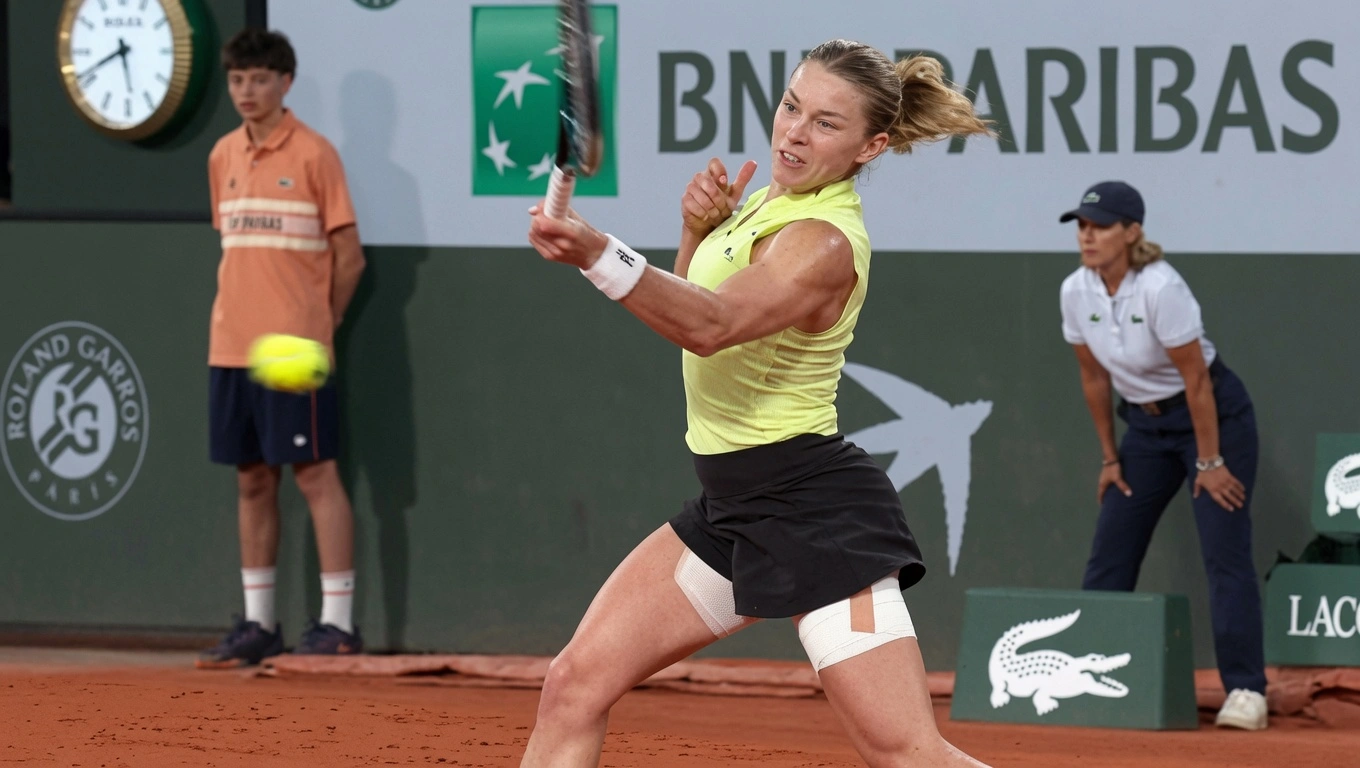
The reward is the 2026 French Open final.
Maja Chwalinska arrived in Paris as a qualifier who had never played the Roland Garros main draw.
Now she is one win from winning it.
Not as a ball-striking machine. Not as another player trying to blast every point into submission.
She has done it with topspin, slice, moonballs, feel, disguise, drop shots and enough tactical mischief to make bigger names look as if they had walked into the wrong kind of tennis lesson.
It took the world No. 114 to bring some old-fashioned flair back to the biggest stage.
Diana Shnaider had just taken out Aryna Sabalenka. She had power, left-handed weight and the momentum of the biggest win of her life. Chwalińska had the angles, the changes of pace, and the nerve to keep making the match awkward until the Russian ran out of clean answers.
The Pole beat Shnaider 7-6(4), 6-4 to become the first qualifier in the Open Era to reach the women’s French Open final. She will face Mirra Andreeva on Saturday.
The player who wondered whether there would be enough money, or even enough rooms, to stay in Paris a little longer now has one more match to play.
For the title.
Chwalinska Turns the First Set Into a Puzzle
The opening set was tense from the start.
Chwalinska held first, then pushed Shnaider in a long second game before the Russian got through for 1-1. The early pattern was already clear: Shnaider wanted to hit through the match, while Chwalinska wanted to make her solve it.
At 1-1, the Pole struck first. She broke for 2-1, held to love for 3-1, and briefly looked as if she might pull away. But Shnaider is not the kind of player who disappears just because the scoreboard starts leaning the wrong way.
She broke back for 2-3, then held for 3-3.
From there, the set became a long test of composure. Chwalinska held for 4-3. Shnaider answered for 4-4. Chwalinska moved to 5-4. Shnaider held again.
Then came the game that could have broken either player.
At 5-5, Chwalinska pushed and pushed on the Shnaider serve. Break chances came and went. Shnaider resisted. Chwalinska kept asking another question. After an 11-minute game, she finally broke for 6-5.
Even then, the set refused to behave. Shnaider broke back immediately for 6-6.
A tie-break had to decide it.
The Tie-Break Belonged to the Player With the Cooler Hand
The breaker briefly tilted toward Shnaider.
She led 4-2 and had the chance to make her power count. But Chwalinska did not panic. She pulled the score back to 4-4, then produced the kind of variety that has defined this entire run.
A net approach. A surprise lob. A point that did not look like the one before it.
Shnaider missed a backhand down the line, and Chwalinska had set points. She took the tie-break 7-4, sealing the first set after another Russian error.
That was not just a set won.
It was a message.
Shnaider could hit harder. Chwalinska could still make the match hers.
Shnaider vs Chwalinska – Set One Stats
| Statistic | Shnaider | Chwalinska |
|---|---|---|
| Dominance Ratio | 0.90 | 1.11 |
| Winners | 22 | 21 |
| Unforced Errors | 22 | 12 |
| Serve Rating | 284 | 280 |
| Aces | 0 | 0 |
| Double Faults | 4 | 3 |
| 1st Serve % | 87% (41/47) | 75% (39/52) |
| 1st Serve Points Won | 61% (25/41) | 62% (24/39) |
| 2nd Serve Points Won | 57% (8/14) | 63% (10/16) |
| Break Points Saved | 67% (2/3) | 75% (3/4) |
| Service Games | 83% (5/6) | 83% (5/6) |
| Ace % | 0% | 0% |
| Double Fault % | 8.5% | 5.8% |
| Return Rating | 118 | 132 |
| 1st Return Points Won | 38% (15/39) | 39% (16/41) |
| 2nd Return Points Won | 38% (6/16) | 43% (6/14) |
| Break Points Won | 25% (1/4) | 33% (1/3) |
| Return Games | 17% (1/6) | 17% (1/6) |
| Pressure Points | 50% (9/18) | 56% (10/18) |
| Service Points | 57% (27/47) | 62% (32/52) |
| Return Points | 38% (20/52) | 43% (20/47) |
| Net Points | 47% (9/19) | 69% (9/13) |
| Total Points | 47% (47/99) | 53% (52/99) |
| Set 1 Duration | 1h18m | |
Shnaider Pushes Back, but Chwalinska Keeps the Match in Her Hands
The second set began with more turbulence.
Chwalinska broke immediately for 1-0, but Shnaider responded again for 1-1. For a while, the set steadied. Shnaider held for 2-1. Chwalińska held for 2-2. Shnaider held again for 3-2. Chwalińska answered for 3-3.
The match was still close, but it was not neutral.
Chwalinska kept making Shnaider uncomfortable in the transitions. The Russian was forced forward more often than she wanted. The rallies stretched into shapes that did not suit her. The Pole’s changes of rhythm kept stopping Shnaider from finding the clean run of points she needed. She was also hitting backhand winners.
At 4-4, the pressure on the Russian finally told.
Chwalinska broke for 5-4.
Then came the biggest service game of her life.
No collapse. No trembling finish. No invitation for one last twist.
The qualifier astonishingly served it out, took the match 6-4, and completed one of the most awesome runs Roland Garros has seen.
Shnaider vs Chwalinska – Set Two Stats
| Statistic | Shnaider | Chwalinska |
|---|---|---|
| Dominance Ratio | 0.72 | 1.38 |
| Winners | 11 | 11 |
| Unforced Errors | 14 | 5 |
| Serve Rating | 250 | 285 |
| Aces | 0 | 0 |
| Double Faults | 0 | 1 |
| 1st Serve % | 88% (23/26) | 74% (20/27) |
| 1st Serve Points Won | 52% (12/23) | 75% (15/20) |
| 2nd Serve Points Won | 50% (2/4) | 57% (4/7) |
| Break Points Saved | 0% (0/2) | 0% (0/1) |
| Service Games | 60% (3/5) | 80% (4/5) |
| Ace % | 0% | 0% |
| Double Fault % | 0% | 3.7% |
| Return Rating | 188 | 238 |
| 1st Return Points Won | 25% (5/20) | 48% (11/23) |
| 2nd Return Points Won | 43% (3/7) | 50% (2/4) |
| Break Points Won | 100% (1/1) | 100% (2/2) |
| Return Games | 20% (1/5) | 40% (2/5) |
| Pressure Points | 33% (1/3) | 67% (2/3) |
| Service Points | 54% (14/26) | 67% (18/27) |
| Return Points | 33% (9/27) | 46% (12/26) |
| Net Points | 29% (2/7) | 75% (3/4) |
| Total Points | 43% (23/53) | 57% (30/53) |
| Set 2 Duration | 0h49m | |
The Stats Show Why Flair Beat Force
The winner count was almost even.
Shnaider hit 33 winners. Chwalinska hit 32.
That tells you this was not just a crafty player waiting for mistakes. Chwalinska created, attacked and finished too. But she did it with far more discipline.
Shnaider made 36 unforced errors. Chwalinska made 17.
Amazing, because the higher-ranked player seemingly held all the cards — but she did not.
The Pole’s dominance ratio was 1.18 to Shnaider’s 0.85. She won 81 of the 151 points, taking 54 percent of the total. She also won six of the 10 pressure points, and in a semi-final this tight, that is a sweet bonus.
Her serve was not spectacular. It was just unbelievably sturdy. She won 65 percent of first-serve points and 57 percent behind the second serve. Shnaider won 56 percent behind both first and second deliveries.
The real split came in the points where the ball stayed alive.
Chwalinska won 71 percent at the net. She made Shnaider play uncomfortable balls. She changed the pace almost constantly to keep the Russian from locking into a rhythm.
Against a hard-hitter, she made tennis flair feel bigger than hitting.
Nine Wins in Paris, From Qualifying to the Final
This is where the run almost stops making sense.
Chwalinska has now won nine matches at this French Open.
Three in qualifying: Alice Rame, Carole Monnet and Suzan Lamens.
Then came the main draw: Zheng Qinwen, Elise Mertens, Maria Sakkari, Diane Parry, Anna Kalinskaya and Diana Shnaider.
Paris can still not believe it.
A normal Grand Slam champion wins seven matches. Chwalinska has already won nine in Paris before even playing the final. She has beaten seeds, home hope, former top-level names, heavy hitters, rhythm players and now the woman who had just taken out the world No. 1.
She started this tournament as a qualifier.
She will finish it as one of the stories of the season, whatever happens on Saturday.
The Player Who Had to Think About the Hotel Is Now Playing for the Trophy
The hotel detail is what makes this feel so human.
Chwalińska did not arrive in Paris with the casual certainty of someone who expected to stay until the final weekend. She had to think about costs, rooms, days, practicalities — the unglamorous part of tennis that sits far away from centre-court photography.
In the end, the financial issue of paying hotel bills was solved by Polish company Oshee. The one attached to… Iga Swiatek.
In the stands, Polish fans were jumping to their feet. Others were silently sobbing on their seats, unable to process what miracle just happened on court.
No tears of joy from the winner, though.
The flair was still running through her veins during the interviews.
“Inside, it’s a storm,” she said. And smiled.
All was done by refusing to become another copy of the same modern template. She has not tried to hit like Sabalenka, Shnaider or Rybakina. She has brought craft into a tournament increasingly ruled by speed and force.
And somehow, against all common sense, it has taken her all the way to the final.
Andreeva Awaits, and the Final Has a Favourite and a Fairytale
Mirra Andreeva will be the favourite.
That is clear. The 19-year-old was ruthless against Marta Kostyuk, winning 6-1, 6-3 and playing with the focus of someone already comfortable with the stage. She has been the cleanest player left in the draw, and she will enter Saturday as the most obvious champion-in-waiting.
But Chwalinska has spent three weeks making obvious ideas look foolish.
The final will bring two very different stories together. Andreeva, the most gifted teenager in the sport, trying to turn promise into a first Grand Slam title.
Chwalinska , the qualifier who revived tennis flair in Paris, trying to complete the most improbable French Open run of all.
One has looked like the future for a while.
The other has spent nine matches making the present lose its balance.
Paris thought it had seen every possible upset this year.
Then Maja Chwalinska kept playing.