
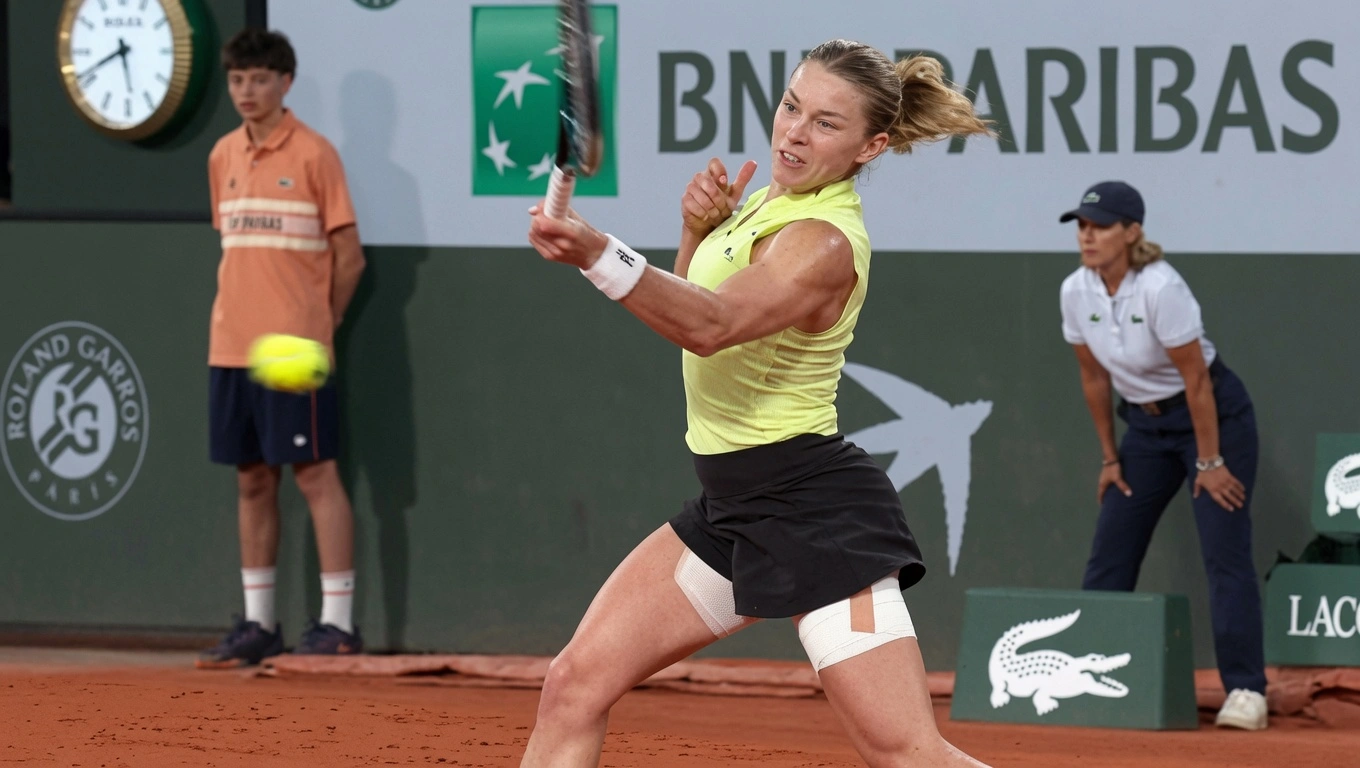
Wimbledon may soon face the kind of problem that sounds too absurd to be real.
What happens if the French Open champion is not even in the Wimbledon main draw?
That is the strange little trap now forming around Maja Chwalinska, whose Paris fairytale has already gone far beyond tennis romance. The Polish qualifier began Roland Garros outside the top 100. She had to come through qualifying. She then kept winning, kept slicing, kept spinning, kept making hard-hitters look as if they had been handed the wrong script.
Now she is in the 2026 French Open final against Mirra Andreeva.
And yet, unless Wimbledon intervenes, she may still need qualifying to get into the next Grand Slam.
That is where the Loïs Boisson comparison becomes awkward. Boisson did not receive a Wimbledon wildcard last year, but she also had not reached the French Open final. Chwalinska has. If the All England Club applies the same cold entry-list logic and leaves a French Open finalist to fight through qualifying, it would create a storyline Wimbledon surely does not want.
A potential Grand Slam champion in qualifying.
A French Open finalist asking for a wildcard.
A player who has just become one of the stories of tennis waiting to see whether Wimbledon has room.
It sounds ridiculous.
It may also be technically possible.
The Entry-List Problem Wimbledon Created for Itself
The issue comes from timing.
Wimbledon’s entry list is based on rankings taken before Chwalinska’s Paris explosion could fully count. At the start of Roland Garros, she was outside the top 100 and nowhere near the status she has now earned on court. Her live ranking has since surged dramatically, with the Pole on course to reach at least the top 20 after her run to the final.
But Grand Slam entry lists do not rewrite themselves every time a player rewrites her career.
That means Chwalinska, despite being a French Open finalist and possibly the champion by Saturday night, is not automatically safe for Wimbledon’s main draw under the existing list. Without enough withdrawals, she would need a wildcard. Otherwise, the story gets even stranger: a newly crowned or newly beaten French Open finalist heading to Roehampton to qualify for Wimbledon.
In sporting terms, it is absurd.
In administrative terms, it is possible.
And that is the problem.
Chwalinska’s Fairytale Could Become Wimbledon’s Headache
The beauty of Chwalinska’s Roland Garros run is that it came from nowhere in ranking terms, but not from nowhere in tennis terms.
She has beaten Zheng Qinwen, Elise Mertens, Maria Sakkari, Diane Parry, Anna Kalinskaya and Diana Shnaider in the main draw after surviving three rounds of qualifying. She has revived natural flair in a draw full of power hitters.
That is exactly the kind of story Wimbledon usually loves.
The problem is that Wimbledon also loves tradition.
Its wildcard process tends to protect British players, reward past champions, and occasionally make room for major international stories. Usually, there is enough space to do all three. This year, Chwalinska could make that balance uncomfortable.
Because if she needs one, how can Wimbledon not give it?
The British Wildcard Queue Is Already Crowded
This is where the politics begins.
Wimbledon traditionally looks after British players. Not as aggressively as Roland Garros protects its French field, but still clearly enough. The list of British women outside direct entry could include Harriet Dart, Katie Swan, Mingge Xu, Alicia Dudeney, Mika Stojsavljevic and Yuriko Miyazaki.
Then come the more complicated names.
Heather Watson has Wimbledon history. Jodie Burrage has had injury interruptions. Both would have reasonable domestic arguments. Francesca Jones and others could also benefit depending on withdrawals and final list movement.
In a normal year, that is already a crowded room.
Add Chwalinska to it, and the tone changes.
Because this is not simply another foreign player asking for a favour. This could be the French Open champion. At minimum, it is the French Open finalist.
Snubbing her would be a statement.
Giving her a wildcard would also mean someone else probably loses out.
The Williams Question Could Make It Even Stranger
And then there is the Williams possibility.
If Serena Williams were to decide she wanted to play singles rather than only doubles, Wimbledon would face a very different kind of pressure. Venus Williams would bring her own legendary case too.
That is the kind of wildcard scenario no tournament can treat casually. The Williams sisters are not ordinary applicants. They are Wimbledon history walking through the gate.
But that only makes the Chwalinska situation more delicate.
There are only so many wildcards.
There may be too many stories.
Why the Boisson Reminder Matters
The Boisson comparison matters because it shows Wimbledon does not automatically bend for a player simply because the tennis world is excited.
But Chwalinska’s case is different.
Boisson was a Roland Garros wildcard who reached the semi-finals and still did not get a Wimbledon wildcard. Chwalinska’s case is stronger: she came through qualifying and reached the French Open final.
That changes the moral weight of the decision.
This is no longer about potential, buzz or one good tournament week. It is about whether Wimbledon wants a French Open finalist, and perhaps the new French Open champion, playing qualifying because of an entry-list date.
That would look careless.
Wimbledon Can Avoid the Mess
The clean solution is simple.
Give Maja Chwalinska the wildcard.
If she loses the French Open final, she is still the first qualifier in the Open Era to reach the women’s final in Paris. If she wins it, the argument becomes almost comically obvious. A Grand Slam champion should not be left outside the main draw of the next Grand Slam because of a ranking cut-off.
Rules matter. Lists matter. Timelines matter.
So does common sense.