
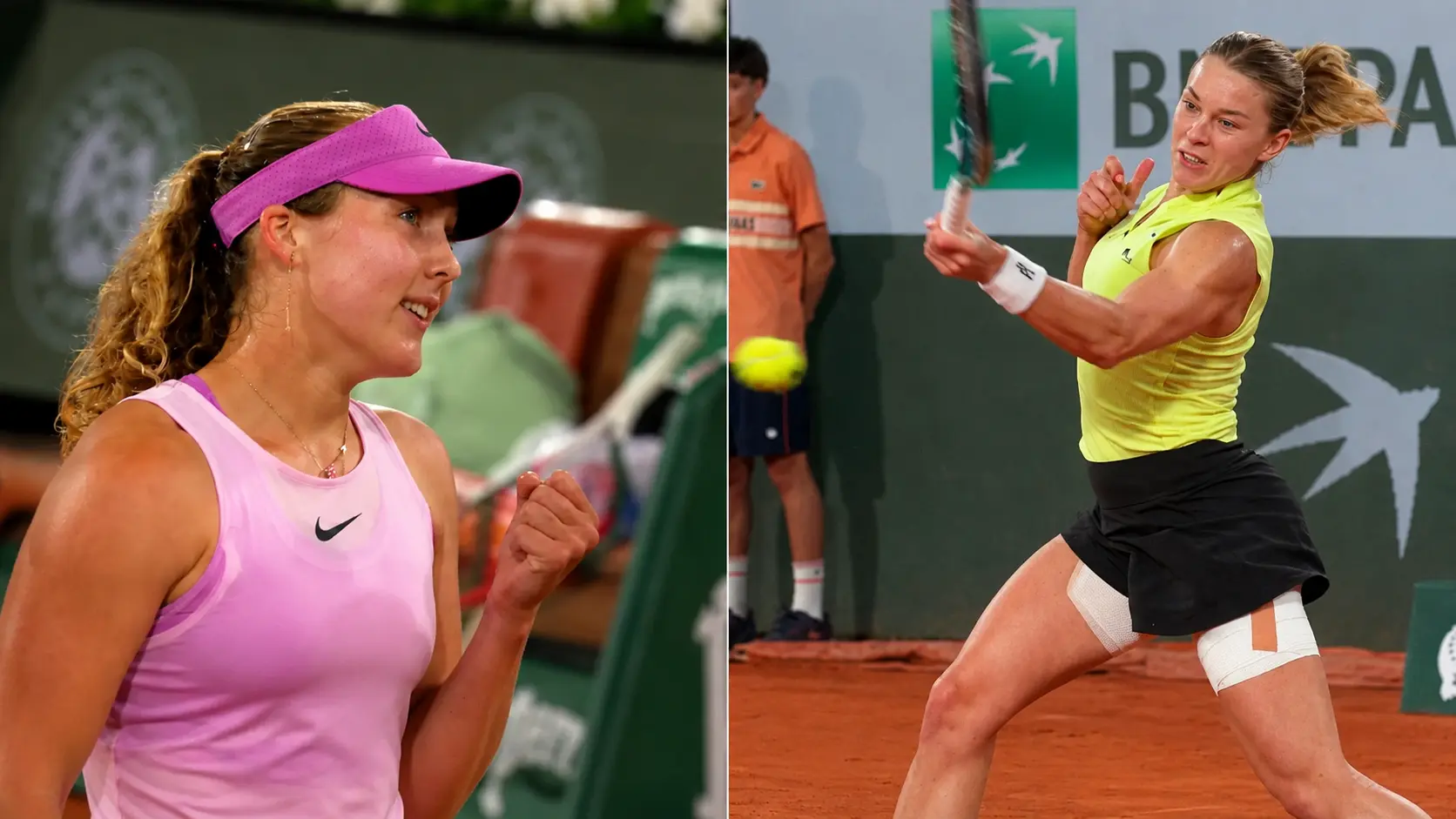
The 2026 French Open final is not the one most people wrote down when the draw came out.
No one wrote that down on the planet. No one.
That is usually said as a polite way of describing chaos. This time it feels more generous than that. Mirra Andreeva against Maja Chwalinska is not a random final. It is a collision between two completely different kinds of tennis imagination.
Andreeva is the player everyone has been expecting to arrive here sooner rather than later. She is 19, already ranked among the elite, already carrying the glow and burden of a future champion. The movement, the backhand, the timing, the cold little decisions inside rallies — all of it has looked Grand Slam-ready for a while.
Chwalinska is something else entirely.
She came through qualifying, then kept going as if the main draw had accidentally been built for her. She did not smash Paris open. She unpicked it. Slice by slice. Loop by loop. Drop shot by drop shot. She made opponents run forward, bend low, reset high, hit one more ball, then another, until the match no longer felt like theirs.
And now the player who began in qualifying is in the French Open final.
One will win a first Grand Slam title. And somehow, after three weeks of heat, wind, shocks and vanishing favourites, that feels exactly like the kind of ending this tournament deserved.
Andreeva Has Stopped Looking Like a Prospect
There was a time when every Andreeva match came with a little emotional weather report attached to it.
How would she react if the set turned? Would frustration spill over? Would the racket talk before the tennis did? Could she stay with the work long enough for her talent to take over?
In Paris, that conversation has gone quiet.
The tennis has been loud enough.
Fiona Ferro was handled in straight sets. Marina Bassols Ribera took the only set Andreeva has dropped all tournament, and even that became a footnote once Andreeva lost only two games across the next two sets. Marie Bouzkova, Jil Teichmann and Sorana Cirstea followed. Different opponents, different shapes, same direction of travel.
Then came Marta Kostyuk.
That was supposed to be the true examination. Kostyuk was unbeaten on clay this season. She had won Rouen and Madrid, beaten Iga Swiatek and Elina Svitolina, and carried the look of someone whose year had started to tilt in her favour.
Andreeva made it brutally simple.
She won 6-1, 6-3, and the scoreline was not a trick of the day. She was first to the patterns, first to the open space, first to the emotional reset. Kostyuk briefly dragged the second set back on serve, the crowd sensed a match might be forming, and Andreeva simply closed the gap before hope could get comfortable.
That has been the most impressive part of her tournament. Not the backhand, though that has been superb. Not the movement, though that has been constant. It is the composure. The sense that she does not assume every point is hers by divine right.
That could shape the final.
We saw what happened to Sabalenka when the match started to feel like an argument with herself. She stopped giving enough credit to Shnaider, stopped enjoying the problem in front of her, and when the other player really was playing better, she could not accept it quickly enough. That kind of arrogance can turn a wobble into a collapse.
Andreeva, so far, has looked different. She has played like someone willing to solve the next point, not complain that the last one was taken from her.
Chwalinska Has Made the Modern Game Feel Less Mechanical
Chwalinska’s route to the final almost sounds fictional when read back in order.
Alice Rame. Carole Monnet. Suzan Lamens.
Those were the qualifying rounds. The part of the tournament most people barely watch, where players fight for a place in the place everyone else is already discussing.
Then came Zheng Qinwen.
Then Elise Mertens.
Then Maria Sakkari.
Then Diane Parry.
Then Anna Kalinskaya.
Then Diana Shnaider, who had just knocked out Aryna Sabalenka.
That is a proper route through serious players, big names, dangerous hitters and different kinds of pressure.
Chwalinska has survived it because she does not play the game everyone else wants to play.
She changes the ball. She changes the speed. She changes the height. She makes the court feel longer, shorter, lower, higher, stranger. Against hard-hitters, she has made force look impatient.
There is something old-fashioned about it, but not outdated. That is the joy of her run. She has reminded the tournament that flair is not decoration. It can be a weapon. A slice can be an attack. A moonball can be a trap. A drop shot can do more damage than a 100mph forehand if it arrives at the right moment.
Shnaider had the bigger recent win. She had just taken out the world No. 1. She had the left-handed power and the emotional tailwind.
Chwalinska had the better questions.
She won 7-6(4), 6-4, and by the end the match belonged to her craft.
The Final Will Be Decided by Whose World This Becomes
Andreeva will want a clean match.
Not easy. Clean.
She wants to settle into rallies, take the ball early, redirect with that backhand and use her legs to turn defence into pressure. She has enough power to hurt Chwalinska, but her real danger is how quickly she takes control of the geometry. Give her rhythm and she starts moving the court around.
Chwalinska cannot let that happen too often.
Her task is not to outhit Andreeva. That would be walking into the wrong fight. She needs to make the final feel irregular. A slice that stays low. A loop that climbs. A drop shot that drags Andreeva forward. A ball that arrives with no pace when the favourite wants something to redirect.
The question is not whether Chwalinska can play beautiful tennis.
She can.
The question is whether she can keep doing it under final pressure against someone who has looked increasingly difficult to disturb.
Andreeva is not Shnaider. She is not Kalinskaya. She is not Sakkari. She has more patience than some of the players Chwalinska has frustrated, and her movement gives her a better chance of reaching the awkward balls before they become decisive.
That is where the final becomes fascinating. Chwalinska has made players uncomfortable by pulling them into unfamiliar exchanges. Andreeva can do the same. Just think of the forehand-slice.
The Crowd Will Lean Toward the Impossible Story
Neutral crowds love a qualifier. They love improbability. They love a player who had to think about hotels and costs and qualifying courts, then somehow ends up walking into the biggest stadium for a Grand Slam final.
Chwalinska will have that energy behind her.
Not necessarily loudly from the first ball. But if she starts making Andreeva look twice at the bounce, if the drop shot lands, if the slice stays low, if the Pole turns one normal rally into something mischievous, the crowd will respond very quickly.
Andreeva has already handled emotional noise in Paris, but this will be different. The public may not be against her. They may simply be seduced by the other story.
That can be just as tricky.
Chwalinska does not need the crowd to win her the match. She needs it to make the final feel alive, to make Andreeva hear the possibility of something strange happening.
In this French Open, strange has travelled far.
What Andreeva Is Playing For
If Andreeva wins, the sport gets confirmation rather than surprise.
A first Grand Slam title at 19 would turn years of anticipation into something solid. It would also suggest that the calmer version of Andreeva is not temporary. She has looked more composed, more professional, more comfortable with carrying herself as a champion-in-waiting.
That is not a small shift.
The talent has always been easy to see. This fortnight has shown the structure around it. The decisions have been cleaner. The reactions have been quieter. The recovery after danger has been faster.
A title would not feel premature.
It would feel like the beginning of a new arrangement. And yet, the kid in her is still there: open, unfiltered, almost disarming. What you see is what you get.
What Chwalinska Is Playing For
If Chwalinska wins, the sport gets one of its great modern interruptions.
A qualifier winning the French Open would be historic. Doing it with this game, this route, and this sense of improvisation would make it even richer.
She has made women’s tennis look less linear for three weeks. That is part of the magic. Not every point has to be a straight line from serve to forehand. Not every answer has to be more speed. She has brought back the pleasure of the unexpected ball, the odd rhythm, the point that makes a coach pause rather than nod.
As said before, Chwalinska has already made every tennis coach think again.
A title would make this player, who battled depression as a young woman, even happier than she already feels.
For tennis, a title for Chwalinska would feel like the happiest moment on court since Emma Raducanu’s US Open triumph.
The Lean
Andreeva should win.
She has been the best player left in the tournament, and she played her finest tennis when the semi-final demanded it. Her movement, return game and backhand control give her the tools to stop Chwalinska turning the final into a complete puzzle.
But there is no comfortable prediction here.
Chwalinska has spent nine matches making logic look silly. She has beaten players with bigger rankings, bigger names, bigger shots and bigger expectations. She has made Paris believe in the odd ball again.
So yes, Andreeva is the pick.
But Chwalinska is the warning.
And this French Open has not been kind to anyone who ignored the warning signs.