
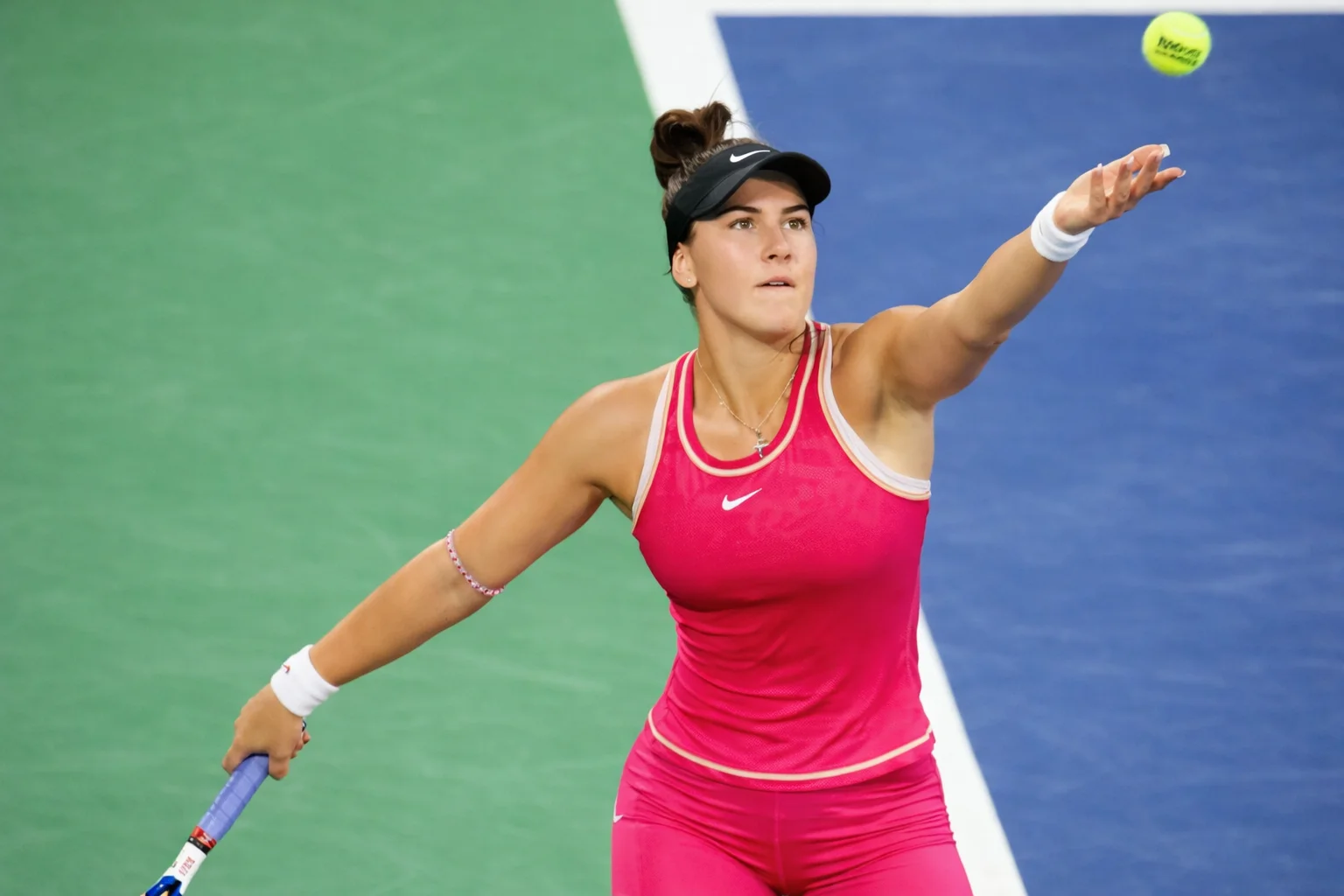

Bianca Andreescu is rebuilding her career — but not in the way she once did.
The former US Open champion has added an unexpected dimension to her 2026 season, revealing that she has returned to making music as part of a broader effort to find balance during her comeback. Uploading tracks to SoundCloud, Andreescu has turned to creativity as a release from the demands of the tour.
A different kind of comeback
There was a time when Andreescu’s progress was measured almost exclusively in results.
Now, it is something more layered. After years disrupted by injury, the Canadian is placing equal weight on stability away from the court — a shift that reflects both necessity and perspective.
“I’m very into spirituality and the esoteric side of life,” she said. “And I also love music, so I create my own music on SoundCloud… It’s a nice outlet to escape all the craziness sometimes.”
The change in outlook is not cosmetic. It is structural — shaping how she approaches both wins and losses in a phase of her career where certainty has often been in short supply.
Results returning, gradually
On court, there are signs the reset is beginning to translate.
Andreescu secured her first WTA main-draw win since July 2025 at the Charleston Open, coming from a set down to defeat Dalma Galfi 1-6, 6-4, 6-1. It was not flawless, but it was telling — a match that required adjustment, patience and, ultimately, control.
Ranked around No. 140 after starting the year outside the top 200, she has built much of her return through the ITF circuit, collecting titles and match wins to re-establish rhythm before stepping back onto bigger stages.
ITF route lays the foundation
The approach has been deliberate.
Rather than chasing immediate results on the main tour, Andreescu has prioritised volume — matches, repetitions, and the steady integration of changes made alongside her coach, Dushan.
“Honestly, I thought it was a great decision,” she said. “I had no expectations to win or lose. My goal was to get as many matches as possible and implement what I’ve been working on.”
Titles at W35 and W75 level have underpinned that progress, offering both confidence and structure during a transitional period.
She is clear-eyed about their role. Lower-tier results may not carry the same weight in ranking points, but they serve a different purpose.
“You shouldn’t base your happiness on results, but results can give your work some kind of measurable meaning.”
Perspective shaped by absence
If the tennis is still a work in progress, the mindset appears more settled.
Andreescu spoke openly about the impact of her most recent injury layoff, describing it as a period that reshaped her priorities rather than simply delaying her return.
“That injury last year opened my eyes so much,” she said. “I met so many incredible people… Without it, I wouldn’t have met them.”
It is a reflection that sits comfortably alongside her broader outlook. Tennis, she acknowledged, is not permanent — something that has become easier to accept.
“At the end of the day, tennis will leave me. But the relationships you have, the people in your life, are very important.”
Finding rhythm again
Her comeback win in Charleston illustrated the balance she is trying to strike.
After struggling with timing and positioning in the opening set, Andreescu adjusted to the conditions, using heavier topspin and greater rally tolerance to turn the match. It was not a return to her peak level, but it was a step towards it — built on adaptation rather than instinct alone.
More importantly, it reflected the version of Andreescu now emerging.
One who is still chasing results, but no longer defined by them.