
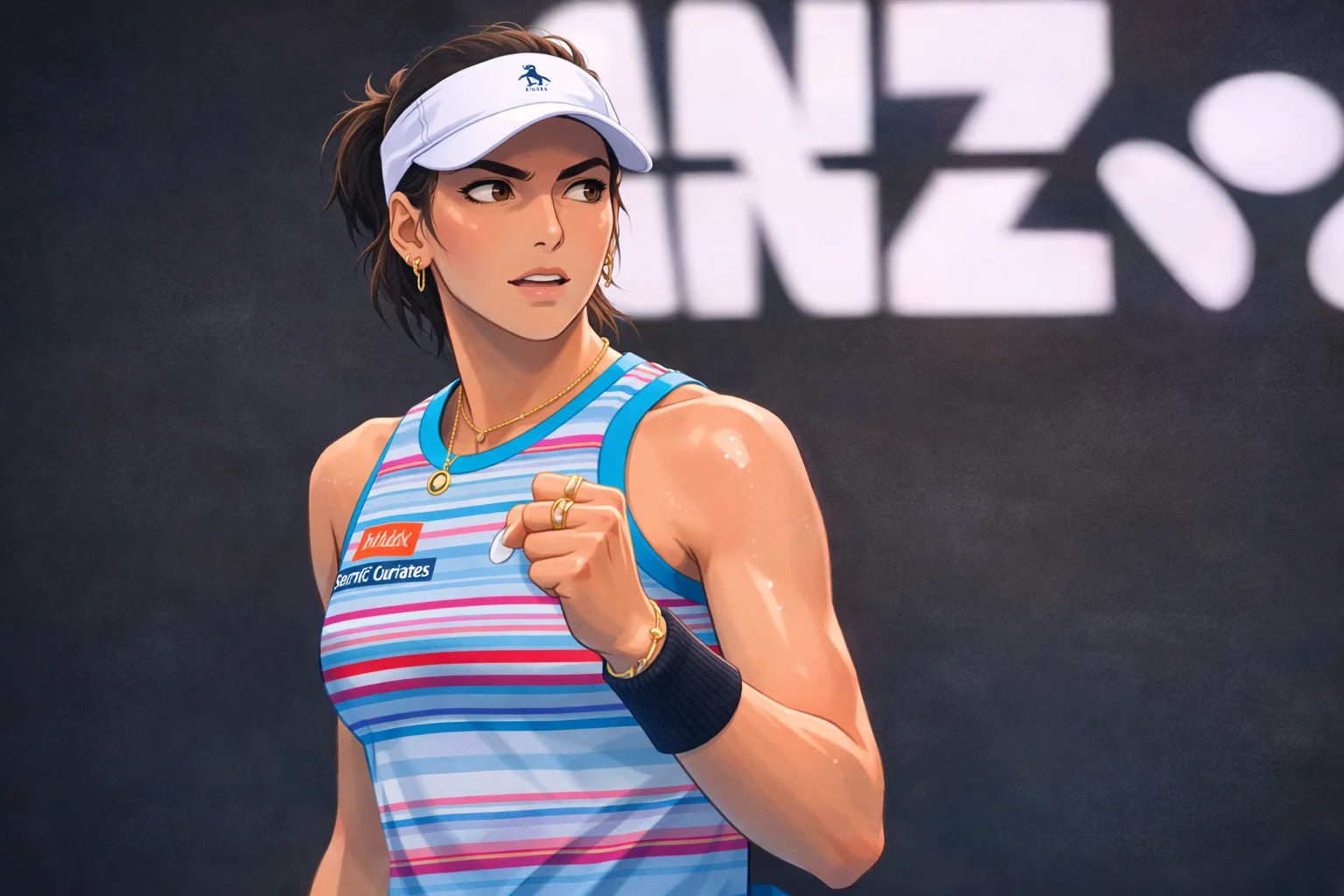

Ajla Tomljanovic has never been a player who hides from the hard questions.
Injury setbacks. Identity shifts. Form fluctuations. Even thoughts about walking away from the sport altogether. She has confronted them all — and now, at 32, she speaks about her career with a clarity that feels both grounded and quietly ambitious.
Sitting down on the Love All Podcast with four-time Grand Slam champion Kim Clijsters, Tomljanovic opened up about her season start, her evolving mindset, the rise in WTA prize money, and why — despite everything — she is still aiming for Los Angeles 2028.
Walking Away From the Middle East Swing
While many top names battled for points at the Qatar Open, Tomljanovic made a deliberate decision to reset.
“After Melbourne I flew to Abu Dhabi, but I didn’t feel great,” she explained. “I got a bit sick and decided to cut that swing short. I’ve never played well there and thought, ‘2026, I’ll change that.’ I didn’t — so my gut was right. I decided to go home, train, and prepare for Austin and the U.S. swing.”
The decision followed an unsettling injury scare just weeks earlier.
“In the second round of Adelaide I injured my pec. At first it was scary — I thought it was really bad. When I got to Melbourne, it wasn’t as bad as I feared. No tear, just a strain. But I’ve had pec issues before and that’s scary. You don’t trust it.”
And if there is one place she does not want doubt creeping in, it is at home.
“If I could pick somewhere not to get injured, it would be Australia.”
Her preparation for the Australian Open was unconventional and cautious.
“We only started serving again on Saturday and I played Monday. It was more rehab and strength work in the gym than court time. It was about building the muscle without irritating it.”
Once match time arrived, hesitation vanished.
“My mindset was: I’m going full throttle. Even if it gets a little worse, at this stage of my career it’s worth it. Slams — especially at home — are what I really play for. I took a couple of ibuprofen for courage!”
She won her opening match before falling to Elena-Gabriela Ruse — but the physical gamble paid off.
From Croatia to Australia: A Long Identity Shift
Born in Croatia, Tomljanovic represented her birth country until 2018 before officially switching allegiance to Australia — a process that took years.
“Once I had ‘AUS’ next to my name, I felt connected. Australia embraced me from the start. I’ve played so many Billie Jean King Cup ties and now two Olympics. It feels natural.”
The administrative path was less simple.
“At around 23 I got residency and could represent Australia at Slams but not on the WTA Tour — which confused people. Around 25 I was cleared for Billie Jean King Cup and got my passport. It took four or five years. For most people that’s not long, but when you want to represent a country, you get impatient.”
The pressure that came with it?
“Good pressure. I never felt like I was carrying something heavy on my shoulders. I just want to play well — for myself and the people cheering. The Australian crowd is incredible. If you embrace them, they embrace you.”
Wimbledon: Where Belief Changed Everything
Wimbledon remains her most successful Slam — quarterfinals in 2021 and 2022.
Ironically, she once hated grass.
“Before my first quarterfinal in 2021, I didn’t like grass at all. Everyone said I had the game for it, but it never clicked. I hated how fast everything happened — I felt out of control.”
Then something shifted.
“I remember texting a friend: ‘I think this year something changes at Wimbledon.’ And it did. After that first run — even though Ash Barty beat me clearly — I came back believing I could win matches there. Belief changes everything.”
That belief has not always been consistent in recent seasons.
“It comes in waves. Some days I feel I can compete with the best. Other days I feel far away. With injuries especially, I wondered if I still had the level. I saw the game evolving and felt like I wasn’t keeping up.”
She began exploring media work. Commentating. Testing life outside the tour bubble.
It eased the pressure.
But it also clarified something.
“When I started commentating, I realized — I still want to be the one playing.”
Reuniting with coach Goran Ivanišević helped restore confidence.
“After Europe last year, I told my dad and the team I thought it might be my last year. I didn’t announce it — that’s not me — because I could change my mind the next day. But thinking that way helped me enjoy tournaments more.”
Now, the horizon has shifted again.
“After Australia this year I told my dad: ‘I’ll make it to LA 2028.’ And he said, ‘Great.’”
Learning From the Best — Especially Sabalenka
Tomljanovic had high praise for world No. 1 Aryna Sabalenka.
“I haven’t played her during her dominant years, but I commentated her match courtside against Victoria Mboko. What impressed me most is that even after two errors she keeps going the same way. That really clicked for me — that’s a champion’s mentality. Her belief never wavers.”
Even after Sabalenka’s recent Grand Slam disappointment, Tomljanovic sees her as the benchmark.
“Even though she didn’t win the Australian Open, she feels like the standard right now. Everyone is asking: what does she do better than everyone else?”
Commentating offers her a new lens.
“I still watch through a player’s eye. What can I learn? What works? What doesn’t? You see body language, small tension moments. You realize they’re human. Calling those matches helps my own tennis.”
No Extra Pressure on Coco Gauff
Despite Coco Gauff’s recent struggles, Tomljanovic remains impressed.
“I love her mentality. We forget she’s only 21. She’s been at the top for years, so expectations are crazy. She’s a two-time Grand Slam champion — that pressure is insane for someone that young.
She never goes away. Even if she’s not playing her best tennis, she’s so athletic you have to earn every point.”
She recalls their US Open meeting.
“She was struggling with the serve, lots of double faults — and still made the quarterfinals. That mental strength is underestimated.”
The Era of Growth in Women’s Tennis
With record prize money at events like Charleston, Tomljanovic also praised the financial evolution of the WTA.
“I’m probably not the best person to ask — when I was younger I didn’t even know how much I earned until my dad did the taxes,” she laughed.
“But when you compare my first Slam main draw to now — it’s incredible. You really see the growth in women’s tennis and women’s sport in general. We have to lead when it comes to equality.”
She singled out Charleston’s support — and Ben Navarro’s role in elevating the event.
“Charleston has always been a tournament I never wanted to miss. It shows what’s possible and starts conversations. That’s how change happens.”
Then came the wistful smile.
“Honestly, sometimes I wish I was 20 again to play ten more years in this era.”
Still Here. Still Aiming.
Ajla Tomljanovic has lived through the waves — injury doubt, identity transitions, ranking swings, career crossroads.
But beneath it all remains a player who still wants to compete.
Still wants to improve.
Still wants one more Olympic Games.
And perhaps that clarity — this balance between acceptance and ambition — is exactly what gives her career its next chapter.