
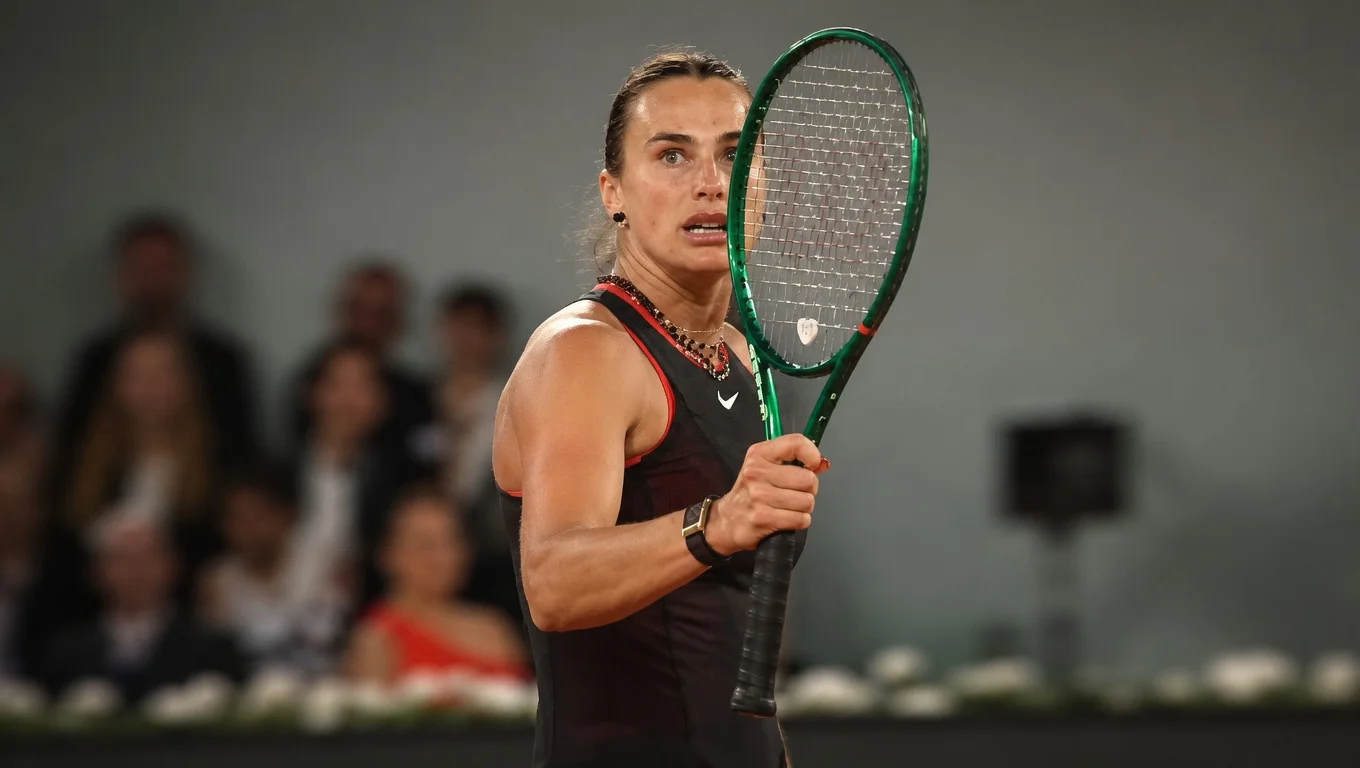
Where was the clay Aryna?
Wrong person.
Ask Amélie Mauresmo. The Roland Garros tournament director may have scheduled this on Paris clay, but Sabalenka played Osaka as if the court had been shipped in from New York.
Apart from the opening game, when Osaka broke immediately and briefly hinted that this might become something complicated, Sabalenka turned the match into a serving exhibition. Twelve aces. Eighty-three percent of first-serve points won. Only one break point faced all match. The surface said clay, but the rhythm said hard court: first strike, short points, scoreboard pressure, no time to breathe.
Osaka followed that tone for stretches. That may even have been part of the problem. If this became a hard-court shootout, Sabalenka was never going to mind.
The world No. 1 hit through the match with the kind of power that travels anywhere and beat Osaka 7-5, 6-3 to reach the Roland Garros quarter-finals.
Next up: Diana Shnaider.
Osaka Starts Fast Before Sabalenka Locks In
Osaka began with exactly the jolt she needed.
She broke Sabalenka in the opening game, then held for 2-0. For a few minutes, the match had danger in it. Osaka was striking cleanly, stepping into the court, and forcing Sabalenka to respond before the world No. 1 had settled.
Sabalenka responded quickly.
She broke back for 1-2, held for 2-2, and from there the first set became a long holding pattern. Osaka stayed close. Sabalenka kept landing heavy first serves. Both players protected their service games through the middle of the set, and by 5-5 there had been no break points for some time.
Then Sabalenka chose the moment.
At 5-5, she found the one return game she had been waiting for. Osaka needed too many second serves, and that was all the invitation the world No. 1 required. Sabalenka stepped in, pushed the score to 15-40, and broke for 6-5.
Then she served out the set to love, capping it with an ace — the sort of authority that makes a tight set feel much clearer in hindsight than it looked while it was happening.
Osaka had started well.
Sabalenka had served ridiculously well, then finished the set like the world No. 1.
Sabalenka vs Osaka – Set One Stats
| Statistic | Sabalenka | Osaka |
|---|---|---|
| Dominance Ratio | 1.69 | 0.59 |
| Winners | 18 | 13 |
| Unforced Errors | 12 | 12 |
| Serve Rating | 286 | 224 |
| Aces | 7 | 1 |
| Double Faults | 2 | 2 |
| 1st Serve % | 77% (23/30) | 50% (20/40) |
| 1st Serve Points Won | 83% (19/23) | 75% (15/20) |
| 2nd Serve Points Won | 43% (3/7) | 33% (7/21) |
| Break Points Saved | 0% (0/1) | 0% (0/2) |
| Service Games | 83% (5/6) | 67% (4/6) |
| Ace % | 23.3% | 2.5% |
| Double Fault % | 6.7% | 5% |
| Return Rating | 225 | 191 |
| 1st Return Points Won | 25% (5/20) | 17% (4/23) |
| 2nd Return Points Won | 67% (14/21) | 57% (4/7) |
| Break Points Won | 100% (2/2) | 100% (1/1) |
| Return Games | 33% (2/6) | 17% (1/6) |
| Pressure Points | 29% (2/7) | 71% (5/7) |
| Service Points | 73% (22/30) | 55% (22/40) |
| Return Points | 45% (18/40) | 27% (8/30) |
| Net Points | 83% (5/6) | 71% (5/7) |
| Total Points | 57% (40/70) | 43% (30/70) |
| Match Set Duration | 0h47m | |
The Second Set Was Decided by One Brutal Shift
The second set stayed close for half an hour.
Osaka held for 1-0, 2-1 and then 3-2, the last of those a pressure game with deuces and a break point saved by a very brave second kick serve out wide. That hold mattered because it kept Osaka in front on the scoreboard and forced Sabalenka to keep answering.
But again, the answer came fast.
Sabalenka held for 3-3, broke for 4-3, then held for 5-3. Suddenly Osaka had gone from leading the set to serving to stay in the match. That is how quickly Sabalenka’s pressure can turn a contest.
The final game gave her match point at 40-15 after the Japanese superstar had just landed a double fault. The Belarusian took it with another thunderous return on a second serve.
The crowd had been craving more tennis from the end of the first set into the start of the second. Sabalenka had other ideas. She decided it was time for an early night.
Sabalenka vs Osaka – Set Two Stats
| Statistic | Sabalenka | Osaka |
|---|---|---|
| Dominance Ratio | 1.73 | 0.58 |
| Winners | 21 | 7 |
| Unforced Errors | 15 | 6 |
| Serve Rating | 297 | 226 |
| Aces | 5 | 1 |
| Double Faults | 1 | 2 |
| 1st Serve % | 48% (12/25) | 60% (21/35) |
| 1st Serve Points Won | 83% (10/12) | 57% (12/21) |
| 2nd Serve Points Won | 62% (8/13) | 50% (7/14) |
| Break Points Saved | – (0/0) | 33% (1/3) |
| Service Games | 100% (4/4) | 60% (3/5) |
| Ace % | 20% | 2.9% |
| Double Fault % | 4% | 5.7% |
| Return Rating | 200 | 55 |
| 1st Return Points Won | 43% (9/21) | 17% (2/12) |
| 2nd Return Points Won | 50% (7/14) | 38% (5/13) |
| Break Points Won | 67% (2/3) | – (0/0) |
| Return Games | 40% (2/5) | 0% (0/4) |
| Pressure Points | 56% (5/9) | 44% (4/9) |
| Service Points | 72% (18/25) | 51% (18/35) |
| Return Points | 49% (17/35) | 28% (7/25) |
| Net Points | 100% (5/5) | – |
| Total Points | 58% (35/60) | 42% (25/60) |
| Set 2 Duration | 0h42m | |
Sabalenka’s Serve Made the Clay Feel Irrelevant
The stats read like a hard-court scorecard.
Sabalenka hit 12 aces to Osaka’s two and won 73 percent of her service points overall. Her first serve was monstrous: 29 of 35 points won, an 83 percent return for the afternoon. Even behind the second serve, she won 55 percent.
Osaka, by contrast, made only 53 percent of her first serves and won 40 percent behind the second. Against Sabalenka, that meant trouble. The world No. 1 broke four times from five chances.
The winner count was just as loud. Sabalenka struck 39 winners to Osaka’s 20. She did make 27 unforced errors to Osaka’s 18, but that was a trade she could live with because she was the player imposing the match.
The dominance ratio told the wider story: 1.71 for Sabalenka, 0.58 for Osaka.
This was not clay-court patience. It was clay-court power wearing hard-court shoes.
Osaka Could Not Make Sabalenka Stay on Clay Long Enough
For Osaka, there were encouraging pieces. She broke at the start. She held her ground through most of the first set. She saved danger in the second and still looked capable of turning a few games into real trouble.
Throughout that opening set, she also looked relaxed in her own particular way, smiling a few times, almost as if she had found a pocket of calm inside the noise.
But she never made Sabalenka uncomfortable for long enough.
The clay should, in theory, have given Osaka ways to stretch the match, change the height, make Sabalenka hit extra balls, force more movement and more patience. Instead, too many points were played on Sabalenka’s preferred terms. First serve. First strike. Heavy return. Shorter exchanges. Osaka was drawn into a rhythm that felt familiar from the hard courts, except the player across the net was in god mode on serve.
That was the trap.
Osaka can play that game. She even showed it in flashes, but Sabalenka can own it.
Shnaider Is Next, and That Will Not Be Gentle
Sabalenka now meets Diana Shnaider, who ended Madison Keys’ run with a brutal third-set bagel and removed the last North American woman from the draw.
That quarter-final will not be soft. Shnaider is a left-hander with weight, angles and the nerve to step into a big match without asking permission. She has already built one of the more impressive runs of the tournament.
But Sabalenka will arrive with the one thing everyone else in Paris has been losing.
Of the four major names who began this tournament as the obvious power centres — Sabalenka, Gauff, Rybakina and Swiatek — only one is left.
The world No. 1.
And against Osaka, she did not look like someone trying to find clay-court answers.
She looked like someone who had brought New York to Paris and decided the surface could adjust to her.