

The greatest name of her generation is no longer just a memory — and not quite a return either. But Serena Williams is closer than she has been in years.
For months, the idea of Serena Williams stepping back onto a professional tennis court felt like nostalgia masquerading as rumor. A fun thought. A social-media echo. Something fans wanted to believe rather than something rooted in reality.
Now, it is neither fantasy nor confirmation — but something far more intriguing.
As of late February, the 23-time Grand Slam champion will once again be eligible to compete in sanctioned professional tournaments, having quietly completed the only formal step required for a potential return: re-entry into the ITIA Registered Testing Pool.
Whether she plays or not remains unanswered. But the door — for the first time since 2022 — is officially open.
From Retirement to Reconsideration
Serena Williams last competed at the 2022 US Open, where she bowed out in the third round to Ajla Tomljanović in an emotional farewell that felt definitive. At the time, she was clear: she was evolving away from tennis, toward family, business, and life beyond the sport she had dominated for over two decades.
Since then, her presence on tour has been symbolic rather than competitive — ceremonial appearances, tributes, and legacy conversations.
That certainty began to blur late last year.
In December, tennis journalist Ben Rothenberg reported that Williams had re-entered the ITIA Registered Testing Pool, a requirement for any retired player seeking to return to professional competition. Under anti-doping regulations, players must be available for six months of unannounced testing before becoming eligible to compete.
The move raised immediate eyebrows.
Williams responded quickly on social media, attempting to extinguish the fire before it spread.
“Omg people, I am NOT coming back. This is wild.”
And yet — the action itself told a more complicated story.
Why the Testing Pool Matters
The ITIA testing pool is not symbolic. It is procedural, inconvenient, and unnecessary unless a player is seriously considering competition.
For Williams, it became relevant once before.
According to Rothenberg, the application was originally submitted in August, after Williams had explored the possibility of playing the 2025 US Open. That plan never materialized, largely because she was not yet eligible under anti-doping rules.
Six months later, the clock has nearly run out.
As of February 22, Serena Williams becomes fully eligible to compete again — whether she chooses to do so or not.
That technical detail changes everything.
“I’m Just Enjoying My Life” — But Not Closing the Door
When Williams appeared on the Today Show earlier this year, she was asked directly — again — whether a comeback was possible.
This time, the response was noticeably softer.
“I’m just having fun and enjoying my life right now. I don’t know. I’ll just see what happens,” she said, laughing.
Host Savannah Guthrie pressed further.
“That sounds like a maybe.”
Williams smiled — but didn’t bite.
“It’s not a maybe.”
It wasn’t a no, either.
When asked about the testing pool, Williams declined to comment.
“Did I re-enter? Listen, I can’t talk about that.”
For a player who once spoke with unmistakable finality, the ambiguity itself has become the story.
Alycia Parks Adds Fuel to the Fire
Speculation shifted from procedural to tangible when Alycia Parks, currently ranked inside the Top 100, revealed she had trained with Serena Williams just one week ago.
Not casually. Not briefly.
Intentionally.
“I actually trained with her last Monday,” Parks told Tennis Majors.
“I texted her again yesterday. She’s definitely a great mentor for me and has helped me a lot — especially in training.”
Then came the line that sent fans into overdrive.
“She’s in great shape. I think she would dominate the tour.”
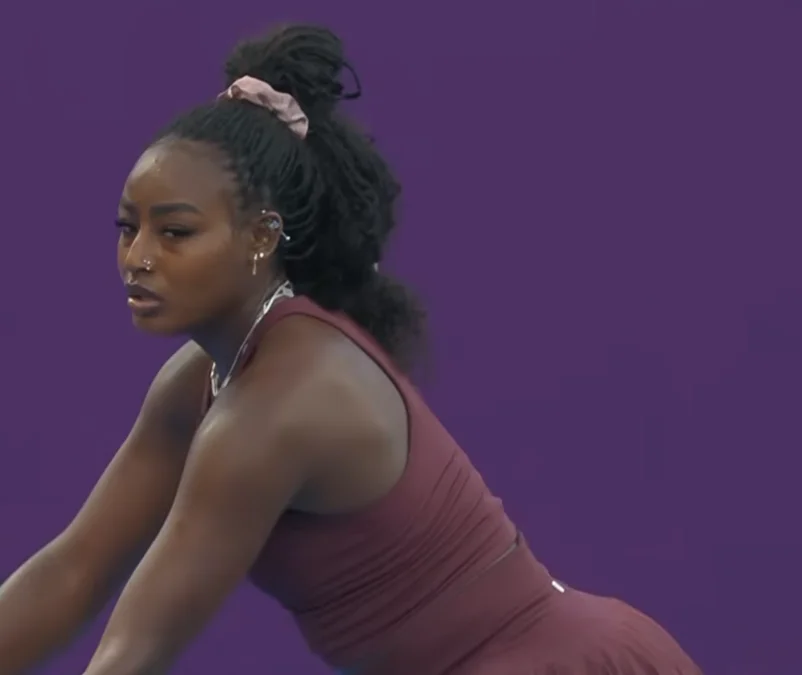
Parks is not a nostalgic observer. She is an active professional, fresh off a quarterfinal run in Ostrava and a successful qualification at the WTA 1000 Qatar Open. Her assessment carries competitive weight.
Williams, notably, has rarely been seen training with current Top-100 players in recent years.
Until now.
Eligibility Opens the Calendar
The timing matters.
The week of February 23 features only WTA 250 events (Austin and Mérida), tournaments unlikely to suit Williams’ return. But just one week later, the tour shifts to Indian Wells, the first marquee hard-court event of the spring.
Indian Wells — a tournament Williams has won twice — would be an obvious stage for a wildcard return, should she choose to accept one.
No confirmation exists. No wildcard has been announced.
But for the first time, the question is no longer if she is allowed to play.
It is whether she wants to.
Venus Williams and the Power of Precedent
Context matters — and so does family.
In recent months, Venus Williams has quietly returned to regular competition. While wins have been scarce in 2026, her 2025 campaign included notable victories, including a win over Peyton Stearns in Washington and a deep doubles run at the US Open.
Venus has proven that age alone is no longer the barrier it once was.
That reality reframes Serena’s situation. At 44, she would not be chasing dominance — but relevance, moments, perhaps even shared history.
A doubles appearance alongside Venus remains one of the most tantalizing possibilities for fans — nostalgia paired with legitimacy.
What This Is — and What It Isn’t
To be clear: there is no confirmation of a comeback.
Serena Williams has denied it before, avoided it since, and continues to prioritize her life beyond tennis. She has two young children, thriving business ventures, and nothing left to prove.
But the facts are undeniable:
- She re-entered the ITIA testing pool
- She becomes eligible in February
- She is training with active WTA players
- She has stopped issuing firm denials
In tennis, those signals rarely align by accident.
The Final Unknown
If Serena Williams does return, it will not be about rankings or trophies.
It will be about choice.
Choice to step back into the arena she once ruled.
Choice to compete on her own terms.
Choice to remind the sport — and perhaps herself — that evolution does not always mean closure.
For now, the only certainty is this:
Serena Williams is eligible again.
And that alone is enough to make the tennis world hold its breath.