
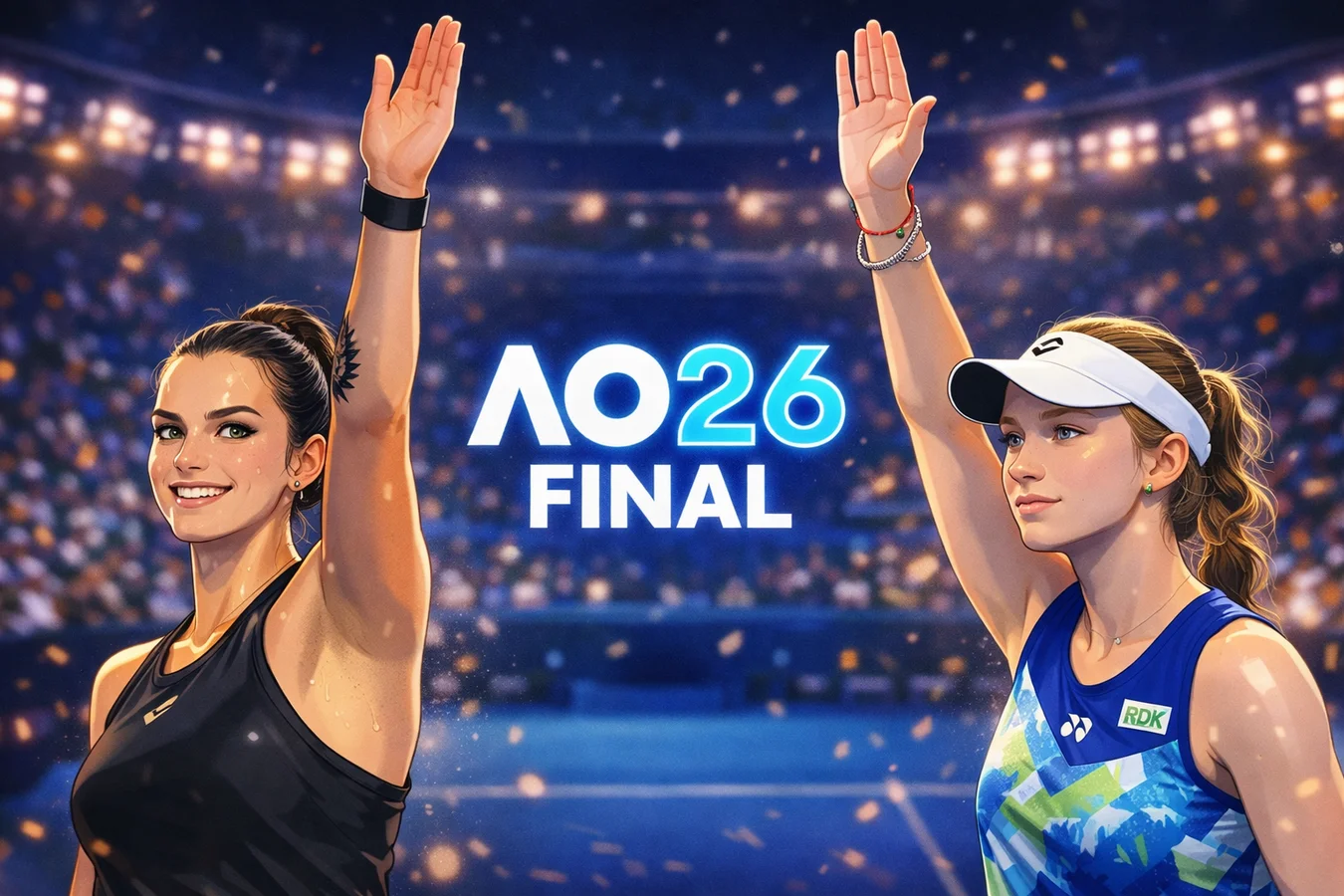

As Aryna Sabalenka and Elena Rybakina prepare to meet once more on the sport’s biggest stage, two former world No.1s have weighed in on what could decide the 2026 Australian Open women’s final. Andy Roddick and Kim Clijsters, speaking on the Served with Roddick podcast, outlined why this rematch may hinge on initiative, first-strike tennis and razor-thin margins.
Sabalenka arrives chasing a third Melbourne crown in four years and a fourth consecutive Australian Open final. Rybakina, meanwhile, returns to the scene of her most painful major loss: the 2023 final she led by a set before Sabalenka stormed back to claim her first Grand Slam title.
Remarkably, both players have reached this final without dropping a set — a feat not seen in a women’s Grand Slam final since Wimbledon 2008, when Venus and Serena Williams faced off.
Clijsters: Early dominance will decide everything
Kim Clijsters believes the match will be settled almost immediately after the serve.
“Whoever is more dominant early in the rally will win this match,” Clijsters explained. “The second or third shot is going to decide it.”
The four-time Grand Slam champion expects ultra-aggressive, high-risk tennis from both players.
“We’ll probably see more unforced errors than usual because the ball quality will be so high. It will be flat, aggressive, close to the lines — whoever dictates first takes control.”
Roddick: Sabalenka must target Rybakina’s patterns
Andy Roddick agreed that initiative is decisive, but went further in outlining a potential pressure valve for Sabalenka.
“When Rybakina steps into the middle of the court, 95% of the time she’s taking that forehand on immediately,” Roddick said. “She doesn’t take pace off and redistribute as much.”
According to Roddick, Sabalenka can exploit this with direct, pace-heavy patterns.
“If you’re Sabalenka, you tell her: don’t worry about placement — hit hard, almost give her the line, and set your movement accordingly. There’s almost a two-shot pattern there.”
Clijsters counters: Sabalenka’s evolution matters
Clijsters pushed back slightly, highlighting Sabalenka’s growing versatility.
“Sabalenka is the better mover, in my opinion. And she has more variation now.”
She credited coach Max Mirnyi with helping Sabalenka expand her toolkit.
“We’ve seen more slice, more forward movement, more willingness to volley. She’s no longer just overpowering opponents — she’s adding layers.”
That evolution, Clijsters believes, could be crucial against a player as relentlessly deep and flat-hitting as Rybakina.
History, numbers and what’s at stake
Sabalenka leads the head-to-head 8–6 overall, while Rybakina holds a narrow edge on hard courts at 6–5. Their most famous meeting remains the Australian Open final of 2023, where Sabalenka overturned a one-set deficit to win 4–6, 6–3, 6–4.
Saturday’s final will be Sabalenka’s eighth Grand Slam final (4–3 record) and Rybakina’s third (1–1). Rybakina is already guaranteed a return to her career-high ranking of world No.3, while Sabalenka has secured her place atop the WTA rankings regardless of the outcome.
What remains undecided is supremacy in Melbourne — and whether raw power or refined aggression will prevail.
Related WTA Articles You Might Enjoy
“Pure conjecture”, Kim Clijsters and Andy Roddick Debate Rybakina’s Weird Situation
Andy Roddick: It’s Not If, but When Amanda Anisimova Wins a Grand Slam